
 The FSA allergen guidance published for food businesses selling non-prepacked food marks a fundamental change in how allergen information should be communicated. Non-prepacked food and prepacked food for direct sale faced different allergen labelling requirements in the past. But fatal and avoidable allergic reactions have resulted in the FSA recommending similar standards for both. The guidance advises food businesses to provide written information about the top 14 allergens and support this with verbal communication. This piece explains the regulatory context and practical implementation strategies while clarifying where guidance is different from legal obligation.
What is FSA Allergen Guidance?
Image Source: Food Standards Agency
The Food Standards Agency publishes allergen guidance as a detailed resource that bridges legal compliance with operational best practise for food businesses. This guidance represents the agency’s interpretation of how businesses should implement allergen management systems while meeting their statutory duties under food law.
Purpose and scope of the guidance
FSA allergen guidance serves multiple functions within the food safety regulatory framework. The main goal centres on helping food businesses provide accurate allergen information to consumers, a responsibility that has become more pressing given that around 6% of the UK adult population have a food allergy [1]. This figure excludes those with food intolerances, which means the actual number of consumers who need allergen information goes much further.
The guidance addresses allergen management in three different areas: provision of allergen information for both prepacked and non-prepacked food, effective handling and management of food allergens during preparation, and the training requirements for staff members. Each area receives in-depth coverage within the technical documentation, which provides specific examples of compliance approaches for different food types and business models.
The scope extends beyond simple labelling requirements. The guidance covers cross-contamination prevention, risk assessment methodologies, and communication protocols for both in-person and distance selling scenarios. This has online food sales, where allergen information must be provided before an order is placed and again upon delivery. The FSA developed this updated guidance following consultation processes and research engagement with both consumers and food businesses to understand how written information could be improved for consumers with food hypersensitivities.
Who the guidance applies to
The FSA allergen guidance targets specific categories of food business operators in the supply chain. Food businesses in the retail and catering sector selling non-prepacked or ‘loose’ food represent the main audience and include restaurants, cafés, delis, market stalls, takeaways, bakeries, and fast food outlets of all sizes. These businesses face specific challenges in allergen control compared to manufacturers producing prepacked goods.
There is separate technical guidance for food manufacturers, importers, producers, packers, and institutional caterers. Manufacturers producing prepacked food must follow the allergen labelling requirements set out in the Food Information for Consumers Regulation, whilst those producing prepacked for direct sale food must comply with Natasha’s Law requirements that came into force on 1 October 2021.
The guidance applies to businesses that operate in England, Wales and Northern Ireland. Different arrangements exist for businesses that move goods from Great Britain to Northern Ireland under the Windsor Framework, which was adopted by the UK and EU on 24 March 2023. Enforcement authorities also use this guidance when they assess compliance during inspections, which makes it relevant for Environmental Health Officers and authorised food officers.
Guidance vs legal requirements
This difference is key to understanding how businesses should approach FSA allergen guidance. The document states its legal status as best practise guidance, which means it provides helpful examples of approaches that businesses might employ but are not legally required to follow. But this classification requires careful interpretation.
Certain elements within the guidance describe existing legal obligations under Food Information Regulations and the Food Safety Act. Food business operators must declare the presence of any of the 14 major allergens whether used as an ingredient or processing aid. They must ensure staff receive allergen training. They must provide allergen information to consumers. These requirements exist as legal obligations whatever businesses do with the FSA guidance.
Based on legal interpretation principles, guidelines such as these carry evidential value even when not legally binding [2]. Courts have regard to FSA standards when they interpret legislation and assess whether a food producer has met the reasonable standard of duty of care and due diligence required. Compliance with the guidance helps demonstrate that appropriate steps were taken to prevent allergen-related incidents.
The guidance itself has both regulatory compliance sections, which explain how to comply with existing requirements, and best practise recommendations, which suggest enhanced approaches beyond the minimum legal standard. The recent update that encourages written allergen information for non-prepacked food represents best practise rather than legal mandate, yet businesses that implement this recommendation can promote consumer confidence whilst they reduce the risk of miscommunication during service.
The fact is that understanding this dual nature allows businesses to prioritise their compliance efforts. Legal requirements just need immediate attention and full implementation, whilst best practise guidance offers a roadmap for continuous improvement in allergen management systems.
Understanding the UK Legal Framework for Allergens
Allergen regulations in the UK operate within a multi-layered legal structure that food businesses must work through. The framework combines retained EU legislation, domestic regulations and statutory acts that establish baseline requirements and enforcement mechanisms together.
Food Information Regulations 2014
The Food Information Regulations 2014 represent the domestic enforcement measures for Regulation (EU) No 1169/2011 on the provision of food information to consumers [3]. These regulations came into force on 13 December 2014 and changed how allergen information must be communicated across all food business sectors [3].
Food law refers to the retained version of EU Regulation 1169/2011 for businesses operating in England and Wales [4]. Northern Ireland’s reference to food law means EU food law, and that has the original Regulation (EU) No 1169/2011, reflecting the Windsor Framework arrangements [4]. The FIR 2014 extended allergen declaration rules beyond prepacked foods to cover all food sold non-prepacked, and that means loose items and catering situations [3].
Food business operators in retail and catering must provide allergen information for both prepacked and non-prepacked food and drink under these regulations [5]. The UK adopted a national measure that allows provision of such information through any means the operator chooses, and that has oral communication, with specific exceptions for distance selling [3]. This flexibility distinguishes the UK approach from some EU member states that mandate written allergen information for all non-prepacked food.
Food Safety Act 1990
The Food Safety Act 1990 provides the foundational statutory authority under which allergen regulations operate [6]. This Act grants powers to the Secretary of State to make regulations concerning food safety, labelling and consumer protection. The Food Labelling (Declaration of Allergens) (England) Regulations 2008 were made under sections 16(1)(e), 17(1), 26(1)(a) and 48(1) of this Act [6].
The 1990 Act holds businesses accountable and ensures that food served is safe and free from undeclared allergens [6]. Failure to comply with allergen information requirements constitutes a criminal offence under this legislation, with potential prosecution by local authorities. The Act establishes the due diligence defence, and businesses must demonstrate they took all reasonable precautions and exercised due diligence to avoid committing an offence.
The top 14 allergens
UK food allergen regulations identify 14 specific substances that must be declared when present in food. These allergens are: celery (that has stalks, leaves, seeds and celeriac), cereals containing gluten (wheat, rye, barley, oats, spelt, kamut and their hybridised strains), crustaceans (prawns, crabs, lobsters), eggs, fish, lupin, milk (that has lactose), molluscs (mussels, oysters, squid), mustard, peanuts, sesame, soybeans, sulphur dioxide and sulphites at concentrations exceeding 10mg per kg or 10mg per litre expressed as SO2, and tree nuts (almonds, hazelnuts, walnuts, brazil nuts, cashews, pecans, pistachios, macadamia nuts) [4][5].
The declaration requirement extends beyond ingredients themselves to additives, processing aids, solvents, media for flavourings and any other substances present in the final product, even in altered form [6][5]. To cite an instance, sulphur dioxide used as a preservative in dried fruit or frying oil containing peanut traces both require declaration [6]. Certain processed forms of allergens receive exemptions under the regulations, such as wheat-based glucose syrups, fully refined soybean oil and cereals used to make distillates in spirit production [6].
Natasha’s Law and PPDS food
Natasha’s Law came into force on 1 October 2021 as an amendment to the Food Information Regulations [7]. Named in memory of Natasha Ednan-Laperouse, who died in 2016 after consuming a prepacked sandwich containing undeclared sesame [8], this legislation introduced mandatory allergen labelling for prepacked for direct sale food.
PPDS food is defined as food packaged at the same premises where it is offered or sold to consumers and placed in packaging before being ordered or selected [7]. This has sandwiches prepared in-store, bakery items packaged on-site and salads assembled where they are sold. The law requires PPDS products to display the food’s name, a full ingredients list and allergenic ingredients emphasised within that list [4][9].
Emphasis can be achieved through bold type, capital letters, contrasting colours or underlining [4]. But where the food name clearly refers to the allergen concerned, such as ‘milk’, separate indication is not required [4]. These labelling requirements do not apply to goods sold by distance communication, where separate allergen declaration rules apply [7].
FSA Guidance on Allergen Communication
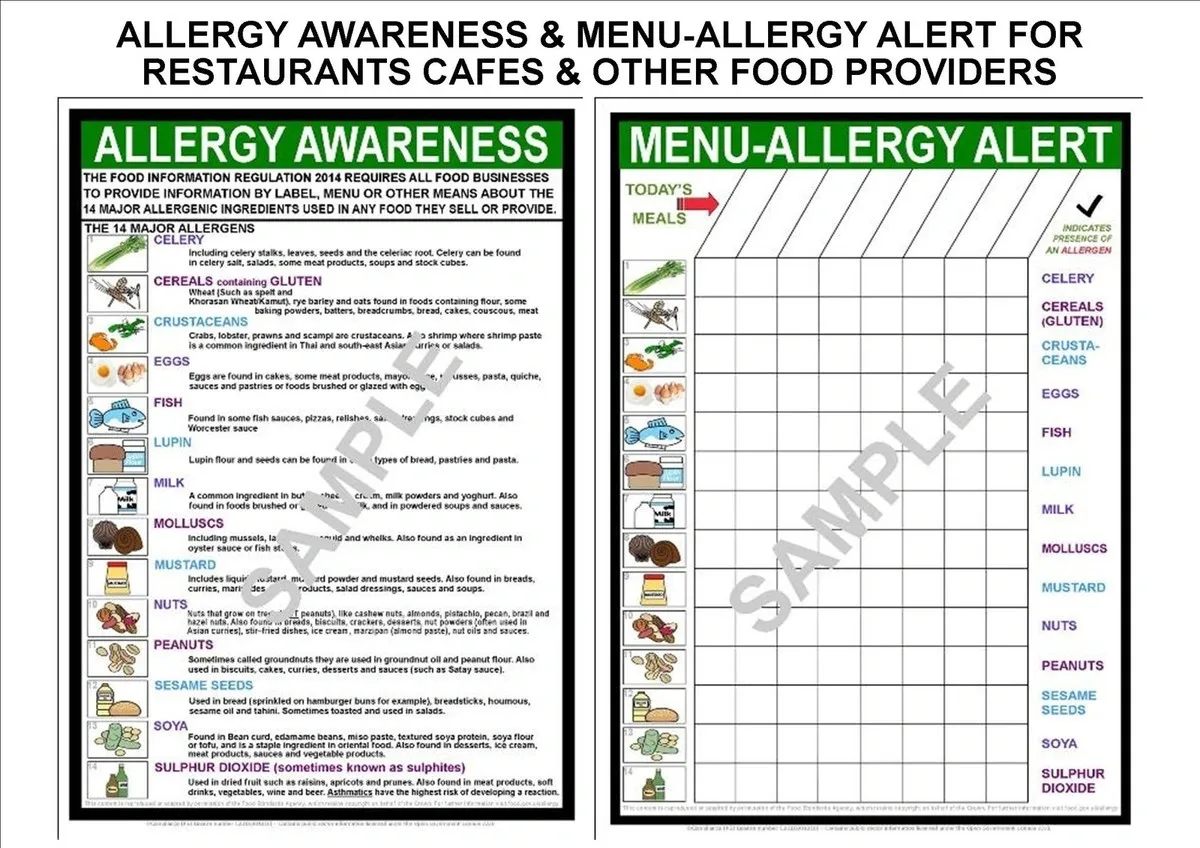
Image Source: eBay UK
Food businesses selling non-prepacked items face distinct communication challenges compared to prepacked food manufacturers. The FSA allergen guidance addresses these challenges and outlines how allergen information should reach consumers through written documentation, verbal interactions and digital platforms.
Written allergen information requirements
The FSA advises that written allergen information should be made easily available for consumers when purchasing non-prepacked food [10]. This recommendation reflects research showing that written formats reduce miscommunication risks and provide consumers with a reference point during ordering decisions. Food businesses can present this information through several approved formats. Each has specific implementation considerations.
Menus represent the most direct method. Allergen declarations appear next to dish descriptions. A statement such as “Tuna Salad (Contains: milk, egg, mustard, fish)” provides immediate clarity [11]. Businesses may deploy allergen matrices that cross-reference menu items against the top 14 allergens. Customers can identify safe options at a glance. Chalkboards positioned near ordering points serve the same functions for businesses with frequently changing offerings [10].
Allergen symbols offer visual communication where the allergen name forms part of the image [3]. The allergen must appear underneath or reference a legend with written allergen names when symbols are used without the written name integrated into the design [3]. Businesses must communicate the specific cereal or tree nut variety for cereals containing gluten and tree nuts, not just the allergen category [3].
Written allergen information must meet four critical standards. It must be clear and show exactly which allergens exist in each dish or product [11]. Accuracy demands regular review and updating whenever recipes or ingredients change [11]. Complete coverage requires inclusion of all 14 allergens, not selective disclosure of common ones [11]. The information should be readily available without consumers needing to request it. Position it on main menus (paper or digital), allergen booklets, or matrices in consumer-available areas [3].
Placement proves just as important as content. Signs should sit in prominent positions within a consumer’s eyeline or in clearly visible places on menus, preferably at the top [6]. Allergen information must be presented at each location when customers can order from multiple points such as bars or tables [5]. Information needs visibility only from that position if customers place orders at a single point by queuing at a counter [5].
Verbal communication expectations
Written information provides a foundation, but the FSA guidance emphasises that having a conversation about allergen requirements remains very important. Consumers can make safe and informed choices this way [6]. Staff must receive sufficient training to conduct these conversations and know where to locate the information needed to give accurate responses [10].
The conversation serves multiple functions beyond simple allergen identification. It will give the person preparing the meal an understanding of any additional care required during preparation [6]. It allows explanation of potential cross-contamination risks within the preparation process [6]. It clarifies whether meals can be adapted to suit consumer needs [6]. It provides a chance to communicate any last-minute changes and maintain accuracy [6].
Food businesses should encourage consumers to make staff aware of allergen requirements [12]. Displaying a message on signs or menus becomes critical where direct questioning of every customer proves impractical [6]. These prompts might state: “Please talk to us if you have a food allergy, intolerance or coeliac disease. We want to cater safely for everyone” [6]. The message should be prominent, clear, simple, empathetic and motivating to encourage disclosure [6].
Legal requirements mandate that businesses place a notice in a clearly visible position if allergen information is provided verbally rather than in writing. The notice explains how customers can get this information [10]. Signposting examples include: “Allergies and intolerance: please speak to a member of staff if you require information about our ingredients” [5]. Till prompts remind staff to ask about allergens, whether through computer systems or physical signs at the till [5].
Providing information for online sales
Distance selling introduces specific obligations under the Food Information Regulations that extend beyond in-person service. Allergen information must be provided at two stages in the order process when food is sold online or by phone [10]. Information can be delivered in writing through websites, catalogues or menus, or orally by phone before purchase completion [10]. Information must be provided again through written formats such as allergen stickers on food packaging, enclosed menu copies, or orally by phone when food is delivered [10].
The FSA advises that food businesses providing food for delivery or takeaway should make written allergen information available to consumers both before ordering and upon delivery [10]. Businesses can provide specific allergen information for each dish next to its description or signpost through a link to the full menu or allergen breakdown on websites [5]. Staff can invite customers to ask about allergenic ingredients by reading the in-store allergen statement when taking telephone orders, or direct them to website information whilst prompting whether anyone has allergies or intolerances [5].
Information relating to any allergy or intolerance must be clearly passed to the kitchen and those responsible for packing food after taking an order [5]. Staff should highlight allergy requests using underlining, star symbols or highlighter pens to prevent orders being missed [5]. Consistency between pre-purchase and delivery information proves critical. Discrepancies undermine consumer confidence and create safety risks [13].
Allergen Management Responsibilities by Business Type
Different categories of food businesses face distinct allergen management challenges based on their operational models, preparation methods, and customer interactions. The FSA allergen guidance recognises these variations and provides sector-specific recommendations among core requirements.
Retail food businesses
Retail outlets selling food directly to consumers must focus allergen management on three primary areas: accurate labelling, environmental cleanliness, and staff competency. Allergen information appears on packaging for prepacked products displayed for sale, with the 14 allergens highlighted in bold within ingredients lists. This has information on whether ingredients were produced in environments where allergens are present and addresses precautionary allergen labelling considerations.
Products packed at the direct point of sale, such as pies made and sold from the same bakery, fall under different requirements. These businesses must ensure someone on premises possesses complete knowledge of allergen contents in every product or maintain easily-visible documentation detailing allergen information. Recommended practise is to display ingredient lists alongside each food product with allergens highlighted in bold.
Cleanliness controls are equally important. Unclean serving environments present cross-contamination risks where allergen-containing products unintentionally contaminate allergen-free items. Surfaces require cleaning after contact with uncovered food, and utensils need cleaning between uses with different products. Allergenic ingredients must be stored in separate, sealed, labelled containers never used for other purposes.
Catering and hospitality
Catering businesses face particular complexity in allergen control due to reliance on human judgement during service. All new starters and agency staff should receive allergy awareness training on their first day and understand to report when customers disclose allergies immediately so correct procedures can be followed.
Businesses should identify staff who need improved allergen training, particularly those responsible for menu planning, recipe development, and customer-facing service. Allergy leads need complete understanding of allergen procedures and menus. They meet at shift starts to discuss bookings for those with allergies and communicate menu changes. Teams know who to refer customers to when businesses provide ‘allergy lead’ badges.
Suppliers are not legally obliged to notify businesses when ingredients within products change. Agreements confirming they will do so and specifying notification methods become essential before taking on new suppliers. Businesses may need to amend menu planning software, allergen charts, labels, websites, and promotional literature when ingredients change. Version control systems make removing outdated information straightforward.
Businesses can learn from every occurrence and monitor trends when they investigate and record allergy incidents and near misses. Robust procedures should detail how investigations take place and who reviews results. This ensures effective root cause identification and action to reduce recurrence risks.
Manufacturing and food production
Food manufacturers manage allergen risks through hazard analysis and critical control point programmes. They must identify hazards that need prevention, elimination or reduction, then establish critical control points where control is essential. Effective monitoring procedures at these points, combined with corrective actions and verification processes, are the foundations of allergen management.
Employee training, product design and formulation, supply chain management of raw materials, manufacturing premises design, equipment and processes, cleaning protocols, and packaging with accurate labelling are key considerations. Production scheduling can isolate products containing allergens by running them at shift ends or on dedicated lines. This prevents cross-contact and saves sanitation costs and production downtime.
Implementing FSA Allergen Training and Staff Competency

Image Source: MakeSOP
Staff competency is the operational backbone of allergen management and translates regulatory requirements into safe food service. Food business operators must ensure personnel receive training on managing allergens, yet the scope and delivery of this training varies according to role, responsibility, and operational context.
Allergen knowledge staff need
Personnel in all food handling roles must possess specific competencies. Staff should know the procedures when asked to provide allergen information and be trained to handle allergen information requests accurately. They must guarantee allergen-free meals reach the correct customer and understand cross-contamination risks during handling and preparation while knowing prevention methods [14]. This baseline applies equally to temporary staff, agency workers, volunteers and students involved in ingredient handling or food service [15].
Businesses must identify personnel requiring advanced allergen training, specifically those responsible for menu planning, recipe development and direct customer service [8]. The Level 3 Award in Food Allergen Management offers detailed hazard spotting and mistake prediction training for these roles [8]. Appointing allergy leads who understand allergen procedures and menus inside out strengthens service delivery. Identifiable badges help teams know who to consult [8].
FSA food allergy training resources
The FSA provides free food allergy training comprising six modules covering allergen effects in the body, information rules, factory management, prepacked and non-prepacked food information, catering environment management and voluntary labelling use [16]. Completing 85% of test questions correctly allows downloading a certificate worth three hours of Continuing Professional Development [16]. This training reflects prepacked for direct sale changes implemented on 1 October 2021 [16].
Businesses can access allergen checklists to share with staff [17][14], menu planning recipe sheets to track allergens in dishes [14], and allergy posters in English, Welsh, Bengali, Cantonese, Punjabi and Urdu [14].
Training frequency and record-keeping
All new starters and agency staff should receive allergy awareness training on their first day [8]. The FSA allergen checklist recommends providing suitable allergen and food hypersensitivity training on an annual basis [13]. Refresher courses every three years maintain current knowledge [18]. Businesses should maintain training records that demonstrate compliance during inspections.
Building a culture of allergen awareness
Staff engagement on allergen management requires regular meetings with kitchen and front-of-house teams [4]. Explaining why allergen risks matter to customers and the business while reiterating proactive checks and procedures builds commitment [4]. Making clear who holds overall responsibility for allergen management and ensuring responsible staff availability on each shift establishes accountability [4].
Allergen Risk Assessment and Cross-Contamination Prevention
Risk assessment provides the systematic foundation that food businesses use to identify, assess and control allergen hazards in their operations. The main goal centres on determining risks from unintentional allergen presence [9].
Conducting allergen risk assessments
The FSA allergen guidance recommends assessing the likelihood of unintentional allergen cross-contamination throughout the supply chain, from raw materials to finished products [7]. Businesses must identify potential allergen sources at their premises. They need to think over whether foods or ingredients entering the site intentionally contain allergens and whether incoming items carry precautionary allergen labels that suggest unintentional allergen presence [7].
The assessment should look at how allergen cross-contamination could occur during handling, storage, preparation, production processes, packing or distribution [7]. Physical characteristics of ingredients matter here. Milk powder represents greater risk in situations where airborne contamination is possible, whilst liquid milk may pose less concern with sufficient separation through physical barriers, distance, timing or cleaning [7]. Allergens in powder form distribute more evenly in products than particles such as lumps, seeds and nuts, which may appear as concentrated “hot-spots” that deliver higher allergen doses [7].
Preventing cross-contact in food preparation
Cross-contamination prevention requires businesses to clean utensils before each usage, especially after preparing meals with allergens. Hands must be washed between preparing dishes with and without certain allergens. Ingredients and prepared foods should be stored separately in closed and labelled containers, and allergenic ingredients kept separate from other ingredients [17]. Research shows that full cleaning using a wash-rinse-sanitise-air dry method removes allergens and minimises allergen transfer effectively [12]. Pre-scraping food from surfaces prior to full cleaning helps allergen removal [12].
Cleaning and equipment management
Wet cloths and alcohol-based sanitising wipes work better at allergen removal from surfaces than dry wipes [12]. Cloths stored in sanitiser solution minimise allergen transfer between surfaces [12]. Allergens are more difficult to remove from textured plastic than stainless steel or wood surfaces [12].
When should precautionary allergen labelling be used
Precautionary allergen labelling should only be applied when an unavoidable and real risk of allergen cross-contact exists that cannot be removed through risk management actions such as separation or cleaning [19]. Businesses must first attempt allergen removal or substitution and implement physical separation. They should confirm cleaning effectiveness before applying precautionary statements [20].
Documentation, Record-Keeping and Enforcement
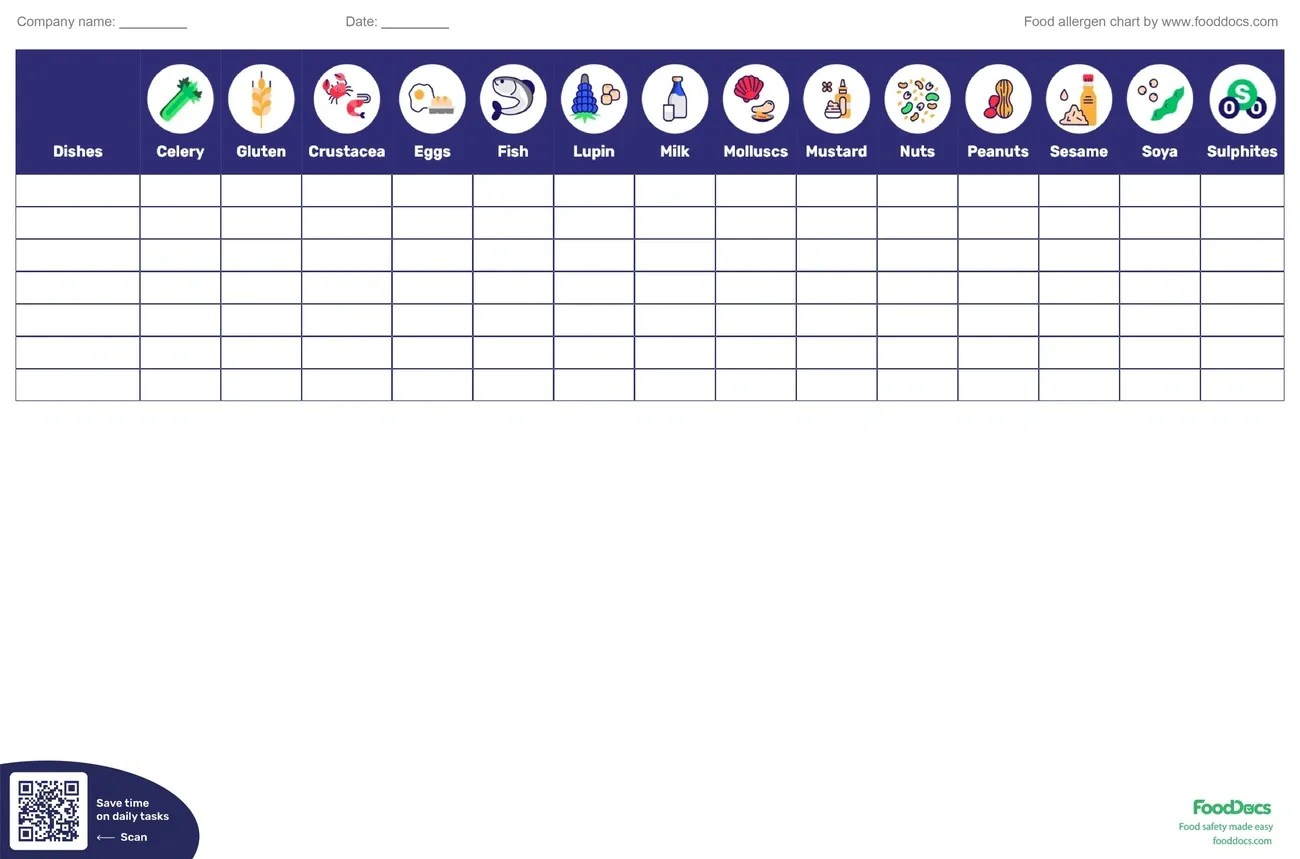
Image Source: FoodDocs
Documentation systems are the foundations that enforcement officers assess when evaluating allergen compliance. Businesses must record allergen ingredient information in written format on product specification sheets, ingredients labels kept in original or labelled containers, and recipes or dish explanations [17]. These records require updating whenever recipes change, as delays mean customers receive incorrect information that may result in illness or death.
Allergen records businesses must maintain
Product specifications should detail all allergenic ingredients used. Recipe documentation must list allergens present in each dish, whilst storage containers need clear labelling to prevent cross-contact. Version control becomes essential when ingredients change and allows removal of outdated information from menu planning software, allergen charts, labels, websites and promotional literature.
Allergen labels and menu information
Pre-packed food requires ingredients lists with allergenic ingredients emphasised through bold type, contrasting colours or underlining [6]. Allergens must be indicated by ‘contains’ followed by the allergen name for alcoholic drinks without ingredients lists [6]. Multi-pack outer packaging must display allergen information consistent with individual product labelling [6].
How Environmental Health Officers enforce guidance
Authorised food officers at Local Authorities hold responsibility for official controls relating to allergen rules in the UK [3]. EHOs expect documented allergen control measures within food safety management systems [21]. Failure to comply with labelling requirements constitutes a criminal offence and results in unlimited fines determined by Magistrates case-by-case [3]. Local authorities may issue improvement notices before prosecution, with 14 days allowed to appeal [17].
Common compliance issues identified during inspections
About one third of noncompliances relate to labelling violations [22]. Undeclared or incorrectly declared allergens returned to pre-pandemic levels following declines during 2020-2021 [22][23]. Packaging errors cause product recalls frequently [6], especially incorrect label application or failure to destroy labels after production runs [6].
Common Misinterpretations and Real-World Application
Businesses make three recurring errors when they misapply FSA allergen guidance. These mistakes increase consumer risk and legal exposure.
Mistaking guidance for legal obligation
The guidance includes both best practise recommendations and explanations of existing legal duties. This creates confusion. Best practise principles are not required by law, but they protect customers’ health and reduce risks [24]. But certain elements describe statutory obligations under Food Information Regulations that businesses must meet whatever guidance they adopt.
Relying on verbal communication alone
Many food businesses rely on verbal communication alone to convey allergen information. This has led to inconsistencies and increased risks when staff lack proper training or businesses have high staff turnover [10]. Research shows 53.9% of restaurant allergic reactions occurred despite staff being informed of the allergy [5]. Verbal-only approaches fail when communication breaks down.
Poor staff training
Insufficient training and gaps in staff knowledge about allergens are common challenges. This results in inconsistent allergen communication [10]. Fatal cases demonstrate devastating consequences when untrained workers serve customers.
Step-by-step compliance checklist for food businesses
Businesses should verify allergen management responsibility assignment and make sure responsible staff are available each shift. Display prominent allergen inquiry signage and establish cross-contamination prevention procedures. Implement ingredient verification systems upon delivery [13].
Frequently asked questions about FSA allergen guidance
Common queries address whether written information is mandatory (recommended but not required by law) and training frequency (recommended once a year [13]). Questions also cover when precautionary allergen labelling should be used (only after a full risk assessment when unavoidable cross-contact exists [25]).
Conclusion
Allergen management represents a critical responsibility for food businesses, especially when you have non-prepacked food service. Written allergen information remains a recommendation rather than a legal mandate. This approach reduces miscommunication risks by a lot and protects vulnerable consumers. Food businesses should view FSA allergen guidance as a roadmap that bridges minimum legal compliance with operational excellence.
Staff training, reliable documentation systems and consistent cross-contamination prevention protocols are the foundations of effective allergen control. Businesses that invest in detailed allergen management systems safeguard customers and demonstrate due diligence. They reduce legal exposure and build consumer trust in their operations.
Key Takeaways
Understanding FSA allergen guidance helps food businesses protect customers whilst demonstrating legal compliance and operational excellence.
• Written allergen information is recommended, not mandatory – FSA guidance advises providing written allergen details for non-prepacked food to reduce miscommunication risks and build consumer confidence.
• All staff require allergen training on their first day – New starters, agency workers, and volunteers must understand cross-contamination prevention and accurate allergen communication procedures immediately.
• Cross-contamination prevention demands systematic controls – Clean utensils between uses, store ingredients separately in labelled containers, and implement wash-rinse-sanitise protocols for effective allergen removal.
• Documentation proves compliance during inspections – Maintain updated recipe records, ingredient specifications, and training logs as Environmental Health Officers assess these during enforcement visits.
• Verbal communication alone increases safety risks – Research shows 53.9% of restaurant allergic reactions occurred despite staff being informed, highlighting the importance of written backup systems.
Effective allergen management combines legal compliance with best practise recommendations. Businesses that implement comprehensive systems protect vulnerable consumers, reduce legal exposure, and demonstrate the due diligence required under UK food safety legislation.
FAQs
Q1. Is written allergen information legally required for non-prepacked food in the UK? No, written allergen information for non-prepacked food is not a legal requirement. The FSA recommends providing written allergen details as best practise to reduce miscommunication risks and protect consumers, but businesses can legally provide this information verbally. However, if allergen information is only available verbally, you must display a clear notice explaining how customers can obtain this information.
Q2. How often should food business staff receive allergen training? All new starters and agency staff should receive allergen awareness training on their first day of work. The FSA recommends providing suitable allergen training on an annual basis, with refresher courses every three years to maintain current knowledge. Businesses must maintain training records to demonstrate compliance during inspections by Environmental Health Officers.
Q3. What are the 14 major allergens that must be declared on food in the UK? The 14 allergens are: celery, cereals containing gluten (wheat, rye, barley, oats), crustaceans, eggs, fish, lupin, milk, molluscs, mustard, peanuts, sesame, soybeans, sulphur dioxide and sulphites (above 10mg per kg or litre), and tree nuts (almonds, hazelnuts, walnuts, cashews, pistachios, etc.). These must be declared when present in food as ingredients, additives, processing aids, or any other substances.
Q4. How can food businesses prevent allergen cross-contamination in the kitchen? Prevent cross-contamination by cleaning utensils thoroughly between uses, especially after preparing allergen-containing meals. Wash hands between preparing different dishes, store ingredients separately in sealed and labelled containers, and keep allergenic ingredients away from other ingredients. Use a wash-rinse-sanitise-air dry cleaning method, as wet cloths and alcohol-based wipes prove more effective than dry wipes for allergen removal.
Q5. When should precautionary allergen labelling such as “may contain” be used? Precautionary allergen labelling should only be used when an unavoidable and real risk of allergen cross-contact exists that cannot be removed through other control measures. Before applying precautionary statements, businesses must first attempt allergen removal or substitution, implement physical separation between allergen-containing and allergen-free products, and validate that cleaning procedures are effective.
References
[1] – https://www.food.gov.uk/business-guidance/food-allergen-labelling-and-information-requirements-technical-guidance-general-background-on-allergens
[2] – https://cms.law/en/gbr/legal-updates/fsa-guide-on-allergy-labelling
[3] – https://www.food.gov.uk/business-guidance/food-allergen-labelling-and-information-requirements-technical-guidance-enforcement-of-the-measures
[4] – https://www.nsf.org/gb/en/knowledge-library/managing-allergen-risks-food-businesses
[5] – https://www.culawreview.org/journal/food-or-foe-the-need-for-federally-mandated-food-allergy-training-in-restaurants
[6] – https://www.food.gov.uk/business-guidance/allergen-labelling-for-food-manufacturers
[7] – https://www.food.gov.uk/business-guidance/precautionary-allergen-labelling
[8] – https://www.anaphylaxis.org.uk/my-account/media-centre/membership-news/managing-allergens-in-catering-and-hospitality/
[9] – https://sites.manchester.ac.uk/foodallergens/information-for-food-businesses/manufacturing/risk-assessment/
[10] – https://www.nutritics.com/en/blog/non-prepacked-food-allergen-labelling-in-the-uk-and-ireland-a-practical-guide-for-industry-professionals/
[11] – https://www.thesafetyexpert.co.uk/communicating-allergens-to-customers/
[12] – https://www.fda.gov/food/retail-food-protection/allergen-removal-and-transfer-using-wiping-and-cleaning-methods-retail-food-establishments
[13] – https://www.food.gov.uk/business-guidance/allergen-checklist-for-food-businesses
[14] – https://www.food.gov.uk/business-guidance/allergy-training-for-food-businesses
[15] – https://www.tewv.nhs.uk/wp-content/uploads/2021/10/Food-Allergen-Procedure.pdf
[16] – https://allergytraining.food.gov.uk/
[17] – https://www.food.gov.uk/business-guidance/allergen-guidance-for-food-businesses
[18] – https://skilltopia.co.uk/allergen-training-for-food-businesses-why-its-essential-in-the-uk/
[19] – https://www.anaphylaxis.org.uk/business/precautionary-allergen-labelling-checklist/
[20] – https://www.food.gov.uk/business-guidance/precautionary-allergen-labelling-checklist
[21] – https://www.ncass.org.uk/news/allergen-management-what-are-ehos-looking-for/
[22] – https://www.food-safety.com/articles/9017-excepting-allergen-labelling-violations-uk-food-safety-mostly-unchanged-in-2022-despite-global-challenges
[23] – https://allergenbureau.net/allergen-labelling-violations-in-the-uk-return-to-pre-pandemic-levels/
[24] – https://www.foodalert.com/new-fsa-guidance-on-allergen-management-for-non-prepacked-food/
[25] – https://www.food.gov.uk/sites/default/files/media/document/Precautionary Allergen Labelling FBO research.pdf