 Understanding UK food allergen regulations has become critical as approximately 10 people die every year from allergic reactions to food. Over 2 million people in the UK live with food allergies and hospital admissions have increased by 500% since 1990. Allergen controls are a legal obligation, not just good practise. Failure to comply with food allergy law is a criminal offence that can result in severe penalties and prosecution. This complete guide covers the 14 food allergens UK businesses must declare and allergen labelling requirements. It also explains what legislation regulates allergen labelling on food products to ensure full compliance with allergen legislation UK standards.
The Legal Framework for Food Allergen Control in the UK
Image Source: Food Standards Agency
Food Information Regulations Overview
Food businesses operating in the UK must follow a framework we built on retained European legislation that has evolved into domestic law. The foundation of allergen legislation UK requirements rests on Regulation (EU) No. 1169/2011, commonly known as the Food Information to Consumers (FIC) regulation. This regulation applies in England and Wales as retained legislation, whilst Northern Ireland operates under the direct EU regulation due to the Windsor Framework arrangements adopted in March 2023.
The UK’s exit from the EU brought most important changes to how this legislation is referenced and applied. What was previously termed “retained EU law” became known as integrated law from 1 January 2024. Any references to legislation with ‘EU’ or ‘EC’ in the title now represent integrated law applicable to Great Britain. This transformation affects how food businesses interpret and apply regulations, though the practical requirements remain largely consistent.
The FIC regulation sets out detailed rules on what information must be provided to consumers when purchasing food and how that information must be presented. All food business operators in retail and catering sectors face mandatory obligations under this framework to provide allergen information for both prepacked and non-prepacked food items. The regulation mandates declaration of the 14 major allergens listed in Annexe II whenever these substances appear as ingredients or processing aids in the finished product.
The Food Information Regulations 2014 serve as the domestic enforcement mechanism for the FIC regulation across England. These regulations translate European-level requirements into practical UK law and set out offence provisions, penalties and enforcement procedures. Local authorities bear responsibility for monitoring and enforcing food safety regulations within their jurisdictions, whilst the Food Standards Agency oversees broader food safety and hygiene standards across England, Wales and Northern Ireland.
Key Legislation You Must Follow
What legislation regulates allergen labelling on food products requires familiarity with multiple interconnected laws. The Food Safety Act 1990 provides the foundational legal framework and grants powers under sections 16(1)(e), 17(1), 26(1)(a) and 48(1) for allergen-related regulations. This Act remains the life-blood of food law enforcement in England, with the Food Safety (Northern Ireland) Order 1991 serving the equivalent function in Northern Ireland.
The Food Labelling (Declaration of Allergens) (England) Regulations 2008 represented an earlier iteration of allergen law and implemented Commission Directive No. 2007/68/EC. Although superseded by later legislation, these regulations set the precedent for mandatory allergen declarations that continues under current law. The regulations originally came into force on 31 May 2008, with transitional provisions extending to 31 May 2009.
Businesses must also comply with Regulation (EU) No. 828/2014, which addresses gluten-free labelling requirements. This regulation governs claims about reduced gluten presence and sets thresholds for ‘gluten-free’ and ‘very low gluten’ designations. The General Food Law, Regulation (EC) No. 178/2002, sets out overarching principles requiring open and transparent consultation during regulation development and evaluation.
England, Wales, Scotland and Northern Ireland Differences
Allergen requirements remain broadly consistent across the UK, but separate yet parallel regulations exist for each nation. The Food Information (Wales) Regulations 2014 mirror the English regulations, as do The Food Information Regulations (Northern Ireland) 2014 and The Food Information (Scotland) Regulations 2014. Each set of regulations came into force on 13 December 2014 and set unified allergen standards across all four nations.
Regional enforcement bodies differ in their remits. Trading Standards and Environmental Health Officers conduct inspections and ensure compliance within their local authority areas. Scotland introduced its prepacked for direct sale regulations later than other nations, though the coming into force date of 1 October 2021 aligned with England, Wales and Northern Ireland.
Northern Ireland operates under unique arrangements given that Regulation (EU) No. 1169/2011 applies directly rather than as integrated law. The Windsor Framework permits Great Britain standards for public health to apply for prepacked retail goods moved via the NI Retail Movement Scheme and creates a distinctive regulatory environment for businesses operating cross-border between GB and NI. Food businesses moving goods from Great Britain to Northern Ireland must understand these arrangements to maintain compliance across both jurisdictions.
Complete Guide to the 14 Major Allergens
UK law mandates declaration of 14 specific allergens whenever they appear in food products as ingredients, processing aids, or any other substances present in the final product [1]. These allergens represent the most common sources of severe allergic reactions and affect an estimated two million people in the UK [2][3].
Gluten-Containing Cereals
Cereals containing gluten include wheat (including spelt and Khorasan wheat, also known as Kamut), rye, barley, oats, and their hybridised strains [4][1]. You must declare these cereals using their specific names rather than the generic term ‘gluten’. So ingredients derived from these cereals require emphasis within ingredient lists, such as ‘wheat starch’ or ‘barley malt extract’ [1]. Foods containing flour often harbour these allergens. Examples include baking powder, batter, breadcrumbs, cakes, couscous, meat products, pasta, pastry, sauces, soups, and fried foods dusted with flour [5][1].
Peanuts and Tree Nuts
Peanuts are legumes that grow underground. Sometimes called groundnuts or monkey nuts, though ‘peanuts’ must be used for allergen labelling purposes [1][5]. Common sources include biscuits, cakes, curries, desserts, satay sauce, groundnut oil, and peanut flour [5]. Tree nuts grow on trees and include almonds, hazelnuts, walnuts, Brazil nuts, cashews, pecans, pistachios, and macadamia nuts [4][1]. These appear in breads, biscuits, crackers, desserts, nut powders used in Asian curries, stir-fried dishes, ice cream, marzipan, nut oils, and sauces [5].
Milk and Egg Allergens
The term milk includes milk from all mammals: cow, sheep, goat, and buffalo [1]. All mammalian milk proteins share similar structures. Those allergic to cow’s milk react to other mammalian milk as well [1]. Milk products such as cheese, butter, fermented milk, and cream require declaration, alongside components like lactose, casein, and whey [1]. Eggs refers to eggs from all bird species, not just chicken eggs but also duck, quail, geese, gulls, and guinea fowl [1]. Eggs appear in cakes, meat products, mayonnaise, mousses, pasta, quiche, sauces, pastries, and foods brushed or glazed with egg [5].
Fish, Crustaceans and Molluscs
Fish means all species of fish and fish products [1]. Labelling requires clear reference to fish, such as ‘cod (fish)’ or ‘salmon (fish)’ [1]. Fish hides in fish sauces, pizzas, relishes, salad dressings, stock cubes, and Worcestershire sauce [5]. Crustaceans include all types such as crabs, lobster, prawns, langoustines, and scampi [1][5]. Shrimp paste, often used in Thai and South-East Asian curries or salads, requires particular attention [5]. Molluscs include all types: oysters, squid, cockles, mussels, winkles, scallops, and land molluscs like snails [1]. Oyster sauce and fish stews contain mollusc ingredients [5].
Seeds: Sesame and Lupin
Sesame seeds can be black, white, brown, or red. They appear in bread (hamburger buns especially), breadsticks, houmous, sesame oil, and tahini [2][5]. Products derived from sesame seeds, such as tahini, must be labelled with reference to sesame [1]. Lupin flour and seeds find use in bread, pastries, and pasta [2][5]. Lupin belongs to the legume family and is related to peanuts and soybeans [6]. Studies demonstrate a link between peanut and lupin allergy. Those allergic to peanuts may react to lupin [6].
Celery, Mustard and Soy
Celery refers to any part of the celery plant: stalks, leaves, seeds, and root (celeriac) [1]. Forms include celery salt, celery oil, celery spice, celery seed oil, and celery seed oleoresin [1]. Celery appears in salads, meat products, soups, and stock cubes [5]. Mustard includes the mustard plant and products originating from it, such as leaves, sprouted seeds, mustard flour, table mustard, mustard oils, mustard seed oils, and mustard oleoresins [1]. Mustard hides in breads, curries, marinades, meat products, salad dressings, sauces, and soups [5]. Soya appears in bean curd, edamame beans, miso paste, textured soya protein, soya flour, and tofu [5]. Soya features in desserts, ice cream, meat products, sauces, and vegetarian products [5].
Sulphites and Sulphur Dioxide
Sulphur dioxide and sulphites require declaration only when present above 10mg per kilogramme or per litre, expressed as SO₂ [4][1]. This threshold applies to the total sulphite content in the finished product, calculated according to the manufacturer’s instructions [1]. Sulphites serve as preservatives in dried fruit (raisins, dried apricots, prunes), meat products, soft drinks, vegetables, wine, and beer [5]. Those with asthma face higher risk of reactions to sulphur dioxide [5].
Allergen Labelling Requirements by Food Type
Image Source: Food Standards Agency
Different categories of food face distinct labelling obligations under UK food allergen regulations. Each is designed to ensure consumers receive clear information before they make consumption decisions.
Prepacked Food Standards
Prepacked food includes any product fully or in part enclosed by packaging. The packaging cannot be altered without opening or changing it, and the product must be ready for sale [7]. These products must display an ingredients list where allergenic ingredients appear emphasised through bold type, contrasting colours, capital letters or underlining [7]. The emphasis must occur every time an allergen appears within the list [7]. Allergenic ingredients require clear reference to ensure uniform understanding, such as ‘whey (milk)’, ‘tofu (soya)’ or ‘tahini paste (sesame)’ [7]. The ingredients list may be omitted where packaging surface area measures less than 10cm². Allergens must still be declared using ‘Contains’ followed by the allergen name [8].
Non-Prepacked and Loose Food
Non-prepacked foods include meals served at restaurants, loose items at deli counters and drinks made to order [9]. Allergen information for these foods can be communicated through various means to suit business operations [10]. Businesses retain flexibility to provide this information orally by staff members, though clear signposting must direct customers to where they can get information [10]. Signage might state: ‘Please speak to our staff about the ingredients in your meal when making your order’ or similar wording that invites customer questions [10]. Documented allergen information must exist in charts, recipe books or ingredient sheets for staff reference where oral communication is chosen [10]. Allergen information should be provided for each food item separately rather than collectively for buffet service [10].
Natasha’s Law PPDS Requirements
Prepacked for direct sale food represents items packaged before being offered for sale by the same business on similar premises, on the same site or from moveable premises like market stalls [11]. Requirements for PPDS food came into effect on 1 October 2021 across all four UK nations [11]. Each PPDS item must display the food name and a full ingredients list with allergenic ingredients emphasised [11]. Examples include sandwiches placed into packaging and sold from the same premises, café samples of cakes made on site and foods packaged then taken to market stalls by the same operator [11]. Food packaged after a consumer orders it does not constitute PPDS food. This includes freshly prepared sandwiches wrapped following an order [11].
Catering and Hospitality Rules
Food provided through catering and hospitality channels must declare allergen presence for any item. This includes complimentary food given without charge [9][2]. Allergen information must appear on menus or be signposted clearly where retrieval occurs [2]. Allergen information should be provided for each food item separately in buffet formats [2]. Vehicles and mobile stalls follow similar rules and legislation on allergen labelling as fixed premises [2].
Distance Sales and Delivery Services
Businesses selling non-prepacked food through distance means such as telephone or internet ordering must provide mandatory allergen information at two distinct stages [10]. Information must be available before purchase concludes and again at the delivery moment [10]. Allergen information can be provided through online menus, by telephone from staff or through clear signposting to written sources before ordering [10]. Methods at delivery include stickers on containers that identify allergenic ingredients, menus provided with orders that allow clear identification or written information presented by delivery staff [10].
Gluten-Free Labelling Regulations
The term ‘gluten-free’ applies only to food containing no more than 20mg per kilogramme of gluten [5]. This threshold applies to both prepacked products and foods served at catering establishments [3]. Oat products uncontaminated with other gluten-containing cereals may be labelled gluten-free if they meet the 20ppm threshold. However, ‘oats’ must still be emphasised as the allergen [5]. Non-Gluten Containing Ingredients statements should be avoided, as these can mislead consumers [10]. Businesses should provide ‘gluten-free’ statements where strict controls ensure compliance with the 20mg/kg threshold [10].
Your Legal Obligations as a Food Business
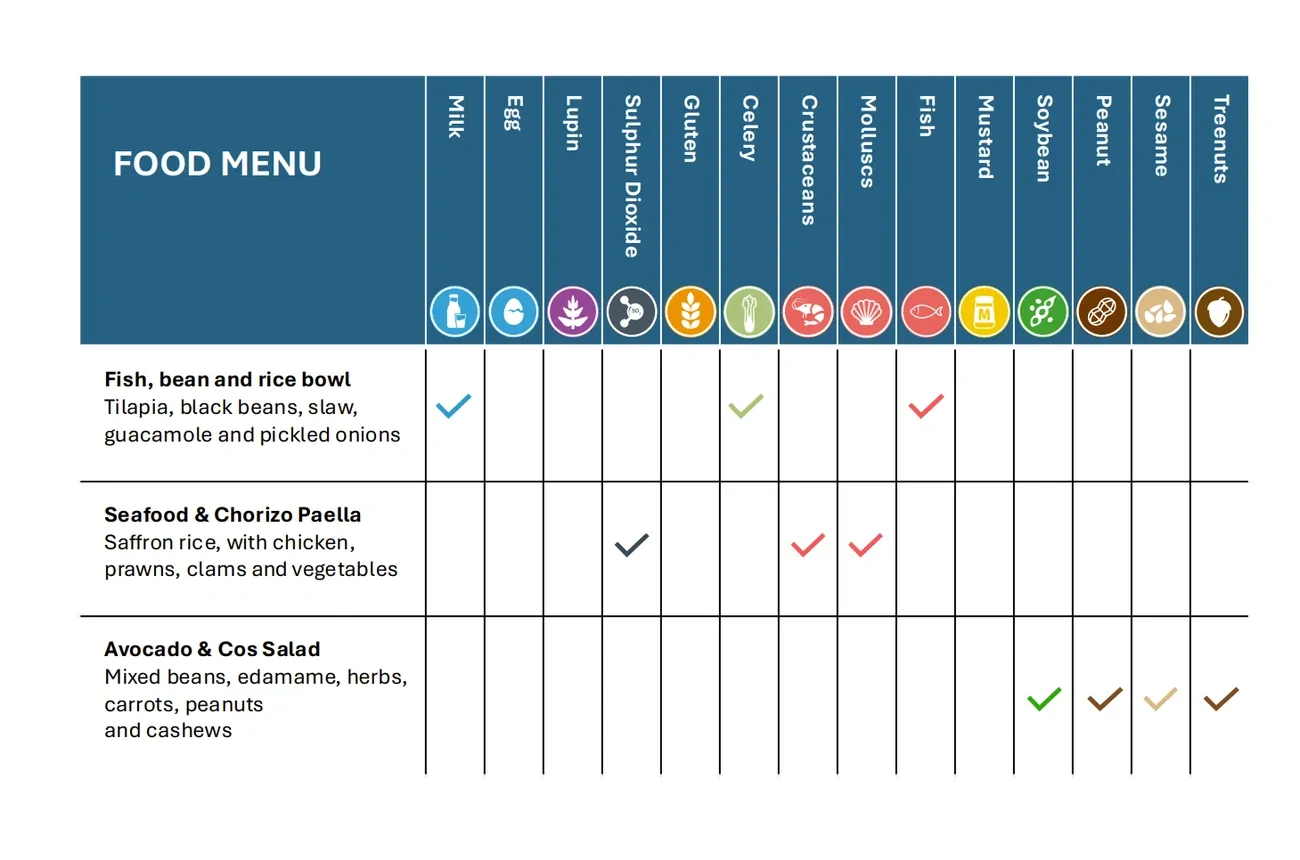
Image Source: Food Standards Agency
Providing Accurate Allergen Information
Food businesses bear legal responsibility to provide complete and accurate information about the 14 allergens present in their products [10][12]. This requirement extends beyond the listed allergens. Customers may declare allergies to any ingredient, and businesses hold legal responsibility to ensure the food served remains safe for consumption [10]. Staff must receive sufficient training to conduct conversations about allergens and know where to locate information needed for accurate consumer responses [1]. A responsible member of staff must be available on each shift to manage requests from customers with allergies [1][13]. Signage that requests customers ask about allergens must be displayed at points where customers make food choices [1][13]. Written allergen information should be easily available for consumers and underpinned with conversations that allow consumers to make safe and informed choices [14].
Recording and Documenting Allergens
Allergen ingredient information must be recorded in written format on product specification sheets, included on ingredients labels, and kept in recipes or explanations of dishes [14][15]. Kitchen staff need clear understanding of how to record allergens when recipes change and who to report this to [1][13]. Clear procedures and dedicated personnel must exist for updating written allergen information following any recipe or ingredient changes [1]. Ingredients should be stored in sealed and labelled containers. Systems must be in place to identify allergens present when transferring ingredients from original packaging [1]. Accurate recipe lists must document allergens present in all food served [1]. Best practise involves dating labels when added to folders and updating information with every delivery or ingredient purchase [10].
Preventing Cross-Contamination
Cross-contamination occurs when allergens transfer accidentally from one food to another and result in small protein amounts that can cause reactions [4]. Food businesses must implement clear instructions for cleaning premises, equipment and work tools [1][13]. Kitchen surfaces require regular cleaning to eliminate visible food debris or crumbs from other meals [1]. Staff must wash hands with soap and hot water when preparing allergen-free meals [1]. Spillage policies should address contamination when one ingredient spills onto another [1]. Separate storage for allergenic ingredients from non-allergenic ones, dedicated equipment for allergenic foods, and cleaning between uses prevent allergen residues [16]. Businesses must communicate these risks to customers where cross-contamination cannot be avoided [1].
Managing Supplier Relationships
Communication with suppliers remains essential for providing accurate allergen information [13]. Procedures must verify delivered items match orders. Systems to approve, record and report ingredient substitutions must be in place [1][13]. Suppliers bear legal obligation to provide precise ingredient lists [13]. Businesses must identify replacement products that contain allergens and flag them to staff and customers [13]. Regular reviews of supplier specifications verify allergen information is communicated and documented clearly [16].
Emergency Response Planning
Staff must understand procedures if customers experience allergic reactions during meals [1][17]. Food businesses should provide staff with suitable allergen and food hypersensitivity training on an annual basis to appreciate what it all means when providing incorrect information, which could be life-threatening [1]. Emergency protocols include calling for medical assistance and helping customers use epinephrine auto-injectors if carried [17].
Enforcement, Inspections and Penalties
Trading Standards and Environmental Health Officers
Local authorities enforce allergen information regulations through dedicated officers who monitor compliance within their jurisdictions [15]. Trading Standards and Environmental Health Officers conduct routine food hygiene inspections and understand how businesses manage allergen presence and communicate risks to consumers [18]. England splits enforcement responsibility between county councils, which bear a duty to enforce Food Information Regulations, and district councils, which possess powers to enforce specific elements [19]. Authorised food officers are encouraged to discuss and reach understanding on how to enforce allergen requirements at local level.
Inspection Assessment Criteria
Environmental Health Officers seek evidence that businesses operate in a compliant, safe and legal manner during routine inspections [18]. Inspectors assess how businesses identify allergens in ingredients and menu items. This includes checks on food deliveries and awareness that suppliers may substitute or change ingredients without notice [18]. They review staff training on food allergen awareness and emergency procedures. Officers examine communication systems that provide information to consumers and verify clear product labelling with allergen ingredients highlighted on prepacked foods [18]. Officers expect relevant allergen control measures documented in food safety management systems, with details outlined in Food Safety Risk Assessments available to review [18].
Warning Notices and Improvement Orders
Businesses failing to comply with allergen requirements receive advice from local authorities at first [15]. An improvement notice may be issued if businesses fail to act on this advice [15]. Operators have 14 days to appeal an improvement notice from the date it was issued [15]. Penalties are issued when operators fail to meet requirements specified in the notice [15].
Financial Penalties and Fines
Failure to comply with requirements under Regulation 10(1) and (2) of Food Information Regulations on labelling allergenic ingredients constitutes a criminal offence [19]. Those convicted face unlimited fines, with Magistrates determining fine levels on a case-by-case basis [19]. Costs extend beyond fines. Food recalls can cost companies an average of £1.5 to £10 million per incident, excluding crisis management, legal fees and brand rehabilitation expenses [20].
Criminal Prosecution Outcomes
Businesses may face prosecution for serious breaches [15]. Westminster City Council prosecuted Trocadero (London) Hotel Limited, owners of Rainforest Café, for multiple allergen failures. These included inadequate gluten-free procedures, limited staff training and failure to store gluten-containing burger buns separately [6]. Haute Dolci owners in Cheshire paid £3,635 after a customer collapsed from eating nuts despite warning staff [21]. Royal Spice in North Staffordshire received fines exceeding £5,000 for selling pizza containing almond powder to a customer with nut allergy [21].
Creating a Compliant Allergen Management System
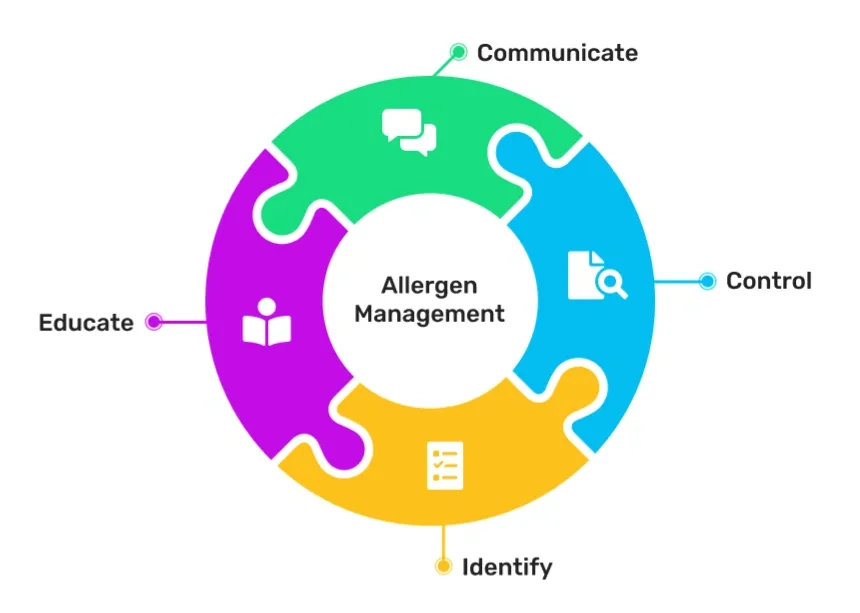
Image Source: Apicbase
Building an effective allergen management system requires systematic procedures that identify, control and document allergen presence throughout operations. Food businesses must establish documented policies and procedures specific to their operations. This allows demonstration of steps needed to eliminate or reduce unintended allergen presence.
Step 1: Assess All Menu Items
A full review begins with analysing every item on the menu to identify which of the 14 allergens appear in each dish. An allergen matrix provides the quickest way to demonstrate assessment of all foods for allergens. This matrix identifies allergens present through visual indicators, such as ticks that show confirmed presence, stars that indicate potential presence, or crosses that denote absence. The allergen inventory is the foundation that drives all subsequent control steps.
Step 2: Document Every Ingredient
Accurate recipe lists establish clear documentation of allergens present in served food. Standard recipes ensure food preparation uses the same brands and allergens consistently. Product specification sheets must record complete ingredient breakdowns with allergens highlighted. This includes ‘may contain’ statements that detail cross-contact risks from manufacturing facilities. Compound ingredients require full breakdowns rather than generic listings.
Step 3: Verify Supplier Information
Supplier-provided allergen information needs to be verified rather than accepted at face value. Compare specifications against product labels for consistency and check compound ingredients are fully broken down. Confirm ‘may contain’ statements match manufacturing environments. Request that suppliers notify businesses in advance of formulation or manufacturing changes affecting allergen content. Build this requirement into supplier agreements. Staff must check product labels on every delivery against current specifications on file at goods-in. Quarantine products when discrepancies arise.
Step 4: Implement Control Procedures
Production scheduling minimises changeover frequency between allergen-containing and allergen-free products. Store allergenic ingredients in sealed, clearly labelled containers and position them separately from non-allergenic materials. Dedicated or really cleaned equipment prevents residual allergen transfer. Validated cleaning procedures designed for allergen removal are essential.
Step 5: Monitor and Review Regularly
Schedule periodic specification reviews with suppliers at least annually to confirm unreported changes have not occurred. Conduct internal audits that focus on allergen control effectiveness and look at proper segregation and cleaning validation. Review allergen management plans when recipe changes, new products launch, equipment modifications occur, or suppliers change.
Training Your Team on Allergen Safety

Image Source: Food Safety Magazine
Induction Training Requirements
Staff training on allergen management stands as a mandatory legal requirement under UK food allergen regulations [22]. Food business operators must ensure employees know procedures when asked to provide allergen information and handle information requests with accuracy. They must also understand cross-contamination risks during food handling and preparation [22]. The Food Standards Agency is a great way to get free training that covers allergen management in kitchens and catering allergen information requirements [22]. Induction programmes contain four key modules: everything in allergies and intolerances, the 14 major allergens, allergen legislation and control procedures to prevent cross-contamination [23]. Those delivering training should complete Level 3 Allergen Awareness Training to ensure it works [23].
Ongoing and Refresher Training
The Food Standards Agency recommends providing staff with suitable allergen and food hypersensitivity training on an annual basis [24]. Industry best practise suggests completing refresher training every three years to maintain awareness of current guidance and legislation [25]. Staff can retake courses and download updated certificates with new dates to demonstrate continued competence [26].
Practical Competency Testing
Training effectiveness requires assessment through knowledge checks and practical evaluation. The FSA allergen training has six modules. Each module has knowledge checks and a final assessed test requiring 85% accuracy in any question [26]. Successful completion awards a certificate that represents three hours of Continuing Professional Development [26].
Maintaining Training Records
Businesses must maintain accurate records documenting all training staff receive [27]. Records demonstrate compliance during inspections and verify that appropriate personnel possess current allergen knowledge.
Handling Customer Allergen Requests
Effective communication between front-of-house staff and customers determines allergen safety outcomes [28]. Conversations about allergies require precision rather than assumptions.
Taking Allergen Orders Correctly
Staff must ask customers about food allergies or dietary requirements as soon as they place an order [29]. Staff should never answer from memory or guess about allergen presence. They must check allergen files every time [12][10]. Best practise involves making written records of allergen requests. Busy kitchens can result in verbal communication being misunderstood, unheard, or forgotten [10]. Till prompts remind staff to ask about allergens, and computer systems can flag allergen requests [10].
Communicating with Kitchen Staff
Allergy information must be passed to kitchen staff and those responsible for packing food [10]. Underlining allergy requests, using star symbols, or applying highlighter pens will give visibility [10]. Point-of-sale systems should print allergen alerts in distinct formatting, such as red text, to alert kitchen teams [30].
When to Say No to Allergen Requests
Businesses hold no legal obligation to provide allergen-free food [12]. Airborne traces can settle on food, clothing and utensils if powdered allergenic ingredients are used. This makes contamination prevention impossible [12]. Businesses must refuse requests if they are not confident about producing allergen-free meals [12].
Serving Allergen-Free Meals Safely
Safe allergen-free meals require clean work surfaces, equipment and utensils using two-stage cleaning processes [31]. Staff must wash hands, wear clean aprons and use dedicated or really cleaned equipment [31]. Allergen-free orders should be packaged separately. Deliver them first or seal them in distinct containers [32].
Frequently Asked Questions About UK Allergen Regulations
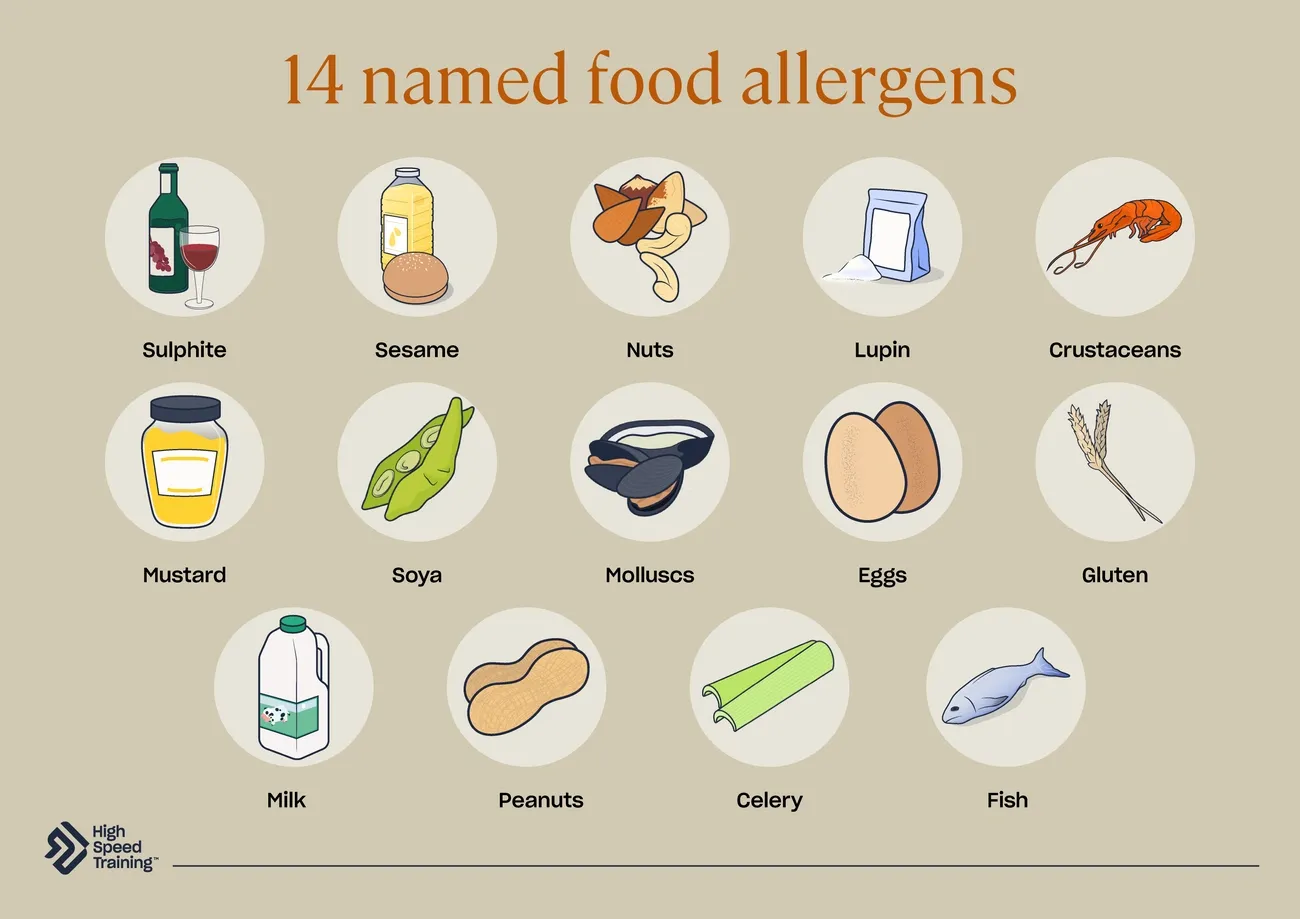
Image Source: High Speed Training
Businesses often ask questions about everything in allergen compliance. These questions address the most pressing concerns.
What is the food allergy law in the UK?
The Food Information Regulations 2014 and Natasha’s Law are the foundations of allergen labelling on food products [33][34]. Natasha’s Law came into effect on 1 October 2021. The law requires full ingredient lists and allergen information on prepacked for direct sale foods [33][35].
Who enforces allergen legislation?
Local authorities enforce allergen information regulations through authorised food officers [15][36]. These officers have the power to issue fines or prosecute businesses that fail to comply [36].
What are the 14 allergens I must declare?
Celery, cereals containing gluten, crustaceans, eggs, fish, lupin, milk, molluscs, mustard, peanuts, sesame, soybeans, sulphur dioxide and sulphites above 10mg/kg, and tree nuts [15][10][9].
How should I display allergen information?
You can provide allergen information through written menus, chalkboards, notices, or signposting that directs customers to staff [10][12]. For prepacked foods, emphasise allergens using bold, contrasting colours, or underlining [7].
What training do my staff need?
Staff need food allergy training that covers the 14 allergens, legislation, and cross-contamination control [15][22]. The Food Standards Agency provides free online training [10][22].
What happens if I don’t comply with allergen laws?
Non-compliance is a criminal offence and results in unlimited fines determined by Magistrates [19][20]. Businesses may face improvement notices and prosecution, with costs averaging £1.5 to £10 million per recall incident [20].
Conclusion
Managing food allergens is a matter of public safety rather than optional good practise. Around 10 people die each year from allergic reactions to food, and this makes resilient allergen controls essential for every food business operating in the UK. The legal framework demands clear allergen declarations and complete staff training. It also requires documented management systems that prevent cross-contamination. Those who fail to comply face unlimited fines and criminal prosecution. Costs can be a big deal as they mean that businesses may pay over £10 million per incident. Businesses should implement the procedures outlined in this piece to ensure full compliance with UK food allergen regulations immediately. This protects vulnerable customers from preventable harm.
Key Takeaways
Understanding and implementing UK food allergen regulations is essential for protecting customers and avoiding severe legal consequences. Here are the critical points every food business must know:
• Legal compliance is mandatory: UK food allergen regulations are criminal law – failure to comply can result in unlimited fines, prosecution, and recall costs averaging £1.5-10 million per incident.
• Declare all 14 major allergens clearly: Businesses must emphasise allergens (gluten cereals, nuts, milk, eggs, fish, shellfish, sesame, soya, celery, mustard, lupin, sulphites) in ingredient lists using bold text or contrasting colours.
• Staff training is legally required: All employees handling food must receive annual allergen awareness training covering the 14 allergens, cross-contamination prevention, and emergency procedures.
• Implement robust management systems: Document all ingredients, verify supplier information, prevent cross-contamination through dedicated equipment and cleaning procedures, and maintain written allergen records.
• Know when to refuse requests: Businesses have no legal obligation to provide allergen-free food – if you cannot guarantee safety due to airborne contamination or inadequate controls, you must decline the order.
With approximately 2 million people in the UK living with food allergies and hospital admissions increasing by 500% since 1990, proper allergen management protects both customers and your business from potentially devastating consequences.
FAQs
Q1. What are the main laws governing food allergen labelling in the UK? The primary legislation includes the Food Information Regulations 2014, which implements EU Regulation No. 1169/2011, and Natasha’s Law, which came into force on 1 October 2021. These laws require businesses to declare the 14 major allergens on all food products, whether prepacked or sold loose, and mandate full ingredient lists on prepacked for direct sale items.
Q2. Which allergens must UK food businesses declare by law? Food businesses must declare 14 specific allergens: cereals containing gluten (wheat, rye, barley, oats), peanuts, tree nuts, milk, eggs, fish, crustaceans, molluscs, sesame, soya, celery, mustard, lupin, and sulphur dioxide/sulphites (when present above 10mg per kilogramme). These must be emphasised in ingredient lists using bold text, contrasting colours, or underlining.
Q3. What penalties can businesses face for failing to comply with allergen regulations? Non-compliance with allergen regulations is a criminal offence that can result in unlimited fines determined by Magistrates’ courts. Beyond fines, businesses may face improvement notices, criminal prosecution, and substantial costs from product recalls, which average between £1.5 million and £10 million per incident, excluding legal fees and reputational damage.
Q4. How should allergen information be provided for non-prepacked foods? For non-prepacked foods such as restaurant meals or deli counter items, allergen information can be provided orally by trained staff, displayed on menus or chalkboards, or through clear signposting directing customers where to obtain the information. Businesses must maintain written allergen documentation for staff reference, even when providing information verbally.
Q5. Is allergen awareness training mandatory for food business staff? Yes, allergen training is a legal requirement under UK food allergen regulations. All staff handling food or taking orders must receive training covering the 14 allergens, cross-contamination prevention, and emergency procedures. The Food Standards Agency recommends annual refresher training, with industry best practise suggesting formal updates every three years.
References
[1] – https://www.food.gov.uk/business-guidance/allergen-checklist-for-food-businesses
[2] – https://www.regencypurchasing.co.uk/allergen-management-advice-for-caterers/
[3] – https://craftguildofchefs.org/news/new-law-introduced-gluten-free-food
[4] – https://www.foodallergy.org/resources/avoiding-cross-contact
[5] – https://commercial.coeliac.org.uk/gluten-free-law
[6] – https://www.westminster.gov.uk/news/owners-former-jungle-themed-restaurant-prosecuted-after-gluten-free-allergen-failures
[7] – https://www.food.gov.uk/business-guidance/allergen-labelling-for-food-manufacturers
[8] – https://www.food.gov.uk/business-guidance/food-allergen-labelling-and-information-requirements-technical-guidance-part-1-guidance-for-businesses-providing-prepacked-food
[9] – https://www.gov.uk/food-labelling-and-packaging/ingredients-list
[10] – https://www.devonsomersettradingstandards.gov.uk/business/food-law-guidance/allergens-in-food/
[11] – https://www.food.gov.uk/business-guidance/food-allergen-labelling-and-information-requirements-technical-guidance-part-3-guidance-for-businesses-providing-food-prepacked
[12] – https://www.businesscompanion.info/en/quick-guides/food-and-drink/food-allergens-and-intolerance
[13] – https://www.nsf.org/gb/en/knowledge-library/managing-allergen-risks-food-businesses
[14] – https://saferfoodscores.co.uk/written-allergen-information-guidance-for-food-service/
[15] – https://www.food.gov.uk/business-guidance/allergen-guidance-for-food-businesses
[16] – https://www.anaphylaxis.org.uk/my-account/media-centre/membership-news/navigating-the-complexities-of-food-allergen-management/
[17] – https://www.allergensafe.co.uk/how-to-handle-allergy-emergencies-in-your-business/
[18] – https://www.ncass.org.uk/news/allergen-management-what-are-ehos-looking-for/
[19] – https://www.food.gov.uk/business-guidance/food-allergen-labelling-and-information-requirements-technical-guidance-enforcement-of-the-measures
[20] – https://libereat.com/2022/03/consequence-businesses-not-following-allergen-rules/
[21] – https://www.reedsmith.com/articles/tomorrows-hospitality-a-z/prosecutions-are-soaring-due-to-allergens-labelling-breaches-in-the-uk/
[22] – https://www.food.gov.uk/business-guidance/allergy-training-for-food-businesses
[23] – https://foodallergyaware.co.uk/resources/allergy-aware-induction-training/
[24] – https://www.thesafetyexpert.co.uk/level-3-food-allergen-management/
[25] – https://www.virtual-college.co.uk/courses/level-2-food-hygiene-allergy-training
[26] – https://allergytraining.food.gov.uk/
[27] – https://www.bsaci.org/wp-content/uploads/2019/12/AllergyNurseCompetences_Edition1_Nov2014.pdf
[28] – https://www.anaphylaxis.org.uk/my-account/media-centre/membership-news/how-to-train-your-staff-on-allergen-safety/
[29] – https://zems.org.uk/2025/11/18/allergen-communication-best-practise-how-food-staff-can-keep-customers-safe/
[30] – https://www.unileverfoodsolutions.us/chef-inspiration/allergen-101/5-food-allergy-guidelines-to-follow-in-your-restaurant.html
[31] – https://www.thesafetyexpert.co.uk/food-handler-allergen-responsibilities/
[32] – https://restaurantbusinessonline.com/operations/tips-making-go-orders-allergen-safe
[33] – https://www.anaphylaxis.org.uk/my-account/media-centre/membership-news/understand-natashas-law/
[34] – https://essentialsafetytraining.org.uk/what-legislation-regulates-allergen-labelling-on-food-products/
[35] – https://www.gov.uk/government/news/natashas-legacy-becomes-law
[36] – https://www.allergensafe.co.uk/who-enforces-allergens-regulations-in-uk/