
 Inconsistent precautionary allergen labelling continues to pose most important risks in UK food manufacturing. The European Court of Auditors called for harmonised allergen rules by 2027. VITAL allergen labelling offers a science-based alternative to the widespread misuse of generic “may contain” statements. The voluntary incidental trace allergen labelling VITAL programme launched in 2007 and provides manufacturers with a standardised risk assessment methodology to determine when precautionary allergen labelling should be used. The voluntary incidental trace allergen labelling programme VITAL 4.0 now incorporates ED05-based reference doses. This enables food businesses to make evidence-driven decisions about allergen cross-contact risks instead of relying on precautionary statements by default.
What is VITAL (Voluntary Incidental Trace Allergen Labelling)?

Image Source: Allergen Bureau
Definition and core purpose
The Allergen Bureau’s VITAL (Voluntary Incidental Trace Allergen Labelling) Programme represents a standardised allergen risk assessment process designed for food industry application [1]. The voluntary incidental trace allergen labelling VITAL programme assists food companies in conducting full reviews of allergen status across all ingredients and processing conditions that contribute towards finished product allergen profiles [1].
A VITAL risk assessment using programme tools, including VITAL Online, produces a ‘labelling outcome’ that summarises food allergens present due to intentional recipe inclusion. It identifies where allergens present through cross-contact should appear on labels [1]. The precautionary statement format reads: ‘May be present: allergen x, allergen y’ [1].
The main goal centres on ensuring manufactured food remains safe for most consumers with food allergies. It does this by providing consistent labels that declare allergens from documented, unavoidable and sporadic cross-contact [2]. This framework makes it possible for allergic consumers and their carers to avoid purchasing foods presenting personal risk [2]. VITAL allows assessment of likely allergen cross-contact sources from raw materials and processing environments, plus assessment of amounts present and review of knowing how to reduce allergenic material from contributing sources [1].
VITAL vs precautionary allergen labelling (PAL)
Traditional precautionary allergen labelling practises lacked standardised methodology before VITAL’s development. This resulted in inconsistent communication of allergen risks to consumers [3]. The absence of structured assessment led to two problematic outcomes: over-cautious labelling that restricted food choices for allergic consumers without need, and inadequate labelling failing to warn of genuine risks [3].
VITAL provides manufacturers with a systematic approach to assess cross-contact risks and apply precautionary labelling when science justifies it [3]. The programme wants to preserve precautionary statements as genuine risk management tools whilst maximising safe food choices for allergic consumers [3]. Generic PAL statements such as “may contain” get applied without risk assessment. VITAL’s methodology requires documented evidence of cross-contact assessment against defined threshold concentrations.
The VITAL Action Level Grid contains concentrations of cross-contact allergen proteins that determine when precautionary allergen labelling statements become appropriate [2]. This approach avoids indiscriminate PAL use and preserves its value as a risk management tool [2]. The programme operates on the premise that products may have foreseeable allergen levels through incidental cross-contact, which will not require labelling where levels fall below Action Levels [2].
The Allergen Bureau and programme origins
The Allergen Bureau was founded in 2005 as the peak industry body representing best practise food allergen management around the world [3]. The Bureau operates as a pre-competitive, not-for-profit membership organisation. It provides food industry with rapid responses to questions about allergen risk management in ingredients and manufactured foods [3].
VITAL 1.0 received its original release in June 2007 in Australia and New Zealand [2]. The programme gained development support from the Australian and New Zealand food industry through consultation with consumer organisations, industry bodies, regulators and retailers [4]. Approximately 7,400 organisations have registered to use the VITAL online tool and generated more than 74,500 reports since the online version became accessible to more people [3].
VITAL 4.0 marks the third update since 2007 and follows wider global review of science underpinning quantitative risk assessment for Codex [2]. During this progress, the VITAL Scientific Expert Panel (VSEP) reviewed science to ensure reflexion of latest data and risk management practises [2]. The most important change in the voluntary incidental trace allergen labelling programme VITAL 4.0 involves adoption of ED05-based reference doses per Joint FAO/WHO Expert Consultation recommendations [4]. This change from ED01 to ED05 occurred because expert review determined that ED01 did not reduce health risks to food-allergic individuals in a meaningful way but could affect food choices for those with allergies [4].
Why VITAL matters in UK food manufacturing
Image Source: the University of Manchester WordPress Websites & Blogs
Challenges with allergen cross-contamination
Allergen cross-contamination or cross-contact occurs when traces of allergens enter products accidentally during processing, manufacturing, handling, transport, or storage of foods [5]. The phenomenon presents unique challenges distinct from other food safety hazards. Food allergen cross-contact can occur at every stage of the food chain, from agricultural production through to final processing [5]. Remnants of crops persist in fields and contaminate other produce during crop rotation. Transport vehicles carrying multiple products create cross-contact opportunities when equipment fails to receive thorough cleaning between loads [5].
Manufacturing settings have many vectors that help allergen transfer: personnel movement, environmental surfaces, shared equipment and utensils, plus spillages of allergenic material [5]. Rework presents hazards when food removed from processing gets added back at later stages and potentially introduces different allergen profiles to other products [5]. Unlike microbiological risks, food processing procedures such as heating do not destroy food allergens consistently [5]. Thermal processing can increase allergen potency in certain cases. Roasting peanuts, to name just one example, raises allergenic strength rather than diminishing it [5].
The difference between allergen and microbiological control necessitates distinct risk management approaches. Manufacturers cannot rely on cooking or preservation steps to eliminate allergen hazards. Therefore, the biggest goal of an allergen risk assessment centres on understanding the likelihood of unintentional allergen cross-contamination across supply chains, from raw materials through to finished products [5].
The problem with inconsistent PAL use
Excessive use of precautionary allergen labels limits consumer choice and devalues warnings for consumers with food allergies or intolerances [5]. Risk-taking behaviours develop amongst allergic consumers seeking to increase food choice and result in unexpected adverse allergic reactions [5]. Research demonstrates consumers attribute between 2 and 99 per cent risk of reaction to PAL statements, alongside comprehensibility ratings spanning 1 to 98 per cent [6]. Many interpret ‘Produced in a factory’ to reflect less risk than ‘May contain’, though manufacturers’ intended risk messaging may not match this [6].
Consumers judge PAL not as communications meant to benefit the public, but as legal cover for businesses in case of accidental consumer harm [4]. The perception applies to PAL for packaged food products and statements used in restaurant environments [4]. The widespread assumption that PAL remains mandatory creates dangerous outcomes. Consumers assume products without PAL notices have been determined free from cross-contamination risk and potentially accept more exposure risk than safe for their condition [4].
FSA studies found that many food businesses use these labels attempting to protect consumers but remain confused about when and how they need to do so [7]. Evidence suggests businesses need clarity on measures required to control allergen cross-contact risk, which then informs labelling decisions [7]. The biggest problem concerns standardising the system behind the label rather than the label itself [7]. PAL’s voluntary status, inconsistent application, lack of threshold standards and risk analysis processes create profound mistrust in the system for manufacturers [7].
How VITAL addresses modern allergen risk management
The use of precautionary allergen labelling when no genuine risk to consumers has been identified could be misleading food information under UK food allergen regulations [5]. PAL should only be used when allergen cross-contact risk within the supply chain gets identified that cannot be removed through risk management actions, identified through proper risk assessment [5].
VITAL allergen labelling provides the structured methodology absent from UK manufacturing before. No standardised approach existed for assessing or communicating cross-contamination risks before VITAL’s development [6]. The programme’s systematic framework evaluates cross-contact from raw materials, processing equipment, environment and manufacturing processes [6]. The VITAL Action Level Grid determines when precautionary statements become appropriate based on allergen threshold levels [6].
The evidence-based approach addresses both consumer safety and commercial imperatives. Manufacturers gain clear guidance on when PAL protects allergic consumers versus when it restricts product access. The standardised statement ‘May be present: allergen x, allergen y’ eliminates confusion caused by multiple PAL variations whilst preserving the warning’s value as a genuine risk management tool.
The scientific basis of VITAL: reference doses and action levels
Understanding reference doses (ED01 and ED05)
Reference doses derive from population threshold dose distribution modelling using data from double-blind placebo-controlled food challenges conducted globally. Eliciting Dose values (ED01 and ED05) represent doses predicted to provoke objective allergic symptoms in 1% and 5%, respectively, of the allergic population [8]. These values express doses in mg total protein from the allergenic food [8].
Broad international consensus regarding suitable datapoints and methods helped establish ED distributions. This consensus determined individual patients’ No Observed Adverse Effect Levels (NOAELs) and Lowest Observed Adverse Effect Levels (LOAELs) and combined them with state-of-the-art statistical modelling [8]. Population threshold dose distribution modelling applies different statistical models, where the estimated reference dose proves model-dependent [8]. VITAL 3.0 used Stacked Model Averaging that incorporated five mathematical models (Weibull distribution, log-logistic, log-normal, log double-exponential, generalised Pareto) to produce a single curve for each allergen from which Eliciting Doses could be derived [9].
The ED01 represents the dose below which 99% of allergic individuals would be protected from objectively measurable allergic reactions [9]. Conversely, ED05 signifies the dose at which 5% of the allergic population will react with objective symptoms [10]. Approximately 96-97% of the allergic population will not experience objective symptoms at ED05 levels because their individual thresholds sit higher [11]. Research shows that those few individuals with thresholds below the reference dose would experience only mild to moderate symptoms, primarily subjective in nature [11].
VITAL action level grid explained
The VITAL Action Level Grid contains concentrations of cross-contact allergen proteins, termed Action Levels, which determine when precautionary allergen labelling statements become appropriate [5]. Reference Dose information and the associated Reference Amount determine Action Level concentrations [5].
Action Level 1 indicates low concentration of the relevant allergen under evaluation and presents low chance of adverse reaction, so no precautionary allergen labelling statement is required [5]. Action Level 2 signals high concentration of relevant allergen under evaluation and presents considerable chance of adverse reaction, thus requiring a precautionary allergen labelling statement [5].
This formula calculates Action Levels for packaged products using the Reference Dose and Reference Amount: Action Level transition point = Reference Dose (mg) × 2 × (1000/Reference Amount in grammes) [5]. A biscuit with a 40g Reference Amount provides an example. The Action Level transition point for egg (with 2.0mg reference dose in VITAL 4.0) equals 2 × (1000/40) = 50ppm [5]. So, Action Level 1 applies below 50ppm for cross-contact egg in that biscuit, and Action Level 2 applies at or above 50ppm [5].
How reference amounts are calculated
The Reference Amount represents the maximum amount of food eaten in a typical eating occasion [5]. This may or may not line up with the nominal or declared serving size but will not be an amount less than the declared serving size [5]. Reference Amount determination remains a business decision [5].
Blom and colleagues showed through sensitivity analyses that using the P50 intake (50th percentile) of a food product in the population of users provides a deterministic risk assessment outcome as safe as a probabilistic risk assessment for 99% of food groups [8]. P75 resulted in a deterministic risk assessment outcome as safe as probabilistic modelling for all food groups [8]. P75 was recommended for use as a point estimate in deterministic risk assessment to comply with Reference Doses rather than higher intake figures [8]. The FAO/WHO Expert Committee recommended using P50 consumption amount from the general population distribution of single-eating occasion intake [5].
VITAL 4.0 updates and improvements
The most prominent change in VITAL 4.0 involves the move from ED01 reference doses to ED05 values [12]. This update lines up the VITAL programme with recommendations made by the FAO/WHO Expert Consultation to the Codex Alimentarius Commission [12]. The FAO/WHO Expert Panel endorsed ED05-based reference doses as suitable and adopted them as Reference Doses for VITAL 4.0 [5].
Expert review determined that ED01 did not reduce health risks to food-allergic individuals in any meaningful way but could affect food choices for those with allergies [10]. The FAO/WHO Expert Committee concluded after thorough review that a Reference Dose below ED05 did not reduce risk to food-allergic individuals in any meaningful way and could decrease food availability for consumers with food allergies [10]. Analysis of risks associated with ED05 values showed the likelihood of severe or fatal outcomes remains very low [12].
The recommended reference doses were rounded down from population ED05 values to levels that for many allergens equate to ED03-ED04, which provides an additional safety margin [11].
How VITAL supports risk-based decision making in food production

Image Source: High Speed Training
When should precautionary allergen labelling be used
Risk assessment is the foundation to determine when precautionary allergen labelling should be used in UK food manufacturing. PAL should only be applied when a full picture shows an unavoidable risk of allergen cross-contact that cannot be controlled sufficiently through careful risk management actions [7]. The use of precautionary allergen labelling when no genuine risk to the consumer has been identified could be considered misleading food information [6].
Food businesses must establish whether allergen cross-contact within the supply chain presents a risk that cannot be removed through risk management actions such as separation or cleaning [13]. This determination requires systematic assessment rather than assumptions. Discussions with larger food businesses confirm they carry out risk assessments as part of their allergy management system to inform if PAL is required. This involves every stage of manufacture from procurement of raw materials to goods received, to controls in manufacture, packaging and distribution [4].
The voluntary incidental trace allergen labelling VITAL programme provides a structured methodology to make these determinations. Carrying out a VITAL risk assessment assists a food company to review the allergen status of all ingredients and processing conditions that contribute towards the allergen status of the finished product [1]. This systematic review assesses likely sources of allergen cross-contact from raw materials and the processing environment. It also assesses the amount present and reviews the ability to reduce allergenic material from all contributing sources [1].
Moving from precautionary to evidence-based labelling
The change from precautionary to evidence-based labelling represents a fundamental shift in allergen risk management philosophy. Evidence from qualitative interviews shows considerable variation in risk assessment approach. Small and medium-sized businesses often rely solely on information provided by ingredient suppliers [4]. No SME business that participated in FSA studies understood the requirement to undertake a formal allergen risk assessment before applying PAL [7].
Thresholds help food businesses understand what levels of unintentional allergens in their prepacked products should trigger the use of PAL and standardise the approach [4]. A food business calculates the amount of allergen contamination that may be present in a product and compares this with a reference dose. PAL should be applied if there is a risk that contamination will exceed the reference dose [4]. The introduction of thresholds based on reference doses will give PAL that describes the potential risk accurately and consistently in all products where it is used [4].
Reducing unnecessary ‘may contain’ statements
The proliferation of unnecessary precautionary statements undermines the entire allergen labelling system. Research shows most food products do not contain detectable allergen residue or contain only low concentrations of residue of the allergens declared using PAL [14]. This overuse guides consumers to mistrust warnings and potentially take risks to increase their food choice. This results in unexpected adverse allergic reactions [6].
VITAL allergen labelling addresses this through quantitative risk assessment. The programme produces a ‘labelling outcome’ that summarises where food allergens present due to cross-contact should be included on the label in the form of the precautionary statement [1]. VITAL also provides ongoing monitoring and verification of the risk assessment process to act upon any changes to the level of risk without delay [1].
Benefits for consumer safety and commercial outcomes
The adoption of threshold-based approaches delivers benefits in multiple ways. Providing food businesses with a standard to work to results in PAL being applied in a more consistent manner. This sets a level playing field for industry and provides a more objective basis to decide whether or not to label products [4]. FSA consultation found that 85% of members of the public supported setting allergen thresholds for prepacked foods to guide the application of PAL [4].
A consistent approach based on thresholds that is understood by consumers creates more trust in the labelling system [4]. With trust in a new standard, consumers become more likely to heed the warning rather than ignore it or take a “trial and react” approach. This results in fewer adverse reactions [4]. This approach also expands the range of products available to consumers with food allergies by reserving PAL for products where the allergen concentration exceeds a safe threshold [15].
VITAL provides clear, science-based standards to manufacturers about when PAL should be applied. This reduces guesswork and potential overuse whilst helping rebuild consumer trust [15]. A threshold-based standard potentially improves PAL information in supply chains as a knock-on effect and minimises labelling errors [4].
Step-by-step application of VITAL in UK manufacturing
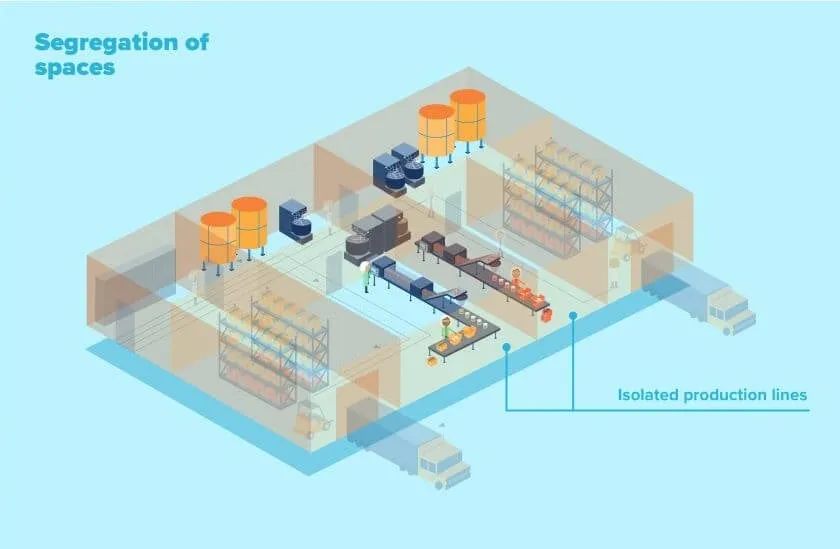
Image Source: CRB Group
Conducting allergen risk assessment using VITAL
Application of PAL represents the final step in a process of risk analysis scrutinising allergen cross-contact within the food supply chain [6]. Undertaking this analysis allows businesses to identify risks, decide whether precautionary allergen labelling is appropriate, and agree next steps. The risk analysis has four stages:
- Risk assessment – What is the risk?
- Risk management – Can the risk be managed? What actions could reduce the risk?
- Risk communication – How should the risk be communicated?
- Risk review – Has the risk changed? How frequently will the system be reviewed? [6]
The risk assessment should think over potential allergen sources at premises as a minimum requirement [6]. This has identifying foods and ingredients that intentionally contain allergens, those that may unintentionally contain allergens (such as incoming ingredients with precautionary labels), and any other potential allergen sources [6].
Evaluating cross-contact risk in production environments
Manufacturers must identify routes through which allergen cross-contamination could occur during handling, storage, preparation, production processes, packing or distribution [6]. The physical nature of particular ingredients being used (liquid, powder or pieces) and geography of the manufacturing environment prove important factors in this evaluation [6].
Businesses then assess how likely cross-contamination will happen, in what amount, and how control measures reduce or eliminate risks effectively [6]. Good supplier management usefully informs decisions on appropriate frequency of checks on raw materials and specification verification [6].
Using VITAL Online calculator
VITAL Online functions as a web-based calculator simplifying the assessment process [16]. The system provides precise documentation requirements to record assumptions and ongoing monitoring while merging naturally with existing food safety certification programmes [16]. Manufacturers can store allergen status of ingredients and processing profiles to use in multiple recipes, record assumptions in risk assessments, and create Action Level reports using the interactive grid [17].
Determining when PAL is required
Precautionary allergen labelling should only be used where a risk of allergen cross-contamination has been identified that cannot be removed [6]. It should not be used as a substitute for Good Manufacturing Practise [6]. Good Manufacturing Practise requires commitment to ensure products meet food safety, quality and legal requirements through appropriate manufacturing operations. This has effective food safety systems, hazard analysis principles and quality assurance systems [6].
Integrating VITAL with HACCP and food safety systems
Arranging VITAL with Critical Control Points (CCPs)
HACCP requires food businesses to put in place, implement and maintain permanent procedures based on HACCP principles [18]. Allergen management may not typically function as a CCP for food businesses, but it definitely represents a control measure requiring verification [8]. Control measures cover any action that prevents, eliminates or reduces food safety hazards to acceptable levels [8].
VITAL allergen labelling works with HACCP principle 3, which requires establishing verified critical limits [8]. Principle 6 mandates verification of the HACCP plan and establishment of verification procedures confirming the system operates as intended [8]. CCPs, critical limits and control measures are part of this [8].
Role of cleaning verification and environmental monitoring
Presence of undeclared food allergens remains the leading cause of food recalls [11]. Regular ingredient testing and environmental monitoring ensure cross-contamination from common food allergens does not occur [11]. Food businesses can properly identify, manage and verify manufacturing and environmental allergen controls through an environmental monitoring programme [11].
Verification gathers evidence proving a cleaning regime can remove allergen residues effectively and repeatedly [19]. Ongoing verification proves the verified allergen cleaning regime was performed correctly and remains effective [19]. Both processes require thorough visual inspections and analytical analyses testing finished products, work-in-progress, rinse water, flush material or environmental surface swabs [19].
Documentation and verification requirements
Food businesses prove they operate resilient systems by maintaining detailed records of verification results and outcomes [20]. Documentation must have all decisions made before starting cleaning verification, from target allergen selection to swab location choices [20]. This documentation is part of a site’s due diligence and proves vital if incidents occur [20].
Supporting GFSI-recognised certification schemes
The VITAL Standard functions as supplementary certification for food manufacturers already certified to GFSI-recognised food safety management standards that have allergen management [21]. GFSI-recognised schemes like BRCGS, SQF, FSSC 22000 and PrimusGFS mandate allergen controls as fundamental requirements [9]. Certification Bodies accredited to ISO/IEC 17065:2012 audit the VITAL Standard [21][22].
VITAL and UK regulatory expectations: alignment with FSA guidance
Image Source: Food Standards Agency
Current FSA position on allergen labelling
The Food Standards Agency requires food businesses to declare presence of any of the 14 major allergens listed in Annexe II of the Food Information for Consumers Regulation [23]. Around 6% of the UK adult population have a food allergy, with an estimated 1 in 100 people having coeliac disease [23]. Tiny amounts of food ingredients can produce an allergic reaction, with symptoms ranging from mild itching to anaphylaxis [23].
Current UK food allergen regulations treat PAL as voluntary food information. So businesses should provide consumers with accurate information about allergen presence that was not intended to avoid providing unsafe food [23]. A precautionary statement should be provided when unavoidable cross-contamination risk has been identified following risk assessment that cannot be controlled sufficiently through segregation and cleaning [23].
Gaps between VITAL and UK legal requirements
The FSA does not set allergen thresholds for precautionary allergen labelling at present [5]. VITAL operates as a voluntary programme, whilst UK law mandates declaration of allergens added on purpose. Some multinational food manufacturers producing much of the world’s prepacked foods, along with a portion of UK food businesses, are members of VITAL [4].
FSA consultation outcomes and future developments
FSA consultation in 2021 found that 85% of members of the public supported setting allergen thresholds for prepacked foods to guide PAL application [4]. There was strong agreement that PAL application without assessing unavoidable cross-contamination risk could breach regulations [24]. The FSA recommended in December 2025 that the Board support Codex proposals on PAL and seek to establish a baseline for PAL in the UK [25]. The Codex Committee on Food Labelling recommended an ED05 threshold. This means PAL should be based on the dose at which 5% of people with relevant allergy would react [25].
Using VITAL as best practise guidance
VITAL functions as best practise guidance rather than regulatory requirement. The FSA published updated technical guidance in 2023 emphasising that PAL should be used following a full picture of risk assessment where genuine cross-contamination risk exists [5]. Food businesses using VITAL demonstrate steadfast dedication to evidence-based allergen management that arranges with emerging international standards [4].
Implementing VITAL: challenges and practical solutions
Common implementation obstacles in UK facilities
Regulations evolve continuously to keep up with emerging risks. Organisations find it difficult to track changes consistently [10]. Staff training that falls short causes data breaches, legal liabilities and productivity loss. Employees become incompetent and unaware of their responsibility in curbing risks [10]. Documentation that lacks consistency proves cumbersome and resource-intensive. It requires significant time, manpower and financial resources [10].
Resource requirements for smaller manufacturers
Small-scale manufacturers operate on tight budgets. They have limited access to financing options, which makes it difficult to invest in new equipment, technology or staff [26]. Food SMEs view formal Quality Management Systems as overly complex and resource-intensive. The systems are poorly suited to small enterprise realities, so adoption remains limited [27]. Common barriers include limited technical capacity and constrained financial resources. Informal organisational structures and resistance to change also pose challenges [27].
Real-life application examples
Companies identify Critical Control Points on production lines. They use the product with highest allergen loading for CCP validation studies [28]. The next product prepared on the line gets tested at eight timepoints from T=0 to T=60 minutes. Testing occurs on three separate occasions to prove PAL is not required [28].
Overcoming testing and validation challenges
Allergen testing costs range from £50-80 per sample. CCP testing totals £1,200-1,920 per control point [28]. Matrix effects in chocolate and high fat products reduce extraction efficiency. Processed goods also affect detectability [29].
Audit and compliance expectations
Regular internal audits highlight inconsistencies before external compliance audits. This allows prompt corrective actions [10]. Auditors exercise professional scepticism to reach reasonable assurance. They verify that organisations conduct activities stipulated by target frameworks [30].
Conclusion
VITAL allergen labelling offers UK food manufacturers a well-laid-out alternative to inconsistent precautionary statements that confuse consumers and restrict choice. The programme applies reference doses and action level grids to make evidence-based decisions about cross-contact risks that warrant labelling. This science-driven approach protects allergic consumers and expands safe food choices, addressing both regulatory expectations and commercial needs. Businesses that implement VITAL show steadfast dedication to best practise allergen management and line up with emerging international standards. Regulatory frameworks continue evolving toward threshold-based approaches, and manufacturers adopting VITAL position themselves ahead of compliance requirements. They build consumer trust through consistent and meaningful allergen communication.
Key Takeaways
VITAL provides UK food manufacturers with a science-based framework to replace inconsistent “may contain” statements with evidence-driven allergen risk assessments.
• VITAL uses ED05 reference doses and action level grids to determine when precautionary allergen labelling is genuinely required, protecting 95-97% of allergic consumers • The programme reduces unnecessary PAL statements that confuse consumers whilst ensuring genuine cross-contamination risks receive appropriate warnings • VITAL integrates seamlessly with existing HACCP systems and GFSI-recognised certification schemes, supporting comprehensive food safety management • Implementation requires systematic risk assessment of ingredients, processing environments, and cross-contact routes using the VITAL Online calculator • FSA consultation shows 85% public support for threshold-based approaches, positioning VITAL as best practise ahead of regulatory developments
Adopting VITAL demonstrates commitment to evidence-based allergen management that balances consumer safety with expanded food choice, building trust through consistent and meaningful labelling whilst preparing for future regulatory requirements.
FAQs
Q1. What is the VITAL programme and how does it differ from standard precautionary allergen labelling? VITAL (Voluntary Incidental Trace Allergen Labelling) is a standardised risk assessment programme that helps food manufacturers determine when precautionary allergen labelling is genuinely necessary. Unlike traditional “may contain” statements that are often applied inconsistently without proper risk assessment, VITAL uses science-based reference doses and action level grids to evaluate cross-contamination risks. This evidence-driven approach ensures that precautionary labels are only used when there is a genuine risk to allergic consumers, rather than as a blanket legal protection for manufacturers.
Q2. How do reference doses work in the VITAL system? Reference doses in VITAL are based on ED05 values, which represent the dose at which 5% of people with a specific food allergy would likely experience objective allergic symptoms. This means approximately 95-97% of allergic individuals are protected from reactions. These doses are calculated using data from double-blind placebo-controlled food challenges conducted globally and are expressed in milligrammes of total protein from the allergenic food. The VITAL Action Level Grid uses these reference doses alongside reference amounts (typical serving sizes) to determine whether precautionary labelling is required.
Q3. When should UK food manufacturers use precautionary allergen labelling according to VITAL principles? Precautionary allergen labelling should only be used when a thorough risk assessment identifies an unavoidable risk of allergen cross-contamination that cannot be sufficiently controlled through risk management actions such as segregation or cleaning. VITAL helps manufacturers systematically evaluate cross-contact risks from raw materials, processing equipment, and the manufacturing environment. If the assessed allergen concentration falls below the Action Level threshold, no precautionary statement is required, thereby avoiding unnecessary restrictions on consumer choice.
Q4. What are the main challenges smaller UK manufacturers face when implementing VITAL? Smaller manufacturers often struggle with limited budgets, constrained technical capacity, and insufficient staff training when implementing VITAL. The costs associated with allergen testing (£50-80 per sample) and validation studies can be significant for businesses operating on tight margins. Additionally, many small and medium-sized enterprises view formal quality management systems as overly complex and resource-intensive. However, VITAL Online provides a web-based calculator that simplifies the assessment process and helps smaller businesses conduct systematic risk assessments without requiring extensive technical expertise.
Q5. How does VITAL align with current UK Food Standards Agency guidance? Whilst VITAL operates as a voluntary programme rather than a legal requirement, it aligns closely with FSA guidance that precautionary allergen labelling should only be used following thorough risk assessment where genuine cross-contamination risk exists. The FSA’s 2021 consultation found 85% public support for threshold-based approaches to allergen labelling. Although the FSA does not currently mandate allergen thresholds, using VITAL demonstrates best practise allergen management and positions manufacturers ahead of potential future regulatory requirements, particularly as the UK considers adopting Codex recommendations on ED05-based thresholds.
References
[1] – https://vital.allergenbureau.net/vital-programme/
[2] – https://vital.allergenbureau.net/wp-content/uploads/2024/08/Food-Industry_Guide_to_VITAL_4.0_2024_F4.pdf
[3] – https://assets.allergenbureau.net/uploads/2024/09/AB_Eurofins_What-is-the-VITAL-Programme-June-2024_Final.pdf
[4] – https://www.food.gov.uk/board-papers/precautionary-allergen-labelling-and-allergen-thresholds
[5] – https://www.food.gov.uk/business-guidance/consultation-on-food-allergen-labelling-and-information-requirements-technical-guidance-summary-of-stakeholder-responses
[6] – https://www.food.gov.uk/business-guidance/precautionary-allergen-labelling
[7] – https://www.food.gov.uk/sites/default/files/media/document/Precautionary Allergen Labelling – risk analysis SME FBOs_Clean_May 2022.pdf
[8] – https://www.food.gov.uk/research/review-of-the-literature-and-guidance-on-food-allergen-cleaning-report-summary-and-discussion
[9] – https://kellermanconsulting.com/episode-5-allergen-programmes-in-gfsi/
[10] – https://www.effivity.com/blog/compliance-audit
[11] – https://www.eurofinsus.com/food-testing/resources/allergen-management-through-environmental-monitoring/
[12] – https://affidiajournal.com/en/updated-allergen-reference-doses-new-vital-4-0-released
[13] – https://www.food.gov.uk/business-guidance/precautionary-allergen-labelling-checklist
[14] – https://pubmed.ncbi.nlm.nih.gov/36682535/
[15] – https://www.anaphylaxis.org.uk/my-account/media-centre/membership-news/implementing-threshold-based-precautionary-allergen-labelling/
[16] – https://www.hooleybrown.com/blog-post/what-is-the-vital-voluntary-incidental-trace-allergen-labelling-system
[17] – https://vital.allergenbureau.net/
[18] – https://www.food.gov.uk/business-guidance/hazard-analysis-and-critical-control-point-haccp
[19] – https://www.hygiena.com/news/allergen-cleaning-validation-and-verification
[20] – https://www.rssl.com/media/ayohzhst/rssl-white-paper-cleaning-validation-in-allergen-management.pdf
[21] – https://vital.allergenbureau.net/vital-standard/
[22] – https://vital.allergenbureau.net/wp-content/uploads/2025/09/VITAL_Scheme_Certification_Body_Requirements_V2.1_F1.pdf
[23] – https://www.food.gov.uk/business-guidance/food-allergen-labelling-and-information-requirements-technical-guidance-general-background-on-allergens
[24] – https://www.food.gov.uk/about-us/fsa-22-06-07-annexe-c-summary-of-pal-research-and-consultation-findings
[25] – https://www.food-safety.com/articles/10952-uk-fsa-shows-support-for-codex-precautionary-allergen-labelling-proposals
[26] – https://www.deskera.com/blog/small-scale-manufacturing-a-complete-guide/
[27] – https://www.mdpi.com/2071-1050/18/2/890
[28] – https://www.food.gov.uk/research/review-of-allergen-analytical-testing-methodologies-stakeholder-engagement
[29] – https://www.romerlabs.com/en/library/webinars/detail/main-challenges-in-allergen-testing-and-how-to-overcome-them
[30] – https://optro.ai/blog/compliance-audit