
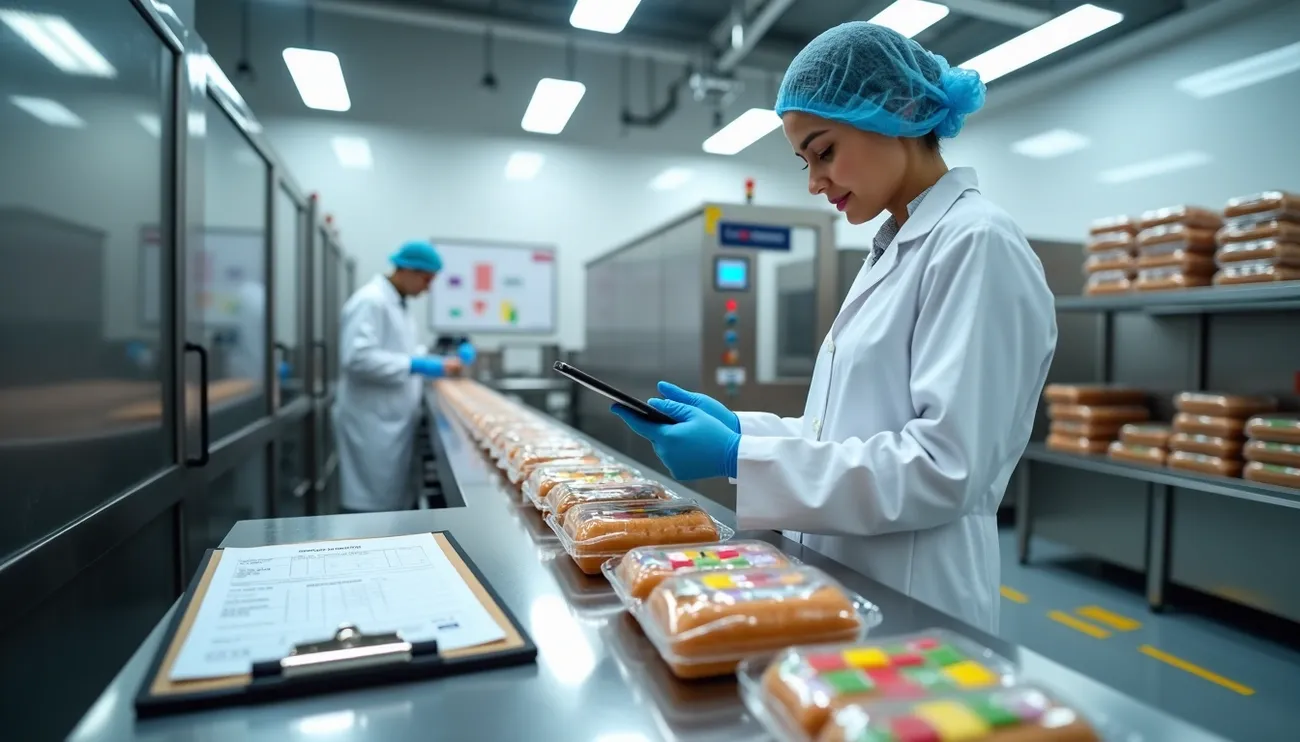
Allergen traceability UK systems face mounting pressure as 296 food recalls were issued in 2024, with undeclared allergens accounting for 34% of cases. Companies lose millions from these failures through lost product, legal claims and damaged reputation. Operational errors within food businesses cause 92% of food allergy alerts. Mislabelling is responsible for 54% of incidents. Resilient allergen management and traceability frameworks cover everything in preventing recalls, protecting consumers and maintaining compliance. We get into UK legal requirements, batch coding systems, supplier controls, production traceability and recall effectiveness measures that technical managers and quality teams must implement in this piece.
What is allergen traceability and why it matters in UK food safety
Definition of allergen traceability in food manufacturing
Food allergen traceability involves tracking allergenic ingredients and materials throughout the whole supply chain, from raw material sourcing through manufacturing and packaging to finished products. This tracking capability goes beyond simple ingredient lists to cover the physical movement, handling and potential cross-contact of allergenic substances at every production stage. The system requires documented evidence that links specific allergen-containing batches to their origins, processing history and distribution endpoints.
An effective allergen traceability UK system operates on the principle of one-step back, one-step forward visibility. Food business operators must verify allergen information from suppliers, maintain records during production and track products to customers. This chain of documentation makes rapid identification of affected batches possible when allergen incidents occur. The traceability framework integrates with broader food allergen control UK measures, including risk assessments, segregation protocols and labelling verification.
Allergen management represents a food safety issue that requires integrated approaches across operational standards. Efficient record-keeping underpins the application of allergen management within food safety programmes, with documentation retained to demonstrate due diligence [1]. Food operators can only perform effective risk assessments when they possess correct information about the complete allergen status of raw materials and ingredients. This requires knowledge of each supplier’s allergen management practises [1].
The critical role of traceability in protecting allergic consumers
Allergic consumers react to varying amounts of allergenic foods, ranging from micrograms to grammes depending on individual tolerance, health status and medication [1]. A few acutely sensitive consumers react to very low levels in the low microgram range, although the majority experience mild reactions at this level [1]. This variability makes accurate allergen information and robust traceability systems essential for consumer protection.
Consumers with food allergies must be informed about the nature and composition of foods they purchase to manage their condition [1]. Legislation provides clear allergen declaration through labelling, but unintended allergen presence can occur throughout the supply chain from farm to retailers. This requires an integrated management approach [1]. The fact that 32 million Americans have food allergies, including 5.6 million children under age 18, with daily exposure risks affecting up to 20 percent of patients, is most important [2].
The UK food allergen regulations legal compliance framework establishes clear duties for food business operators to provide allergen information for both prepacked and non-prepacked products. Traceability systems make swift action possible when contamination incidents occur. Agencies can trace contamination back through suppliers and pinpoint potential risks before they escalate. This rapid response capability protects vulnerable consumers from exposure to undeclared allergens directly.
Business and legal consequences of poor allergen traceability
Financial penalties for allergen traceability failures extend way beyond initial fines. Food recalls cost companies between £1.5 to £10 million per incident, excluding crisis management expenses, legal fees and brand rehabilitation costs [3]. Reputational damage reduces customer trust and drives consumers toward safer, more transparent brands. This results in sustained revenue losses [3].
Research demonstrates that 38% of regular customers never repurchase recalled food products, whilst those who remain take an average of 59 days to repurchase items with recall records [4]. For manufacturers, 52% of food producers incur losses of £7.15 million or more when recalling products, including sales losses and direct recall costs [4]. Therefore, a single product recall can trigger supermarket fines, revenue reductions and potential exclusions from future range reviews [5].
Legal consequences under UK food allergen regulations carry unlimited fines for breaches of allergen labelling requirements, with actual penalties based on business revenue and severity [6]. The 2016 Natasha Ednan-Laperouse case, where a teenager died after consuming a baguette that contained undeclared sesame seeds, prompted introduction of Natasha’s Law. This law mandates full ingredient and allergen labelling on prepacked foods for direct sale [7]. The 2014 manslaughter conviction of Mohammed Zaman, whose restaurant substituted almond powder with cheaper peanut-containing mix, resulted in criminal prosecution after a customer died from anaphylactic shock [7].
Enforcement actions for allergen control documentation failures range from improvement notices to criminal prosecution. Local authorities issue compliance advice initially, followed by improvement notices for non-compliance. Continued failures result in penalties including business closure in extreme cases [3]. Coroners investigate deaths from allergen exposure when circumstances appear unknown, unexpected or suspicious. This subjects businesses to lengthy, disruptive legal processes [3].
Legal requirements for allergen traceability under UK law
Food Safety Act 1990 and general traceability duties
The Food Safety Act 1990 establishes the foundational framework for food safety enforcement in the United Kingdom. This legislation provides local authorities with powers to investigate food safety incidents, issue improvement notices and prosecute food business operators who breach safety requirements. The Act does not specify detailed traceability protocols, but it creates the enforcement infrastructure through which allergen-related violations are prosecuted.
Food business operators bear main responsibility for compliance with food law under this framework, especially regarding the safety of products they produce, distribute, store or sell. The Act enables authorised food officers at local authorities to conduct official controls, inspect premises and examine documentation. A dual enforcement responsibility exists in areas with county and district councils. County councils hold a duty to enforce whilst district councils possess enforcement powers [8].
Food Information Regulations (FIR) 2014 and allergen-specific provisions
The Food Information Regulations 2014 transpose EU Regulation 1169/2011 into UK law and establish enforcement measures for allergen information provision [9]. These regulations mandate that food business operators supply accurate allergen information to customers for food they produce, sell and serve [9]. The framework covers prepacked foods, non-prepacked items and catering situations.
The regulations identify 14 specific allergens that require declaration when used as ingredients: cereals containing gluten, crustaceans, eggs, fish, peanuts, soybeans, milk, nuts, celery, mustard, sesame seeds, sulphur dioxide and sulphites, lupin and molluscs [2]. These allergens must appear emphasised in ingredients lists using bold text, capital letters or coloured text [9].
Major changes took effect from 1 October 2021 for prepacked for direct sale foods. PPDS food packed by a food business before being offered for sale by the same business on similar premises, the same site, or from moveable premises must carry mandatory labelling [9]. This labelling requires the food name, a full ingredients list, allergen information emphasised within that list, and quantitative ingredient declaration for meat ingredients except in mass catering [9]. The name, ingredients list and allergen information must appear directly on packaging or on attached labels [9].
The UK adopted a national measure for non-prepacked foods that allows allergen information provision through any means operators choose, including orally, with exception for distance selling [2]. Businesses must verify accuracy and consistency when providing information orally [2].
Retained EU law and one-step back, one-step forward traceability principles
Retained EU law, specifically Article 18 of Regulation 178/2002, mandates traceability for food, feed, food-producing animals and substances incorporated into food at all production, processing and distribution stages [10]. Food business operators must identify any person from whom they received food or substances intended for incorporation into food [10]. Systems and procedures must enable this information to be made available to competent authorities on demand [10].
Operators must also identify businesses to which their products have been supplied [10]. This one-step back, one-step forward approach requires each supply chain segment to trace all foods received and supplied, including ingredients used to produce finished products [3]. Food placed on the market shall be adequately labelled or identified to help traceability through relevant documentation or information [10].
Retailers, including caterers, are exempt from keeping traceability information relating to sales to final consumers, given that consumers are not food businesses [3]. Where retailers supply directly to another food business such as a catering outlet, traceability requirements must be adhered to despite this exemption [3].
Enforcement and penalties for non-compliance
Failure to comply with allergen labelling requirements under Regulation 10(1) and (2) of the FIR constitutes a criminal offence [8]. Authorised food officers at local authorities hold responsibility for official controls relating to allergen rules. Criminal prosecution may be brought against food business operators breaching these provisions [8].
Persons convicted of offences under the FIR face potentially unlimited fines. Magistrates determine the penalty level on a case-by-case basis [8]. The courts have been willing to impose major penalties for allergen labelling breaches, with fines based on many factors including business revenue [7]. Non-compliance triggers improvement notices from local authorities beyond financial penalties, and continued failures may result in business closure in extreme circumstances.
The role of batch coding and lot identification in allergen control
How batch codes enable product tracking throughout the supply chain
Batch coding are the foundations of traceability and protect both consumers and manufacturers [5]. Each batch code serves as a unique identifier assigned to a group of products manufactured under similar conditions. The code typically consists of numbers, letters, or combinations that encode production date, manufacturing location, sequential numbers and quality indicators [5]. This identification system lets manufacturers document every step from raw material intake to finished product distribution [5].
Traceability has become the guiding principle for almost all food safety regulations. Companies must track material along every step of production [6]. Lot traceability lets manufacturers determine where exact ingredients originated within a given batch and where that batch went [6]. Version control features provide a historical view of the recipe used to produce each finished good lot. This creates a complete audit trail back to the original ingredient lots used at a specific date and time [6].
Batch tracing gives clear visibility of where affected products have been shipped, which customers received them and whether any remaining stock is still in warehouse [11]. Time is of the essence when a recall happens [6]. If a supplier realised a shipment of spice mix contained peanuts, the ERP system would answer specific questions. Where was the ingredient used? How much was used? When was it used? Where did the finished product go [6]? So a targeted recall works better than a widespread one and damages the brand and the bottom line less [6].
Lot numbering systems and their link to allergen risk assessments
A batch number is an identifier that a manufacturer assigns to a group of products produced under the same conditions during a specific period [12]. It helps identify and trace products with similar production characteristics. This simplifies quality monitoring and recall management [12]. These identifiers ensure consistency and accountability in regulated industries. Pharmaceuticals, food, cosmetics and chemical manufacturing use them to track production lots, verify product compliance and respond quickly to safety issues [12].
The terms batch number and lot number usually mean the same thing. However, a batch can mean one specific production run in some industries, and a lot can mean a larger group that may include several batches [12]. Batch numbers group items made the same way at the same time. This makes it easier to handle recalls, monitor quality and manage stock in bulk [12]. Companies can trace a product at two levels when both batch and serial numbers are used: the batch it came from and the individual unit itself [12].
Batch coding requirements for raw materials and finished products
Raw material coding systems typically incorporate functional classification, supplier identification and arrival dates [3]. Milk as a protein source receives a code structure that combines material function (PROT), supplier code (A) and warehouse arrival date (080729). This enables traceability of raw material milk from specific suppliers [3]. Finished goods coding follows different logic and incorporates origin material or product name, specific parameters such as fat content and manufacturing date [3].
Finished goods serialisation and batch coding accuracy is the controlled, system-driven process of assigning, printing and verifying identifiers on consumer units, inners, cases and pallets. Every item can be traced back through manufacture, testing and distribution [13]. Serialisation and coding accuracy ensure that the identifiers on finished goods match the truth in systems. This has trade item (GTIN), lot or batch, expiry or best-before, and in some sectors a unique serial or UDI [13]. Coding accuracy therefore has aggregation: knowing which unit codes are inside each case and which cases sit on which pallet [13].
Common batch coding errors that compromise traceability
Coding problems follow familiar patterns [13]. Manual data entry at the coder HMI guides to transposed lots, wrong dates or old GTINs [13]. Poor line clearance leaves the previous SKU’s packaging or labels in place [13]. Coding accuracy shows up in mock recall performance from a recall readiness standpoint [13]. Mock recalls routinely bog down when QA tries to resolve pallet labels, case codes and unit codes. This is usually a sign that serialisation logic, aggregation or WMS integration are not as resilient as policy documents claim [13].
Research and industry experience show that labelling mistakes and coding errors trigger many recalls [9]. A product may be safe to consume yet still be recalled because the information printed on the packaging is incorrect, unreadable or not traceable [9]. Modern regulatory frameworks and supply chains rely heavily on traceability systems. Manufacturers must know where the product was produced, which batch it belongs to, where it was distributed and whether it can be identified quickly during investigations or recalls [9]. This level of traceability is only possible when coding and labelling systems function reliably [9].
Supplier traceability and raw material allergen tracking
Verifying allergen information from ingredient suppliers
Suppliers represent the starting point of allergen traceability UK chains. Food business operators must ensure suppliers comply with food allergen specifications and provide accurate declarations for all ingredients [14]. Verification extends beyond ingredient composition to include production environments, as raw materials may carry cross-contact risks from shared facilities processing allergenic substances [15].
Allergen questionnaires serve as structured verification tools. They capture ingredient contents and manufacturing conditions [15]. A sugar supplier might process milk powder in the same facility, introducing cross-contact potential that affects downstream food allergen control UK measures. Regular supplier reviews ensure ingredients remain unchanged in ways that introduce new allergenic ingredients or allergen cross-contact. This applies to multi-component items such as sauces and spice mixes [14].
Allergen certificates provide documented assurance and demonstrate due diligence during inspections [2]. These certificates establish clear accountability and speed up verification processes, though they are not mandatory. Food business operators cannot use products safely if suppliers fail to provide allergen information. They must seek alternative suppliers or request specifications with complete allergen details [2].
Documentation requirements for incoming allergen-containing materials
Complete allergen control documentation for incoming materials has product specifications, packaging labels, supplier communications and allergen certificates [2]. Product specifications must be current with every delivery. This requires systematic verification processes [2]. Food business operators document every supplier communication about product changes within 24 hours of receipt. These records create audit trails that protect the business and help track patterns across ingredient suppliers [2].
Allergen information requires recording on product specification sheets and retention in written formats [16]. Ingredients must remain in original or labelled containers to prevent identification errors [16]. Documentation standards support inspection readiness, as authorities require demonstration that allergen information remains current [2].
Managing supplier changes and allergen profile updates
Suppliers modify products frequently. These changes affect allergens in finished goods [2]. Recipe adjustments, new ingredient additions or raw material supplier switches can change allergen composition completely, even if products appear similar [2]. A cream supplier adding nut traces without prominent notification creates life-threatening risks for allergic consumers [2].
Change management processes establish procedures for allergen profile changes [17]. Food business operators conduct allergen risk assessments and identify control measures. They implement plans to inform customers and final consumers [17]. The addition of allergenic ingredients carries higher consumer risk. This requires label change reviews, website updates and customer service training based on new allergens [17]. Companies may also think over informing allergy charities of added allergens to alert at-risk consumers [17].
Precautionary allergen labelling statements require use only where cross-contact risks cannot be controlled through segregation or cleaning [17]. Operators must never ignore ‘may contain traces of’ warnings, as trace amounts trigger life-threatening reactions in severely allergic individuals [2].
Traceability challenges with compound ingredients
Multi-component ingredients present heightened traceability complexity [14]. Compound items such as spice mixes and sauces contain multiple sub-ingredients. Each requires allergen verification. Manual collection and validation of product information from suppliers through spreadsheets and emails proves labour-intensive and carries high human error risks [18].
Research identifies errors in ingredient data updates as contributing to 48.4% of food allergy recalls [18]. The manual processes for capturing supplier information remain time-consuming and get pricey for manufacturers, suppliers and retailers tracking allergens along supply chains [18].
Internal production traceability and allergen management
Production line segregation and allergen zoning
Physical segregation prevents cross-contact between allergen-containing and allergen-free production streams. Dedicated processing lines for products with different allergen profiles eliminate shared equipment risks. Financial constraints limit this approach for low-volume allergen runs, though. Manufacturers implement barriers such as walls, partitions or curtains between lines processing foods with different allergen profiles at the same time where dedication proves unfeasible.
Colour-coded equipment establishes visible differentiation between allergen and non-allergen processes. Containers, utensils, employee apparel including aprons and gloves, and cleaning tools all use this system. Eleven-colour allergen spill kits merge into existing colour-coding plans, with available placement reducing factory downtime during incidents. Storage follows vertical segregation principles and places allergen-containing raw materials on lower racks so spills fall onto floors rather than contaminating ingredients below.
Air handling systems just need isolation when allergen management calls for prevention of airborne cross-contact. Differential airflow maintains higher air pressure in clean areas and prevents allergen migration from processing zones. Receiving areas just need the highest segregation levels, as raw ingredients arrive potentially contaminated from transportation incidents.
Rework is an area of allergen risk: traceability controls for rework and add-back
Rework and work-in-process materials containing allergens just need storage in sturdy containers with secure covers in designated, marked areas. Labels must highlight all food allergens, with proper inventory systems accounting for storage and usage. Manufacturers implement policies that call for rework addition back to the same product whenever feasible and prevent allergen profile mismatches.
Like-for-like allergen matching extends beyond simple ingredient lists. Sesame seeds in rework added to products containing sesame oil may present unacceptable risks despite matching allergen declarations. Flush material such as sugar, salt or flour used in dry blending plants just needs labelling based on allergen exposure if reused. Production scheduling must incorporate flush material usage under the direction of staff with technical qualifications.
Managing changeovers between allergen and non-allergen batches
Recipe changeovers remain high-risk points for allergen management, with audit findings revealing unclear responsibilities, undocumented decision-making and unrealistic timelines. Production scheduling separates manufacture by time and processes foods without allergens before allergen-containing products, combined with cleaning procedures between changeovers that work.
Validation proves cleaning methods remove residues to defined thresholds, whilst verification confirms execution of the changeover. Revalidation addresses formulation changes, equipment modifications and worst-case scenarios on a regular basis. Visual cleanliness alone provides insufficient allergen verification.
Documentation during weighing, mixing and processing stages
Containers and utensils holding allergen-containing foods just need dedication to allergens and marking through tags or colour-coding systems. Cleaning procedures that work must precede use for different allergen profiles where dedication remains impossible. Adding allergenic ingredients late in production processes minimises equipment contact and facilitates cleaning while preventing cross-contact. Manufacturers verify correct product labels through manual checks or automated systems including barcode recognition and vision inspection.
Finished product traceability across distribution channels
Tracking allergen-containing products from warehouse to customer
Distribution systems must maintain complete visibility of allergen-containing products throughout their trip from storage facilities to end customers. Warehouse management systems track batch numbers, storage locations and despatch dates. They create digital records that link specific production lots to outbound shipments [19]. These systems enable manufacturers to identify which customers received particular batches within minutes during allergen recall procedures UK investigations.
Batch tracing provides clear visibility of affected product locations. It identifies customers who received them and any remaining warehouse stock [20]. Temperature records for cold storage products require capture during both warehousing and transportation. This proves foods remained safe and pinpoints when problems originated [20]. So distributors and warehouses maintain labels and records that allow forward and backward tracing, including receipt and shipping information [10].
Despatch documentation and batch-level distribution records
Despatch records must specify batch codes, quantities dispatched, customer identifications and delivery dates for every shipment. This batch-level documentation is the foundation of rapid recall execution, as manufacturers query systems to determine which specific customers received affected batches. Digital traceability systems connect ingredients and recipe databases to distribution records and enable instant updates when allergen profiles change [21].
Food business operators retain allergen control documentation including despatch paperwork. This creates audit trails that demonstrate due diligence. Status tracking systems allow operators to manage supply chains from ingredients through distribution and record traceability data through cloud-based storage [22].
Retail and foodservice traceability requirements
Multi-pack products require allergen display on outer packaging, with individual product information consistent with external labelling [23]. Distance sellers providing delivery services must supply allergen information at two stages: before purchase completion and upon delivery [16]. This information appears in writing through allergen stickers, enclosed menus or verbally during delivery [21].
Takeaway meals demand clear labelling that enables customers to identify dishes suitable for allergic individuals [16]. Retail establishments and restaurants maintain records of received products, including batch codes [10]. These traceability obligations ensure allergic consumers receive accurate information whatever the purchase channel.
How traceability supports rapid and effective allergen recalls
The link between traceability speed and recall effectiveness
Recall costs escalate faster when traceability systems fail. Research shows 73% of manufacturers experienced product recalls within the last five years, with 39% reporting costs between £7.94 million and £39.70 million per incident [8]. Speed determines financial impact. Manufacturers with reliable traceability identify affected batches within hours rather than days and limit distribution reach and consumer exposure.
Targeted recalls prove more effective than widespread withdrawals. Batch codes allow companies to pinpoint which units were affected by quality or safety issues. This enables removal of specific lots and saves time, money and reputation [8]. Digital traceability systems remove manual searching across paperwork and help businesses respond to recalls in hours instead of days [7].
Using batch codes to identify affected products and customers
Batch tracing provides clear visibility of where affected products shipped, which customers received them and whether remaining stock exists in warehouses [8]. When a supplier finds allergen contamination in ingredients, ERP systems answer specific questions: where the ingredient was used, quantities consumed, usage dates and finished product destinations [24]. Live production and batch records give instant access and enable quick identification of affected products [7].
Traceability testing and mock recall exercises
Mock recalls verify system functionality before emergencies occur. Operators should run at least two exercises annually and select random products to test location tracking, timing completion and customer communication [20]. Timed traces on finished lots document minutes required and ensure packaging and labels connect to trace links [25]. Auditors assess speed, accuracy, reconciliation, control execution and documentation completeness [25].
Key performance indicators: recall time and traceability accuracy
Material traceability accuracy targets should reach or exceed 95% to ensure operational integrity [26]. Companies that achieved 92% accuracy experienced major reductions in recall incidents, with savings from reduced recalls and compliance fines exceeding £1.59 million annually [26]. Traceability accuracy between 90-95% requires process reviews, whilst accuracy below 80% demands immediate corrective action [26].
Building a robust allergen traceability system: best practises
Integration with HACCP and allergen risk assessments
Food business operators must incorporate allergen hazards into HACCP-based procedures as Regulation 852/2004 requires [27]. Allergens need treatment as chemical contaminants since heat or subsequent controls cannot remove them once present [27]. HACCP assessments identify allergen cross-contamination risks and establish adequate controls where allergen exclusion from specific dishes is necessary [27].
SME food businesses show limited risk assessment practises. Assessments get conducted in piecemeal fashion rather than through defined, systematic processes [28]. Training focuses on food safety levels 2 or 3 with HACCP, yet allergen-specific training appears only in certain instances [28].
Digital traceability systems versus manual record-keeping
Manual traceability systems struggle in ground production environments. Human error occurs when operators manually record lot numbers, weights and timestamps whilst maintaining production pace [12]. Incorrect lot numbers, illegible handwriting and data entered under wrong batches compound over time and undermine record accuracy [12].
Data silos emerge when production records exist on paper, inventory in spreadsheets and quality data stored separately [12]. Fragmented information prevents rapid lot linking and yield tracking. Manual entry delays issue discovery until day or week end and prevents immediate corrections [12].
Digital systems capture data at activity points including receiving, processing, weighing, labelling and shipping [12]. Automatic lot linking and yield tracking provide immediate insight into loss locations and batch performance [12]. Digital records offer well-laid-out, searchable formats that enable forward and backward traceability completion within minutes [12].
Large-scale operations processing 500,000 certificates between certified suppliers and final purchase orders would require one person 19 years or 41,667 working hours to complete manually [29].
What should an FBO do when reviewing allergen control systems
Allergen control systems require monitoring and regular review [30]. Cross-functional staff involvement during reviews proves significant, as personnel handling receiving, mixing and cleaning provide practical improvement insights [31]. Management support must continue. Leadership signs allergen policies and ensures resource availability including cleaning time, testing kits and label stock [31].
Root cause analysis following food incidents identifies why it happens through methods that have been around for years [32]. Two approaches get used: Fish Bone (Ishikawa) diagrams and Five Whys methodology [32]. Analysis examines People (training), Environment (layout), Method (instructions), Plant (infrastructure), Equipment (digital) and Material (Composition) [32].
Review periods assess mitigation step effectiveness in improving allergen management [32]. Businesses should improve allergen management plans by applying root cause investigation findings [32].
Common traceability failures and how to prevent them
Research shows internal operational errors account for 91.5% of food allergy alerts compared to 8.5% from external factors [33]. Mislabelling represents the biggest cause at 54% of total allergy alerts, followed by wrong packaging at 19% and allergen contamination at 14% [33].
Errors in ingredient data updates contribute to 48.4% of food allergy recalls [34]. Manual processes for capturing supplier information remain time-consuming and costly for manufacturers, suppliers and retailers tracking allergens [34]. Fragmented supply chains create allergen blind spots when ingredients come from one vendor, blending happens at another and kitting at a third [34].
Documentation standards and record-keeping requirements
Records serve as tangible proof of process implementation, including forms, reports and tracking sheets that confirm defined procedures were followed [13]. Documentation will give a traceability trail and demonstrates compliance during internal or external audits [13]. Updated record versions must remain available to ensure relevance [13].
Food business operators should maintain traceability information on prepacked foods for shelf life plus 12 months minimum unless legal requirements specify different periods [3]. Version control proves significant to distinguish approved documents from drafts whilst maintaining change history in compliance with standards [13].
Alignment with recall procedures and crisis management plans
Product withdrawal and recall systems require annual review, testing and verification as effective [35]. Testing should include incoming materials (one back), in-house identification and isolation, and shipped product tracking (one forward) [35]. Records must be managed to keep of withdrawal and recall tests, root cause investigations and applied corrective actions [35].
Crisis management plans document methods and responsibilities to cope with business crises including severe weather events, computer outages, pandemics or refrigeration loss [35]. Senior management must outline approaches that maintain safe food delivery capability during such events [35]. Plans require annual review, testing and verification with documented gaps and corrective actions [35].
Conclusion
Allergen traceability represents way more than a regulatory checkbox for UK food businesses. Reliable batch coding systems, supplier verification protocols and documented production controls protect consumers and safeguard companies from recalls that get pricey and legal consequences. Digital traceability systems deliver superior accuracy compared to manual records and enable rapid identification of affected batches at the time incidents occur.
Food business operators who invest in detailed allergen traceability frameworks see measurable returns through reduced recall costs, improved audit performance and strengthened consumer trust. Regular mock recalls, continuous system reviews and integration with HACCP processes ensure traceability capabilities work at the time emergencies just need swift, targeted responses that limit both consumer risk and business effects.
Key Takeaways
Effective allergen traceability systems are essential for protecting consumers and avoiding costly recalls, with 34% of UK food recalls in 2024 caused by undeclared allergens.
• Implement robust batch coding systems linking raw materials to finished products – this enables rapid identification of affected batches during recalls • Verify allergen information from all suppliers and maintain documented evidence of ingredient specifications and manufacturing conditions • Integrate allergen controls with HACCP systems and conduct regular mock recalls to test traceability speed and accuracy • Use digital traceability systems over manual records – they reduce human error and enable minute-level recall responses versus days • Maintain complete documentation from supplier to customer, including despatch records with batch codes, quantities, and delivery dates • Establish clear production line segregation and changeover procedures to prevent cross-contamination between allergen and non-allergen products
Poor allergen traceability costs companies £1.5-10 million per recall incident, whilst 92% of food allergy alerts stem from internal operational errors. Digital systems achieving 95% traceability accuracy can save over £1.59 million annually through reduced recalls and compliance issues.
FAQs
Q1. How does traceability differ from a product recall? Traceability is the system that enables you to track products throughout the supply chain, identifying which batches, types and products have been affected by an issue. A product recall is the action taken to quickly identify and remove affected products from the marketplace. Essentially, traceability provides the information needed to execute an effective recall.
Q2. What are the different classes of food recalls? Food recalls are categorised into three classes based on severity. Class I recalls involve products that could cause serious injury or death. Class II recalls apply to products that might cause serious injury or temporary illness. Class III recalls cover products unlikely to cause injury or illness but which violate regulatory requirements.
Q3. Is mock recall testing the same as traceability testing? Mock recall testing and traceability testing are related but distinct activities. A mock recall tests the entire recall process, including the performance of your traceability system. Traceability testing specifically evaluates your ability to track products forward and backward through the supply chain. For businesses requiring both, the traceability exercise is typically incorporated into the mock recall, eliminating the need for separate testing.
Q4. Why is accurate allergen labelling so important for preventing recalls? Undeclared allergens represent the leading cause of food recalls. Accurate labelling is essential for protecting consumers with food allergies from potentially life-threatening reactions. Labelling errors often occur when manufacturers change production methods or make mistakes during ingredient updates, highlighting the critical need for robust allergen control systems.
Q5. What batch coding information should be maintained for allergen traceability? Batch codes should include production dates, manufacturing locations, sequential numbers and quality indicators. Documentation must link specific batches to raw material sources, processing history and distribution endpoints. This information enables rapid identification of affected products and customers during recall situations, supporting both one-step back and one-step forward traceability requirements.
References
[1] – https://www.fooddrinkeurope.eu/wp-content/uploads/2022/04/FoodDrinkEuropes-Guidance-on-Food-Allergen-Management-for-Food-Manufacturers-2022.pdf
[2] – https://kitchennmbrs.app/en/knowledge-base/allergen-registration-eu-legislation/how-do-i-manage-allergen-changes-when-a-supplier-modifies-a-product
[3] – https://www.food.gov.uk/sites/default/files/media/document/food-traceability-withdrawals-and-recalls-guidance.pdf
[4] – https://www.food.gov.uk/sites/default/files/media/document/Prevent food allergy alerts – an incentive-based approach.pdf
[5] – https://www.bb-automation.com/en/post/batch-coding-meaning-methods-and-regulatory-requirements
[6] – https://www.aptean.com/en-EU/insights/blog/track-and-trace-focus-on-allergen-controls
[7] – https://www.stevenstraceability.com/food-recalls-guide/
[8] – https://www.respectmanufacturing.com/feeds/blog/batch-code
[9] – https://www.linkedin.com/pulse/small-coding-error-can-trigger-massive-supply-chain-problem-o9jmf
[10] – https://www.freshbyte.com/blog/food-traceability-how-labelling-ensures-safety-quality-control-and-rapid-response-to-adverse-events
[11] – https://www.columbusglobal.com/insights/articles/how-to-manage-allergens-in-food-production/
[12] – https://matrixcontrols.com/digitising-plant-floor-traceability/
[13] – https://efor-group.com/en/documentation-qualite-2/
[14] – https://www.fao.org/fao-who-codexalimentarius/sh-proxy/en/?lnk=1&url=https%253A%252F%252Fworkspace.fao.org%252Fsites%252Fcodex%252FStandards%252FCXC%2B80-2020%252FCXC_080e.pdf
[15] – https://www.fooddocs.com/post/allergen-management
[16] – https://www.food.gov.uk/business-guidance/allergen-guidance-for-food-businesses
[17] – https://www.fdf.org.uk/globalassets/resources/publications/guidance/fdf-guidance-change-allergen-info.pdf
[18] – https://www.repository.cam.ac.uk/bitstreams/c271ca6c-1132-48ea-b96c-563ee8a7ca1a/download
[19] – https://www.foodbatchtracker.co.uk/
[20] – https://balloonone.com/blog/a-guide-to-effective-traceability-in-the-food-supply-chain/
[21] – https://www.highspeedtraining.co.uk/hub/allergen-regulations-for-distance-sellers/
[22] – https://www.statustracker.co.uk/food-producer-batch-tracking/
[23] – https://www.food.gov.uk/business-guidance/allergen-labelling-for-food-manufacturers
[24] – https://www.aptean.com/en-US/insights/blog/food-recall-and-traceability-importance
[25] – https://bamogquality.com/blog/mock-recall-traceability-test
[26] – https://kpidepot.com/kpi/material-traceability-accuracy
[27] – https://www.abcfoodlaw.co.uk/files/documents/Allergens+QA+November+2020.pdf
[28] – https://www.food.gov.uk/sites/default/files/media/document/Precautionary Allergen Labelling – risk analysis SME FBOs_Clean_May 2022.pdf
[29] – https://trustrace.com/knowledge-hub/everything-you-need-to-know-about-manual-vs-digital-traceability
[30] – https://www.gauthmath.com/solution/1802383763865605/Allergen-control-systems-should-be-monitored-and-reviewed-on-a-regular-basis-Wha
[31] – https://www.fooddocs.com/post/haccp-allergen-control-programme
[32] – https://www.fdf.org.uk/globalassets/resources/publications/guidance/allergen-recall-prevention-guidance.pdf
[33] – https://www.food.gov.uk/research/food-allergy-and-intolerance-research/development-of-a-food-recall-prevention-platform
[34] – https://packnfresh.com/allergen-management-in-food-packaging-mitigating-traceability-risks/
[35] – https://www.getmaintainx.com/procedures/d/NzQs_fxCra4/2.6-product-traceability-recall-and-crisis-management