
 Selecting a UKAS accredited lab for allergens just needs more than confirming accreditation status. With over 1700 UKAS accredited testing laboratories operating across the UK, food businesses face a critical challenge: not all accredited laboratories cover all allergens or food matrices within their scope. Many organisations commission testing outside a laboratory’s accredited scope. This undermines the validity of results and compromises audit defensibility. This piece addresses scope verification and the practical criteria that QA and procurement professionals must assess when selecting accredited allergen testing partners.
What Does ‘UKAS-Accredited’ Really Mean for Allergen Testing
Understanding ISO/IEC 17025 Accreditation
ISO/IEC 17025 serves as the internationally recognised standard that specifies general requirements for the competence, impartiality and consistent operation of testing and calibration laboratories [1]. UKAS accreditation to this standard represents far more than a certificate on a laboratory wall when it comes to allergen testing. The standard assesses factors that relate to a laboratory’s knowing how to produce precise, accurate tests and data. These factors include the technical competence of staff, the validity and appropriateness of test methods, the suitability and maintenance of test equipment, the testing environment, and the quality assurance of test data [2]. Sampling, handling and transportation of test items also fall under assessment.
Accreditation to ISO/IEC 17025 gets into a laboratory’s quality management systems and aligns them with the principles and provisions of ISO 9001 [3]. But this integration of quality management principles forms only one component of the assessment. The standard evaluates technical competence of laboratory staff and the facilities, equipment and testing methods used. This generates confidence in the quality and reliability of test results [3]. This dual focus on both management systems and technical capability sets ISO/IEC 17025 apart from standards focused on quality alone.
The accreditation process requires laboratories to maintain a detailed scope of accreditation that has the specific methods evaluated during the accreditation assessment [1]. This scope defines which tests, matrices and analytes the laboratory can report as accredited. Test reports and certificates from accredited laboratories can be accepted from one country to another without the need for further testing, which improves international trade [1]. So allergen verification programmes that rely on UKAS accredited lab allergens benefit from this international recognition.
Accreditation vs. General Testing Capability
A critical difference exists between what a laboratory can do and what falls within its accredited scope. Laboratories often perform testing that has not been evaluated by the accrediting body [1]. The laboratory may possess the technical capability to conduct the analysis in such cases, but the results cannot carry the weight of accredited status. This difference matters for regulatory compliance and audit defensibility.
ISO 9001 certification demonstrates compliance with a generic quality management system but does not involve an evaluation of the technical competence of facilities and personnel [3]. Certification to ISO 9001 should not be viewed as an acceptable alternative to accreditation against ISO/IEC 17025 when you need to identify a competent testing laboratory [3]. ISO 9001 emphasises quality management processes rather than technical testing competence. Laboratories seeking UKAS allergen testing accreditation undergo rigorous assessment of both management systems and technical capability, by contrast.
The difference between accreditation and certification holds practical implications. Certifications involve company registrations without on-site technical assessment [1]. Accreditations involve independent assessment of the laboratory and provide assurance of technical competence [1]. Allergen testing results underpin product safety decisions, cross-contamination investigations and cleaning validation protocols. This independent verification of competence becomes non-negotiable given these stakes.
The Critical Importance of Scope-Specific Accreditation
Accreditation does not represent a lifelong credential. Laboratories must renew accreditation every two years through surveillance assessments. The accrediting body reviews changes to the laboratory, the management system and its capabilities before providing a renewed accreditation certificate [1]. This ongoing scrutiny ensures continued compliance with ISO/IEC 17025 requirements and maintains the integrity of accredited testing services.
The scope-specific nature of accreditation creates a situation where requesting accredited testing requires verification that the laboratory holds accreditation for the specific test required [1]. A laboratory may be accredited for certain allergen determinations while other allergen tests fall outside its scope. To name just one example, a laboratory might hold UKAS accreditation for quantitative determination of peanut, soya and egg white protein in food and swab samples [4], yet lack accreditation for other allergens such as mustard or histamine. Organisations that require PCR allergen detection services must verify that the specific DNA-based method for their target allergen appears on the laboratory’s UKAS schedule.
This scope-specific approach to UKAS accredited lab allergens testing means that assumptions about detailed coverage prove unreliable. The scope defines not only which allergens are accredited but also which food matrices and analytical methods have undergone assessment. A laboratory accredited for ELISA-based milk protein detection in chocolate products may not hold accreditation for the same allergen in grain-based matrices or using alternative detection methodologies. Understanding these limitations are the foundations of competent laboratory selection.
Understanding Scope of Accreditation for Allergen Testing

Image Source: UKAS
What ‘Scope’ Means in UKAS Accreditation
The scope of accreditation defines the boundaries within which a laboratory can issue accredited test reports. Scope for UKAS accredited lab allergens services covers three interconnected elements: the materials or products tested, the specific analytes detected, and the analytical methods used. Each element carries equal weight when you determine whether testing falls within accredited parameters.
A laboratory’s UKAS schedule of accreditation operates as a legal document that specifies which combinations of matrix, analyte and method have undergone assessment. Testing conducted outside these specified parameters cannot be reported as accredited work, whatever the laboratory’s technical capability. This specificity protects the integrity of accredited testing but creates practical challenges for organisations that seek complete allergen control programmes.
Matrix (Food Types) Covered Under Accreditation
Matrix restrictions appear frequently in UKAS schedules. They are often listed as “restricted matrices as appropriate” or specified by product category. One accredited laboratory’s scope states coverage for “food and food products (restricted matrices as appropriate)” among environmental swabs, settle plates and rinse waters from food contact surfaces [5]. This qualification shows that not all food matrices receive equal coverage under the accreditation.
Particular matrices receive explicit mention when validated. To name just one example, accreditation for gluten detection using RIDASCREEN Gliadin Sandwich ELISA may specify coverage limited to meat products, milk products, fish and fish products [5]. Testing the same allergen in grain-based products or confectionery would fall outside the accredited scope unless separately listed. Another laboratory specifies honey as a distinct matrix for casein detection at 0.5ppm, whilst fermented and hydrolysed foods receive separate specification for gluten determination above 10ppm [6].
Environmental monitoring matrices need separate attention. Accreditation for allergen detection on environmental swabs and rinse waters does not extend to finished product testing automatically. Laboratories may hold accreditation for detecting almond protein on production equipment surfaces whilst lacking accreditation for the same determination in chocolate products.
Analytes (Specific Allergens) and Methods Included
The Schedule of Accreditation lists each allergen-method combination. Document 52 shows how one laboratory holds accreditation for detection and quantification of almond using RIDASCREEN FAST Almond Kit (R-Biopharm R6901), beta-lactoglobulin using RIDASCREEN FAST β-Lactoglobulin Kit (R-Biopharm R4912), and casein using RIDASCREEN FAST Casein Kit (R-Biopharm R4612) [5]. Each kit represents a distinct accredited capability.
DNA-based detection receives separate accreditation. The same laboratory’s molecular testing scope covers qualitative detection of almond using SureFood PREP Advance Kit with SureFood ALLERGEN ID Almond Kit and AriaMx RT-PCR. It also has separate entries for celery, fish and molluscs using corresponding PCR detection systems [5]. Method changes require reassessment even when detecting the same allergen.
Laboratories may hold accreditation for certain allergens whilst others remain outside scope. One facility obtained Extension to Scope for histamine and mustard testing recently [7]. This shows these allergens were not covered previously despite holding UKAS accreditation for other determinations. Another laboratory provides UKAS-accredited analysis for six key allergens: gluten (gliadin), casein/caseinates, sulphites (residual SO2), peanut, soya and egg white protein [3].
Why Scope Is Critical for Regulatory Compliance
Companies need laboratories to meet spike recovery parameters and demonstrate ISO 17025 accreditation. Laboratory performance in FAPAS proficiency testing rounds is considered during selection [5]. The accreditation scope affects whether testing provides defensible evidence for cleaning validation studies and regulatory compliance programmes directly.
Risk-based approaches demand that testing laboratories provide suitable data for spike recovery testing on matrices provided by food manufacturers [5]. Without accreditation covering the specific matrix-analyte-method combination, spike recovery data lacks the independent verification that UKAS accreditation provides. Audit defensibility depends on demonstrating that testing occurred within the laboratory’s accredited scope entirely.
How to Verify a Laboratory’s UKAS Accreditation

Image Source: News Highlights – UKAS
You need to access primary documentation to verify laboratory accreditation status rather than rely on laboratory claims or marketing materials. UKAS maintains public directories where organisations can confirm accreditation status independently, review detailed schedules, and verify that specific test methods fall within accredited scope [8].
Reviewing UKAS Schedules of Accreditation Online
The Schedule of Accreditation represents the authoritative document that lists specific test methods and standards for which a laboratory holds accreditation [8]. UKAS publishes these schedules online through its directory at ukas.com/find-an-organisation and provides free access to current accreditation details for all accredited facilities. Each schedule identifies the laboratory by name, location and unique accreditation number alongside complete listings of accredited capabilities.
Schedules follow a standardised format that specifies materials or products tested, types of tests performed, measurement ranges and standard specifications or techniques used. To name just one example, Schedule 1916 for one laboratory spans 25 pages and details environmental swabs and foods testing capabilities [9]. Another facility operating under Schedule 4400 provides a more focused scope limited to food products [10]. Schedule length and detail vary considerably between laboratories based on breadth of accredited services.
Checking Specific Allergens and Methods Listed
Allergen testing capabilities appear as individual entries within each schedule that pair specific analytes with designated analytical methods. Document review reveals that laboratories list allergens alongside the commercial kit used and the documented in-house method reference. One laboratory’s schedule specifies almond detection using “MBP 4018 ELISA immunoassay using R-Biopharm kit R6901” as a distinct entry from beta-lactoglobulin detection using “MBP 4028 ELISA immunoassay using R-Biopharm kit FAST kit R4912” [9].
You must check whether the specific allergen that needs analysis appears on the schedule. Scope limitations mean a laboratory may hold UKAS allergen testing accreditation for six allergens whilst lacking coverage for others [3]. Detection methods matter too: a laboratory accredited for casein determination using one ELISA kit may not hold accreditation for alternative kits or DNA-based detection methods.
Ensuring Relevance to Your Product and Manufacturing Process
Organisations must verify matrix compatibility beyond confirming allergen and method presence. Schedules often specify “restricted matrices as appropriate” or list particular product categories where methods have undergone validation [9]. Testing chocolate products means checking that confectionery or similar matrices appear within scope, whilst environmental monitoring programmes demand explicit coverage for swabs and rinse waters.
Spike recovery testing presents additional considerations. Companies specify that laboratories must meet spike recovery parameters on matrices provided by manufacturers [3]. Spike recovery validation lacks independent verification without accreditation covering the specific food matrix. Procurement specifications should require laboratories to demonstrate accredited capability for the exact matrix-analyte-method combination needed for this reason.
Understanding Accreditation Numbers and Certificates
Each accredited laboratory receives a unique accreditation number that appears on both certificates and schedules. The accreditation certificate has this number, the issuing accreditation body and validity period [8]. But certificates alone provide insufficient information for complete allergen control programmes. The detailed schedule remains the definitive reference for scope verification.
Accreditation validity needs ongoing surveillance. Organisations should check that accreditation remains current and within its stated validity period [8]. UKAS issues schedules with specific issue numbers and dates, with one example showing “Issue No: 081 Issue date: 28 May 2026” [9]. Cross-checking these details against UKAS directories confirms current accreditation status and guards against outdated documentation.
Key Selection Criteria for UKAS Accredited Labs
Image Source: UKAS
Confirming accreditation status represents only the original step in laboratory selection. Procurement and quality assurance teams must assess technical capabilities, operational capacity and support services that determine whether a UKAS accredited lab allergens service arranges with specific manufacturing requirements and risk management objectives after verification.
Accreditation Scope Relevance to Your Products
Laboratories must hold ISO 17025 accreditation with laboratory performance in FAPAS proficiency testing rounds thought about during annual compliance checks [3]. This baseline requirement extends beyond simple accreditation confirmation to cover scope relevance. The laboratory must provide suitable data for spike recovery testing on matrices provided by manufacturing operations [3]. Spike recovery data must be generated before routine testing starts for new matrices introduced into production.
Spike recovery parameters define acceptable performance thresholds. Data must fall within 80-130% of the spiked level to demonstrate method suitability for the specific matrix [3]. This validation proves that food components do not interfere with allergen detection, a concern especially relevant for complex matrices that contain high fat, protein or sugar content. Test results lack defensibility during third-party audits without matrix-specific validation within the accredited scope.
Method Suitability (ELISA, PCR, and Other Techniques)
Method selection depends on analytical objectives and matrix characteristics. ELISA detects allergenic proteins whilst PCR reveals DNA from food allergens [7]. Commercial laboratories provide qualitative and quantitative allergen testing using PCR, ELISA and LC-MS/MS across food, surface and environmental samples under ISO 17025 accreditation [7]. The choice between protein-based and DNA-based detection affects result interpretation and regulatory applicability.
Laboratories that offer accredited tests demonstrate ongoing efforts to extend accreditation to additional targets and matrices [7]. This commitment to scope expansion matters when organisations require testing for emerging allergens or novel product formulations. Method validation standards require laboratories to participate in regular ring and proficiency tests, which guarantees precision when they conduct analytical determinations [7].
Detection Limits and Analytical Sensitivity
The limit of quantification (LOQ) must be achieved in a repeatable manner and deliver reliable and accurate results [3]. Procurement specifications should seek the most accurate limit of detection rather than the lowest value [3]. Unrealistic low detection limits often indicate insufficient validation or poor reproducibility.
Laboratories determine maximum detection limits through dilution testing when sample allergen content exceeds kit range [3]. This capability proves essential for cleaning validation studies where contamination levels vary across sampling locations.
Turnaround Time and Capacity
Standard turnaround times vary by analytical method. ELISA testing offers 2, 5 and 10-day options [11]. PCR testing requires standard 10-day turnaround, though urgent testing becomes available upon request [11]. Faster turnaround capabilities support rapid response during cross-contamination investigations.
Technical Support and Result Interpretation Guidance
Laboratories that conduct analysis should provide guidance on whether results indicate food safety issues [3]. Technical support covers understanding test kit cross-reactivity, where testing detects similar proteins or DNA sequences by mistake [3]. Effective laboratories report known cross-reactivity in results and enable informed risk assessment decisions that integrate with detailed allergen management programmes.
ELISA vs PCR in Accredited Allergen Testing
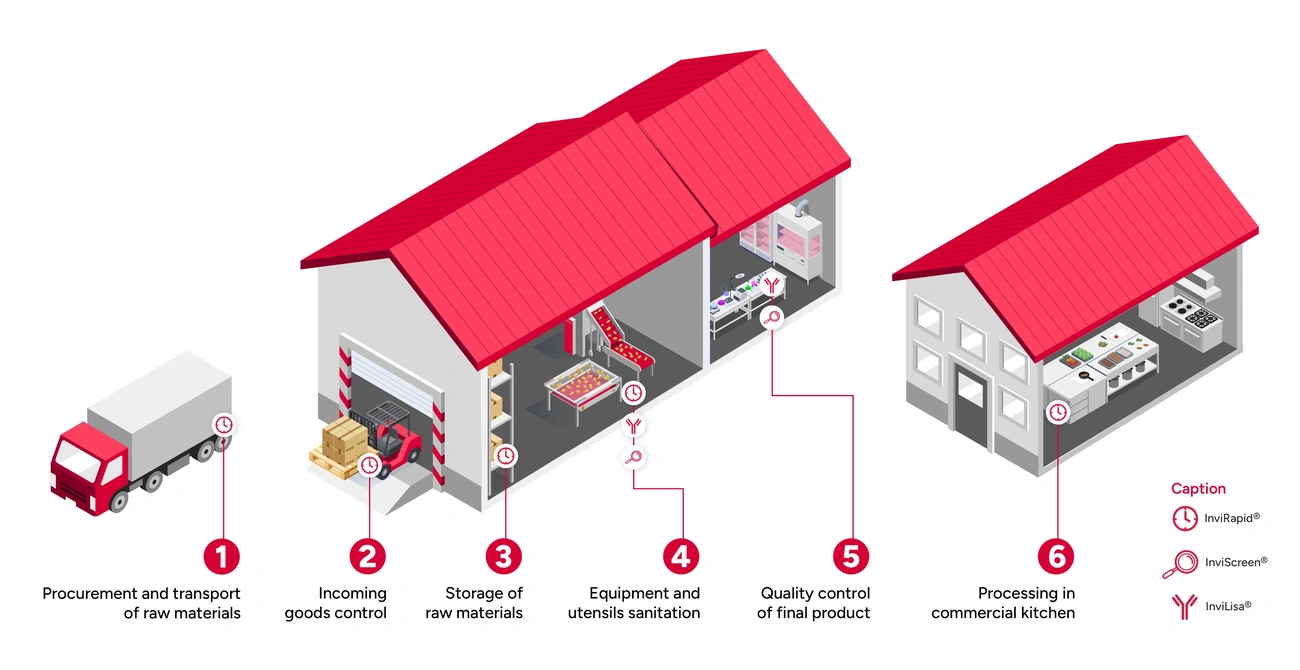
Image Source: Inviblog – Invitek Diagnostics
Two main methodologies dominate accredited allergen testing programmes. Each targets fundamentally different molecular markers. Understanding the technical differences between these approaches is critical when evaluating whether a UKAS accredited lab allergens service meets specific analytical requirements and regulatory expectations.
Protein-Based Detection (ELISA)
ELISA targets specific allergenic proteins through antigen-antibody interactions. This provides direct measurement of the molecules responsible for allergic reactions in sensitive consumers [5]. The quantitative results produced can be reported or converted into protein concentration. This makes ELISA the standard first choice for allergen testing [5]. Sandwich ELISA represents the most common format for allergen determination and utilises dual antibody recognition to achieve high specificity and quantitative measurement capabilities [12].
The clinical relevance of protein detection matters. Allergenic hazards comprise proteins (apart from sulphites and sulphur dioxide). Methods targeting allergen proteins or constituent peptides should be used, with results expressed in mg allergenic ingredient protein/kg food product [6]. This direct protein measurement lines up with FAO/WHO expert consultation recommendations and supports cleaning validation protocols that require quantitative results. ELISA faces limitations in extraction efficiency and matrix interferences, though. Performance varies between kit batches depending on antibody reactivity [13].
DNA-Based Detection (PCR)
PCR amplifies specific DNA sequences unique to allergenic food ingredients. It offers detection capabilities when protein-based methods struggle [5]. The technique demonstrates broader dynamic range and spans 0.1-106 mg/kg compared to ELISA’s 200-4000 mg/kg range. It does not exhibit the matrix interference characteristic of protein-based assays [14]. DNA stability proves especially helpful, as genetic material survives heat, pressure, and pH changes that denature proteins during food processing [12].
PCR results remain qualitative and cannot easily convert into protein measurements, despite these strengths [5]. The presence or absence of DNA does not prove protein presence or absence. This limits regulatory applicability. Then DNA-based methods serve as surrogate testing approaches where protein-based alternatives do not exist, as with celery allergen determination [6].
When Each Method Is Appropriate
Regulatory guidance establishes clear hierarchies for method selection in accredited testing. All testing for protein allergens should use methods targeting allergenic proteins or constituent peptides. PCR methods are considered only when no protein-based method exists [6]. Specific allergen considerations dictate approach. PCR proves unsuitable for egg detection, whilst milk determination requires ELISA in preference to PCR methods due to sensitivity limitations [6]. Testing beef products for cow’s milk allergen or chicken products for egg requires protein-specific methods to avoid false positives from animal DNA [6].
Limitations and Strengths of Each Approach
Processing effects distinguish the methodologies. Thermal treatment, hydrolysation, and fermentation alter native allergen proteins and potentially hamper ELISA detection despite peptide presence [15]. DNA maintains integrity through processing, though. This makes PCR helpful for highly processed foods. Yet this stability creates interpretive challenges, as DNA detection from non-functional allergens produces results unrelated to actual allergenic risk [12]. Cross-reactivity affects both approaches differently. ELISA kits may react with homologous proteins, whilst PCR specificity depends on primer design quality [12].
Integration with Your Allergen Control Programme
Accredited laboratory testing operates as one component within broader allergen management systems rather than functioning as an isolated compliance activity. Food business operators bear primary responsibility for food safety under retained Regulation (EC) No 852/2004, with procedures based on HACCP principles forming mandatory requirements [16]. Then, UKAS accredited lab allergens testing must integrate with validation, verification and documentation frameworks.
Supporting Cleaning Validation Studies
One of the best strategies for preventing allergen cross-contact is effective cleaning, especially when lines and equipment handle products with different allergen profiles [16]. Validation proves that cleaning regimes can remove allergen soils and repeatedly, ideally conducted before implementation to demonstrate cleaning objectives have been met [17]. Industry best practise requires repeating validation exercises three times and achieving non-detectable results for all post-clean and next off-line samples in consecutive rounds [18].
Quantitative ELISA methods remain preferred for cleaning validation because they deliver simple yet sufficiently sensitive results to confirm product safety [19]. Testing rinse water or environmental surface swabs using rapid, reliable onsite kits supports ongoing verification after initial confirmation [17]. Companies employ risk-based approaches and select products with the highest allergen loading to assess sanitation [19].
Investigating Cross-Contact Risks
Allergen cross-contact occurs at every stage of the food chain. Food business operators must employ management systems that reduce potential risks [20]. Risk assessments must identify likelihood of unintentional cross-contamination and assess control measure effectiveness in reducing or eliminating risks [21]. The physical nature of ingredients affects cross-contact patterns: milk powder may represent greater risk in situations where airborne contamination occurs, whilst liquid milk presents less concern with sufficient separation [21].
Providing Defensible Audit Evidence
Documentation explaining why validation was performed, which controls were assessed, and how activities were conducted forms essential audit evidence [22]. Regular internal audits verify that product formulation matches records of allergenic ingredient use, that cross-contact controls are implemented properly, and that line personnel maintain appropriate training [23]. Allergen verification programmes relying on accredited testing benefit from defensibility during third-party assessments.
Link to HACCP and Risk Assessment Requirements
HACCP principles require establishing validated critical limits, with Codex Alimentarius stating criteria often include measurements that can be observed [16]. Principle 6 requires validation of the HACCP plan and verification procedures to confirm the system works as intended [16]. Food manufacturers must think about allergens when undertaking HACCP assessments to identify whether allergens can be eliminated or inform risk management processes [21]. Control measures require validation even when allergen management does not constitute a critical control point [16].
Audit Expectations and Documentation Requirements
Third-party audits scrutinise laboratory selection decisions to prove food safety management system effectiveness. Auditors require documented proof that organisations selected laboratories based on technical competence rather than commercial convenience or cost considerations.
Show Due Diligence in Laboratory Selection
Due diligence defence requires systematic evaluation of laboratory capabilities before hiring [24]. Certification to the BRC Global Standard provides evidence of commitment and establishes legal defence within the ‘due diligence’ concept in cases of food safety incidents [25]. Therefore, procurement records must document the selection process. This has which laboratories were considered, how accreditation status was verified, and why the chosen facility met requirements.
Evidence of Scope Verification
Auditors expect tangible evidence that organisations verified scope coverage before they commissioned tests. This has copies of UKAS Schedules of Accreditation reviewed during selection. Relevant sections should be highlighted to show matrix-allergen-method verification. Laboratory and method must be UKAS-accredited, with documentation that meets those required for UKAS accreditation [3]. Records should confirm the laboratory holds accreditation not just generically, but for the specific test method used [5].
Documented Rationale for Laboratory Choice
Selection rationale must address technical factors beyond accreditation status. Documentation should reference laboratory participation in FAPAS proficiency testing, spike recovery performance on relevant matrices, and capability to handle required testing volumes [3]. Organisations should record how the laboratory’s detection limits, turnaround times, and technical support capabilities match allergen management programme requirements. An old adage applies: ‘If it’s not documented, it didn’t happen’ [26].
Meet BRC and Other Standard Requirements
BRC Global Standard Issue 8 requires documented supplier approval procedures based on risk assessment. Competent personnel must review laboratory capabilities [27]. Allergen verification programmes must show that selected laboratories contribute to quality systems and certifications, which supports HACCP validation requirements [24].
Common Mistakes and Best Practises

Image Source: One Scientific
Procurement errors in laboratory selection undermine allergen management systems despite good intentions. Several recurring mistakes appear across food manufacturing sectors, among other practises that strengthen audit defensibility.
Assuming All UKAS Labs Cover All Allergens
UKAS accredits laboratories for food testing services to ISO/IEC 17025 [2], yet accreditation scope varies. One facility provides accredited analysis for six key allergens whilst others remain outside scope [4]. You cannot assume complete coverage exists.
Failing to Check Scope of Accreditation
Accreditation applies only within approved scope. Certificates issued outside that scope lack UKAS status [9]. You need to verify by reviewing Schedules of Accreditation rather than accepting laboratory claims. The difference proves critical for regulatory compliance.
Selecting Laboratories Based on Cost Alone
Choosing accredited testing saves time and money by avoiding inaccurate results that need rectification [10]. Cost-driven selection risks engaging facilities that lack matrix-specific validation or appropriate detection capabilities for cleaning validation programmes.
Misunderstanding Test Methods and Their Limitations
Cross-reactivity affects both ELISA and PCR methodologies differently, so laboratories must report known interferences [5]. Companies recognise uncertainty in ELISA-generated data whilst distrusting qualitative lateral flow devices [3].
Best Practise: Always Verify Scope Before Testing
Request Schedules from UKAS rather than laboratories [28]. Confirm test standard edition and specific parameters listed. Check current accreditation at testing facility location before commissioning work.
Best Practise: Line Up Laboratory Capability with Your Risk Assessment
Risk-based approaches select products with highest allergen loading for validation studies [26]. Laboratory selection should mirror this risk assessment and ensure capabilities match identified control requirements.
Conclusion
UKAS accreditation alone does not guarantee complete allergen testing capability. Scope verification remains the critical step that quality and procurement professionals must prioritise. Allergen control strategies just need laboratories holding accreditation for specific matrix-allergen-method combinations relevant to manufacturing operations. Without doubt, organisations that verify scope coverage and integrate accredited allergen testing with cleaning validation programmes strengthen audit defensibility while reducing compliance risks. Review UKAS schedules really well before commissioning work. This diligence changes laboratory selection from administrative purchasing into strategic risk management and ensures verification protocols deliver defensible evidence supporting food safety objectives.
Key Takeaways
Selecting a UKAS accredited laboratory for allergen testing requires careful verification of scope coverage rather than simply confirming accreditation status. Here are the essential insights for quality and procurement professionals:
• Verify specific scope coverage before testing – UKAS accreditation applies only to approved matrix-allergen-method combinations listed in the laboratory’s Schedule of Accreditation
• Check UKAS schedules directly online – Use ukas.com/find-an-organisation to independently confirm current accreditation status and detailed scope coverage for your specific requirements
• Match laboratory capabilities to your risk assessment – Ensure the laboratory holds accreditation for your exact food matrices, target allergens, and required detection methods
• Prioritise protein-based ELISA methods – Regulatory guidance recommends ELISA for allergen detection over PCR, as it directly measures allergenic proteins rather than DNA
• Document your selection rationale thoroughly – Maintain evidence of scope verification, technical evaluation, and selection criteria to demonstrate due diligence during audits
• Integrate testing with cleaning validation programmes – Select laboratories capable of supporting quantitative ELISA testing for environmental monitoring and cross-contamination investigations
Effective laboratory selection transforms from administrative purchasing into strategic risk management, ensuring your allergen control programme delivers defensible evidence that strengthens audit outcomes and regulatory compliance.
FAQs
Q1. What does UKAS accreditation mean for allergen testing laboratories? UKAS accreditation to ISO/IEC 17025 confirms that a laboratory has demonstrated technical competence, appropriate facilities and equipment, and validated testing methods for specific allergen determinations. It provides independent verification that the laboratory can produce accurate and reliable test results, which is essential for regulatory compliance and audit defensibility in food safety programmes.
Q2. How can I verify if a laboratory’s UKAS accreditation covers my specific allergen testing needs? You can verify accreditation coverage by reviewing the laboratory’s Schedule of Accreditation directly on the UKAS website at ukas.com/find-an-organisation. Check that the schedule specifically lists your required combination of food matrix (product type), target allergen, and analytical method. Accreditation applies only to the exact combinations documented in the schedule, not to all testing the laboratory may offer.
Q3. What’s the difference between UKAS accreditation and general laboratory certification? UKAS accreditation involves rigorous assessment of both technical competence and quality management systems, including evaluation of staff qualifications, testing methods, and equipment. In contrast, general certifications like ISO 9001 focus only on quality management processes without assessing technical testing capability. For allergen testing, UKAS accreditation provides the independent verification of competence that regulatory compliance requires.
Q4. Should I choose ELISA or PCR methods for allergen testing? ELISA is generally preferred for allergen testing because it directly detects allergenic proteins, providing quantitative results that align with regulatory requirements. PCR detects DNA rather than proteins and typically provides qualitative results, making it suitable primarily when protein-based methods don’t exist for specific allergens. Your choice should depend on your food matrix, processing conditions, and whether you need quantitative or qualitative results.
Q5. What documentation do I need to demonstrate proper laboratory selection during audits? You should maintain copies of the laboratory’s UKAS Schedule of Accreditation with relevant sections highlighted, documented rationale explaining why the laboratory was selected based on technical criteria, evidence of scope verification for your specific matrix-allergen-method combinations, and records showing the laboratory’s proficiency testing performance. This documentation demonstrates due diligence in laboratory selection and strengthens audit defensibility.
References
[1] – https://www.eurofinsus.com/food-testing/resources/all-you-need-to-know-about-iso-170252017-accredited-laboratories/
[2] – https://www.ukas.com/accreditation/standards/laboratory-accreditation/food/
[3] – https://www.food.gov.uk/research/review-of-allergen-analytical-testing-methodologies-stakeholder-engagement
[4] – https://www.als-testing.co.uk/news/als-ukas-accredited-allergen-testing
[5] – https://www.rssl.com/insights/food-consumer-goods/food-allergen-detection-choosing-the-right-testing-method/
[6] – https://www.food.gov.uk/research/review-of-allergen-analytical-testing-methodologies-allergen-testing-workflows-to-support-incident-management
[7] – https://www.merieuxnutrisciences.com/food/laboratory-testing/allergen-management/
[8] – https://www.linkedin.com/pulse/role-laboratory-accreditation-reliable-product-testing-tulsi-singh-dry4c
[9] – https://youriso.co.uk/ukas-vs-non-ukas-accreditation/
[10] – https://www.ukas.com/resources/resources/accredited-vs-non-labs/
[11] – https://www.rssl.com/food-consumer-goods/food-allergen-analysis/
[12] – https://certified-laboratories.com/blog/pcr-elisa-allergen-testing-how-manufacturers-detect-hidden-risks/
[13] – https://www.food.gov.uk/research/review-of-allergen-analytical-testing-methodologies-allergen-detection-methods-unbiased-literature-search
[14] – https://pubmed.ncbi.nlm.nih.gov/33617420/
[15] – https://www.hygiena.com/documents/68256/pcr-vs-elisa-in-process-test-selection-for-the-food-industry.pdf
[16] – https://www.food.gov.uk/research/review-of-the-literature-and-guidance-on-food-allergen-cleaning-report-summary-and-discussion
[17] – https://www.hygiena.com/news/allergen-cleaning-validation-and-verification
[18] – https://www.rssl.com/insights/food-consumer-goods/designing-a-successful-allergen-cleaning-validation-strategy/
[19] – https://www.food-safety.com/articles/3812-allergen-validation-analytical-methods-and-scientific-support-for-a-visually-clean-standard
[20] – https://www.campdenbri.co.uk/blogs/allergen-cross-contact-food-chain.php
[21] – https://www.food.gov.uk/business-guidance/precautionary-allergen-labelling
[22] – https://www.pointsnorthcertified.com/allergen-control-and-management-validation
[23] – https://www.fao.org/fao-who-codexalimentarius/sh-proxy/en/?lnk=1&url=https%253A%252F%252Fworkspace.fao.org%252Fsites%252Fcodex%252FStandards%252FCXC%2B80-2020%252FCXC_080e.pdf
[24] – https://www.campdenbri.co.uk/blogs/allergen-testing-partner.php
[25] – https://www.dnv.co.uk/services/brcgs-global-standard-for-food-safety-5148/
[26] – https://www.romerlabs.com/en/library/knowledge/detail/beyond-due-diligence-10-musts-of-allergen-management
[27] – https://www.brcgs.com/media/1055378/food-safety-issue-8-checklist-english.docx
[28] – https://www.element.com/resources/articles/iso-17025-accreditation-scope-medical-device-testing