
 Supplier allergen information failures are among the top reasons for food recalls. These recalls are increasing in the UK and around the world. Fatal anaphylactic reactions in England and Wales occur in food service situations up to 20% of the time. Many trace back to inadequate allergen management at the supply chain level. The UK recognises 14 major allergens that must be declared when used as ingredients. Accurate supplier data is critical for legal compliance and consumer safety. This piece covers food allergen legislation requirements, verification processes and best practise systems for managing allergen info throughout your supply chain.
What is supplier allergen information and why does it matter?
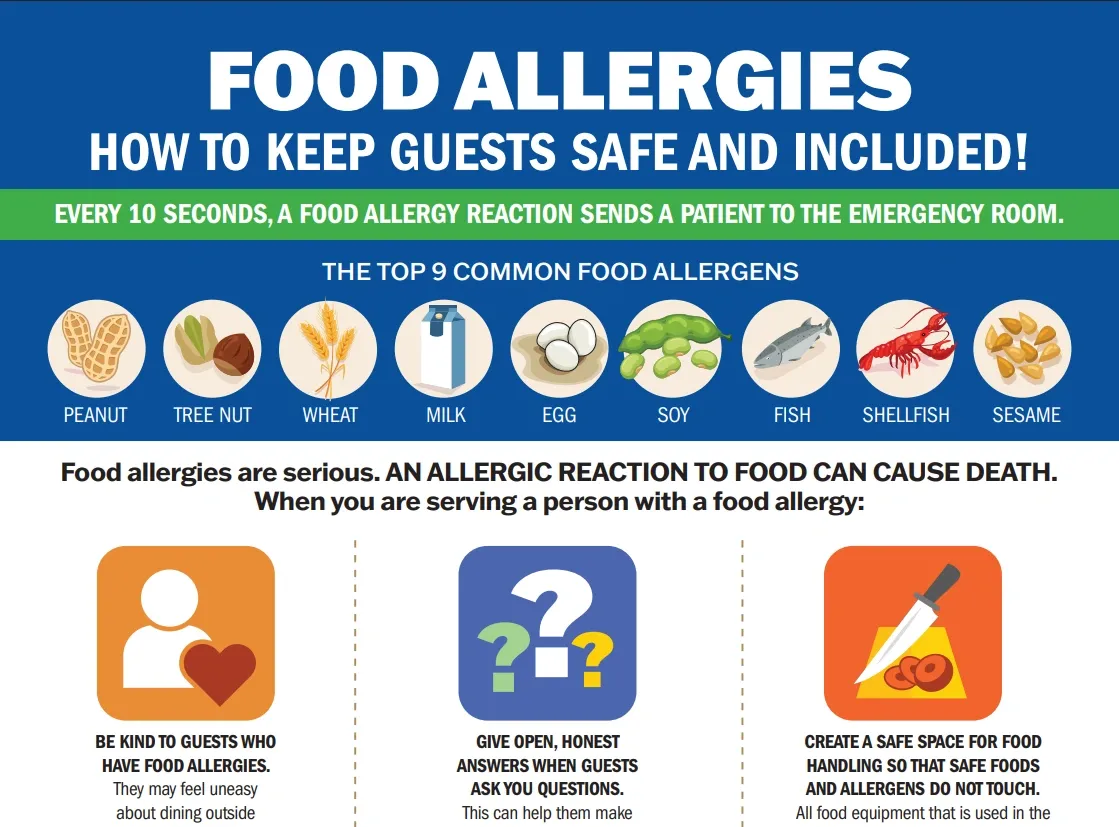
Image Source: The Rotten Apple – Substack
Definition of supplier allergen information
Supplier allergen information covers all documentation and data that ingredient suppliers, raw material providers, and other vendors provide. This data details the allergen status of products entering a food business. Ingredient formulations, specification sheets, allergen declarations, cross-contamination risk assessments, and certificates of analysis are all part of this. The information must cover both intentionally present allergenic ingredients and potential cross-contact allergens. These may arise from shared equipment, processing facilities, or agricultural handling.
Complete allergen status documentation captures every allergen risk associated with a supplied ingredient or material. Generic terms such as ‘flavouring’ or ‘spices’ fail to meet requirements when these substances originate from allergenic sources [1]. Suppliers must provide sublisting details that reveal hidden allergens. To cite an instance, whipped marshmallow contains eggs, whilst soy sauce contains wheat [2]. Processing aids, carriers, and any residual allergen traces from manufacturing processes are part of the full picture.
The role of suppliers in your allergen management system
Suppliers function as the first line of defence in allergen management programmes. Food business operators can only perform effective risk assessments when they possess correct information about the complete allergen status of raw materials and ingredients used [1]. This requires knowledge of each supplier’s understanding and application of allergen management practises.
Over 60% of supplier specification sheets contain errors according to industry data, making verification processes non-negotiable [3]. Suppliers must provide accurate and up-to-date allergen information that food businesses can verify and document [4]. The relationship extends beyond simple data exchange. Suppliers should demonstrate familiarity with food allergen specifications and maintain strong change notification processes. These alert customers when newly identified allergen risks emerge for ingredients already being supplied [1].
A food operator at any point in the supply chain depends on upstream accuracy. Businesses implement controls within their own facilities, but the foundation rests on supplier-provided data. Assessment of each supplier and their allergen management practises must be documented through questionnaires and, where appropriate, audits [1].
Why supplier data is a critical control point
Supplier allergen information represents a critical control point because errors at this stage cascade through the entire UK food allergen regulations compliance framework. Food businesses must identify steps in operations that pose likelihood of allergen cross-contact and assess risk levels. They must find out which steps are critical [1]. But these assessments become meaningless when built on faulty supplier data.
Documented allergen management policies and procedures allow businesses to demonstrate they are taking steps to eliminate or reduce unintentional allergen presence [1]. These policies increase accuracy of allergenic ingredient declarations. They reduce risk to consumers with food allergies. Yet the entire structure collapses when suppliers provide incomplete or incorrect information.
The critical control point status also stems from legal shared responsibility. Businesses must make sure suppliers comply with food allergen specifications and establish procedures for how information received from suppliers is handled, processed, and acted upon [1][1]. Failures in supplier allergen management expose businesses to regulatory action, product recalls, and potential liability for consumer harm.
Proactive verification rather than reactive responses after hazards are detected prevents errors arising in the supply chain [1]. Regular review of supplier specifications makes sure allergen information is communicated and documented clearly [4]. The brand reputation of food businesses rests on supplier processes. Accurate information on all factors affecting products is important yet complex to get [2].
Legal requirements for supplier allergen information in the UK
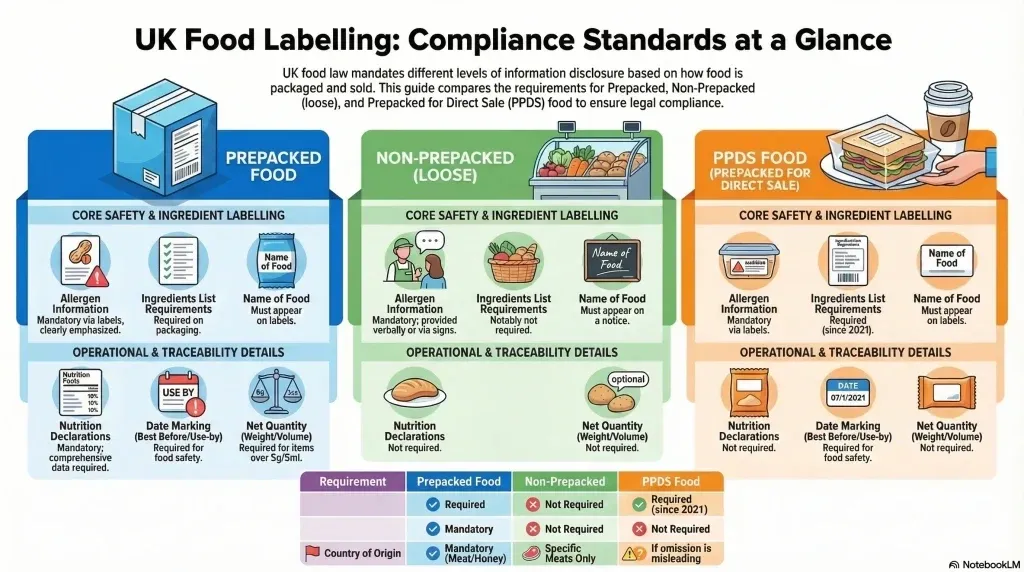
Image Source: PID Labelling
Food Safety Act 1990 and due diligence obligations
The Food Safety Act 1990 establishes the foundational legal framework under which UK food businesses operate. Section 21 of the Act provides a due diligence defence for businesses facing prosecution, but this defence hinges on demonstrating reasonable precautions and exercised diligence to avoid offences [5]. This places supplier allergen information at the heart of legal compliance.
A business satisfies due diligence requirements when it proves that the commission of an offence was due to an act or default of another person not under its control, or to reliance on information supplied by such a person [5]. But this defence applies only if the business carried out all reasonable checks of the food in question, or if it was reasonable to rely on checks carried out by the person who supplied the food [5]. Then food businesses cannot accept supplier declarations at face value. They must verify the accuracy of supplier declarations through documented processes.
The Act further stipulates that businesses must have had no reason to suspect that an act or omission would result in an offence under the relevant provision [5]. This creates a direct obligation to scrutinise supplier allergen management practises and maintain strong verification systems. Businesses cannot establish a valid due diligence defence without complete records demonstrating reasonable checks of supplier-provided allergen info [2].
Food Information Regulations 2014 (FIR)
The Food Information Regulations 2014 and Absorbed Regulation (EU) No 1169/2011 control how food businesses must provide information about food they produce, sell and serve [2]. These regulations mandate that all 14 major allergens must be highlighted on pre-packed foods sold to consumers, and allergen information must be available for non-prepackaged foods [4].
Allergenic ingredients must be emphasised in some way every time they appear in the ingredients list for prepacked food, such as through bold text, capital letters or coloured text [6]. The regulations require that allergen information be provided on packaging or on an attached label [2]. Since 1 October 2021, prepacked for direct sale (PPDS) food must be labelled with the name of the food, a full list of ingredients, and allergen information emphasised in the ingredients list [2].
Food business operators bear responsibility for complying with labelling requirements. Failure to supply accurate allergen labelling information for prepacked food carries criminal penalties [4]. The FIR places emphasis on verification of allergen contamination risks and requires businesses to assess cross-contamination possibilities throughout manufacturing, handling, transport and storage of foods [6]. Authorised food officers at Local Authorities hold responsibility for official controls relating to allergen rules [4].
Shared legal responsibility between suppliers and food businesses
Both suppliers and food businesses share legal responsibility for accurate allergen declarations. Food businesses must ensure suppliers comply with food allergen specifications and establish procedures for how information received from suppliers is handled, processed, and acted upon. This shared responsibility means that relying on supplier-provided data without verification exposes businesses to regulatory action.
All food businesses have a legal responsibility to provide accurate allergen information to all customers that request it and ended up providing food that is safe for people with allergies [7]. This obligation extends to implementing allergen risk assessment UK frameworks that review each supplier’s allergen management capabilities. Suppliers function as the first point in the supply chain. Their failures cascade to food businesses, yet legal liability rests with the business serving the consumer.
Consequences of non-compliance
Non-compliance with UK food allergen regulations results in severe legal and financial consequences. Failure to comply with requirements set out in Regulation 10(1) and (2) of the FIR on labelling of allergenic ingredients constitutes a criminal offence [4]. A person convicted of an offence under the FIR faces a potentially unlimited fine, with the level determined by Magistrates on a case-by-case basis [4].
Documented fines range from £50 for a street trader who failed to make allergen information available to £93,000 for large food businesses [8]. Recent prosecutions demonstrate escalating enforcement. Mansha Sweets Limited paid £7,229.72 in fines, victim surcharge and costs for supplying food injurious to health [7]. Another business owner faced £1,212 in penalties for similar offences [7].
Local authorities enforce allergen information regulations through a progressive system. Businesses failing to comply first receive advice from local authorities, followed by improvement notices requiring corrective action within set timeframes [9]. Businesses receive penalties and face prosecution if they fail to meet notice requirements [9]. Courts have pursued manslaughter charges in extreme cases where fatal reactions occur [7]. The reputational damage alone can lead to reduced customer trust and lost revenue as consumers choose safer, more transparent brands [4].
Types of supplier allergen information you must obtain
Getting complete documentation from suppliers is the foundation of effective allergen management. Each raw material, ingredient and processing aid that enters a facility needs specific allergen info that makes accurate risk assessment and compliant labelling possible. The following categories represent mandatory information that food businesses need to get from every supplier in their chain.
Raw material specifications and datasheets
Raw material specifications are the foundation to understand allergen status. Businesses need to keep specifications on site for all materials. This includes food contact packaging and processing aids, with regular review cycles. These specifications must detail all relevant food safety information associated with ingredients and packaging. This covers shelf-life, storage conditions, allergens and complete ingredient breakdowns.
The Australia Food and Grocery Council’s Product Information Form (PIF) is a great specification format to capture allergen information. Raw material specs make correct product labelling possible for ingredients, allergens and provenance claims. Never use finished product labels as specifications. Ingredient lists and allergen declarations on raw material packaging may have been adjusted to comply with labelling regulatory requirements and fail to provide sufficient information to review risk.
A raw material specification library in a central location will keep information complete and current. Specifications should include confirmation that food contact packaging is suitable to use with foods. Multi-component materials and printed food packaging need annual review. Single ingredients or plain packaging need review every 2-3 years. Verify that specifications relate to materials you purchase currently and that these materials are declared correctly on product labels during reviews.
Allergen declarations and presence statements
Supplier allergen declarations must identify which of the 14 regulated allergens appear as intentional ingredients within supplied materials. Declarations need to break down ingredient formulations into individual components. This reveals products of allergens such as butter from milk, ingredients derived from allergenic sources like yeast grown on barley and components described unclearly such as vegetable oil. Food additives and processing aids need to be included in this review.
Businesses should request formal allergen statements from suppliers on a regular basis. This should happen annually or more often if issues arise. The allergen section must capture whether allergens are present in the supplied material and what allergens are handled in the supplier’s facility. Hidden allergens need special attention, as alternative ingredient names can obscure allergen presence.
Cross-contamination risk information
Cross-contamination happens when traces of allergens get into products during manufacturing, handling, transport or storage. Suppliers must provide detailed information about allergen cross-contact risks throughout their supply chain. This includes agricultural co-mingling from crop rotation, storage facilities, transportation methods and processing operations.
Allergen cross-contact may occur at any stage, so transparency is critical. Complex ingredients processed or handled at multiple facilities present layered risks. Each facility can introduce different allergen hazards. Suppliers need a thorough understanding of cross-contact likelihood throughout their supply chain and must communicate these risks clearly in specifications or supporting documentation.
Processing facility and equipment details
Documentation of processing facility and equipment specifications shows shared equipment risks and facility-wide allergen presence. Suppliers should detail whether allergenic products run on the same production lines, packaging equipment or manufacturing areas as supplied ingredients. When suppliers state an allergen is ‘present on the same line’, businesses must confirm what this means. Does it refer solely to packaging lines or entire manufacturing processes?
Information about cleaning procedures, scheduling of allergenic versus non-allergenic products and evidence supporting control effectiveness helps assess real contamination risk versus defensive labelling.
‘May contain’ and precautionary statements
Research on allergen contamination in prepacked foods found wide variety in precautionary statements across product categories. The most used advisory label was ‘may contain traces’ at 38 percent [5]. The second most common was ‘may contain’ at 20.6 percent [5]. The wording of advisory labels did not reflect actual cross-contamination levels.
Food businesses report difficulty trusting accuracy of ‘may contain’ information from suppliers. There are suspicions that warnings represent defensive labelling based on potential claims rather than quantified risks. Determining what allergen contamination information should pass to final consumers becomes problematic when purchasing from distribution companies rather than direct manufacturers.
Suppliers should explain and provide supporting evidence for ‘may contain’ statements rather than applying blanket warnings. Precautionary information from ingredient suppliers should pass to final consumers unless the food business risk assessment supersedes that information.
Handling and storage requirements
Suppliers must specify handling and storage requirements that prevent allergen cross-contamination during transport and warehousing. This includes requirements for clean vehicles, segregation protocols during loading and unloading and any special conditions needed to maintain allergen integrity. These requirements enable businesses to assess whether incoming materials arrive without contamination from distribution chains when coupled with facility information.
Supplier approval and verification processes
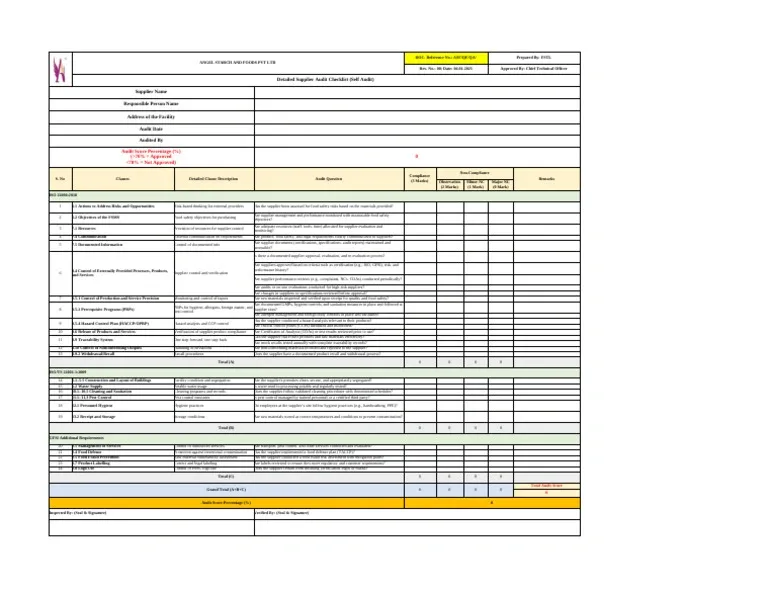
Image Source: Scribd
Resilient approval and verification processes transform supplier allergen management from a passive document collection exercise into an active risk control system. Food businesses certified under SQF, BRCGS, or FSSC 22000, or subject to FSMA regulations, must implement documented supplier approval programmes as a mandatory food safety plan component [2].
Initial supplier approval and qualification
A supplier approval programme includes written procedures, risk classification criteria, qualification requirements, an approved supplier list, and ongoing monitoring activities [2]. The programme governs how facilities identify, evaluate, approve, and monitor every supplier that provides raw materials, ingredients, packaging, or services used in production processes [2].
Approval begins with a documented decision before suppliers appear on approved supplier lists. Approval statuses should include Approved, Provisionally Approved (with conditions), and Rejected [2]. Provisional approval applies in limited circumstances, such as when a new supplier’s audit is scheduled but not yet completed, or when short-term supply necessities arise where no approved alternative exists [2]. Any provisional approval must be time-limited and specify conditions such as enhanced incoming inspection or certificate of analysis review per lot. It must also have a clear path to full approval or rejection by a set date [2].
Risk-based supplier tiering determines qualification intensity. Ingredients that contain or are manufactured alongside common allergens require heightened scrutiny [10]. Suppliers with very low risk may only need to submit necessary documentation, whilst high-risk suppliers undergo audits [10]. Consistency in approach matters, with clear criteria for various qualification activities [10].
Requesting and reviewing allergen documentation
Document collection represents where most manual supplier programmes break down [2]. Businesses need the right documents from every supplier before their first shipment. They also need systematic tracking of which documents have been received, reviewed, and approved along with expiration dates [2].
The standard document checklist for supplier qualification includes a supplier questionnaire, third-party audit report or certificate, product specifications, and certificates of analysis. It also includes an allergen declaration, insurance certificate where required, and FSMA FSVP records for imported materials [2]. Request a full product specification that includes a complete ingredient list with allergens highlighted for every ingredient purchased. The specification should have a ‘may contain’ or cross-contact statement that details allergens handled in the manufacturing facility. It should also show the allergen status of the production line (dedicated or shared), country of origin where relevant, and confirmation of whether the specification relates to a specific batch or is a general product specification [6].
Questionnaires should assess potential allergen cross-contact risks at supplier sites, especially if there is a precautionary allergen labelling statement [4]. The questionnaire format allows assessment of the supplier’s quality and safety systems [10]. To cite an instance, questions should reveal whether sugar comes from a facility that also packs milk powder and risks cross-contact [11].
Verifying accuracy of supplier declarations
Verification extends beyond accepting specifications at face value. The Food Information Regulations place legal responsibility for allergen accuracy on the food business operator selling to the consumer, not on the supplier [6]. Therefore, businesses must verify, not just accept, the allergen information suppliers provide [6].
Verification activities include comparing specifications against product labels for consistency and checking that compound ingredients are fully broken down. They also include confirming that ‘may contain’ statements cover the same allergens as the manufacturing environment would suggest and contacting suppliers if anything appears unclear or incomplete [6]. Think about requesting certificates of analysis or allergen testing results for high-risk ingredients [6].
Train staff to check product labels at goods-in on every delivery and compare against current specifications on file [6]. Quarantine the product until the discrepancy is resolved if the label differs from the spec [6].
Audit and site visit considerations
Annual audits usually represent the appropriate supplier approval and verification activity when allergen hazards present a risk of serious adverse health consequences or death to humans [12]. Audits should evaluate specific aspects of supplier programmes when allergens are being controlled, including ingredient storage, production scheduling, and post-cleaning allergen verification [12].
Assessment of each supplier and their allergen management practises must be documented through questionnaires and, where appropriate, audits [9]. This achieves verification of the supplier’s understanding and application of allergen management in their operations [9].
Re-approval triggers and frequency
Re-qualification becomes necessary when specific triggers occur: a failed certificate of analysis or incoming test, supplier involvement in a recall or market withdrawal, or a lapse in certification. It also becomes necessary when a major change occurs in the supplier’s processes or ownership, or when a customer complaint is traced back to that supplier [2]. Routine monitoring activities depend on risk tier, with high-risk suppliers requiring certificate of analysis review per lot and certificate expiration tracking [2].
Implement a supplier management system that includes agreements for suppliers to notify of any changes in ingredient or allergen profiles, with periodic reconfirmation [4]. Schedule periodic specification reviews with core suppliers (at least once a year) to confirm that no unreported changes have occurred [6].
Risk-based supplier assessment and categorisation
Risk-based approaches reshape supplier allergen information management from a one-size-fits-all system into a targeted control strategy that allocates resources where they deliver the greatest food safety effect. Systematic categorisation enables businesses to prioritise verification activities, audit schedules and monitoring frequency based on actual allergen hazard potential rather than treating all suppliers the same way.
Categorising suppliers by allergen risk level
Supplier categorisation starts with a documented risk analysis of all raw materials, ingredients and processing aids used within the site [13]. Each business must identify the intentional and cross-contact allergens that could occur, plus the potential risk of occurrence [13]. This analysis provides the foundations for tiering suppliers into risk categories that determine appropriate verification activities.
Industry collaboration through forums like IGD’s Technical Leaders Forum has championed uniform, best-practise risk assessments across the sector [7]. Implementing consistent allergen risk assessment UK approaches promotes a more secure environment for those living with allergies [7]. The project group created a standardised template for allergen risk assessment with detailed supporting guidance to boost consistency [7].
High-risk suppliers and ingredients
High-risk suppliers are those providing ingredients containing or manufactured alongside common allergens, especially when compound ingredients are involved or when suppliers use shared equipment [4]. To cite an instance, a confectionery manufacturer may produce numerous product lines, but only one has peanuts [13]. The risk assessment must cover the potential for peanut allergens to contaminate non-peanut products [13].
Inadequate supplier approval represents a major problem causing food allergen recalls [4]. So establishing a supplier approval process that has supplier allergen management risk assessment becomes critical [4]. Questionnaires should assess potential allergen cross-contact risks at supplier sites, especially when precautionary allergen labelling statements appear [4].
Integration with your HACCP plan
The HACCP-based Food Safety Plan must cover all identified intentional and cross-contact allergens, with their controls identified [13]. Supplier review represents a key element helping identify and manage potential allergen contamination points [14]. You must document, review and verify raw material allergen specifications, with supplier formulation changes triggering a HACCP reassessment [15].
Allergen risk assessments for each supplier
You must conduct a documented risk analysis of all ingredients, raw materials and processing aids used within the site [13]. This means ensuring suppliers declare any allergenic substances in materials they supply and the potential for cross-contact allergens [13]. The assessment must extend beyond ingredients to workplace areas such as canteens, locker rooms and vending machines to determine cross-contact risk [13].
Managing allergen changes from suppliers
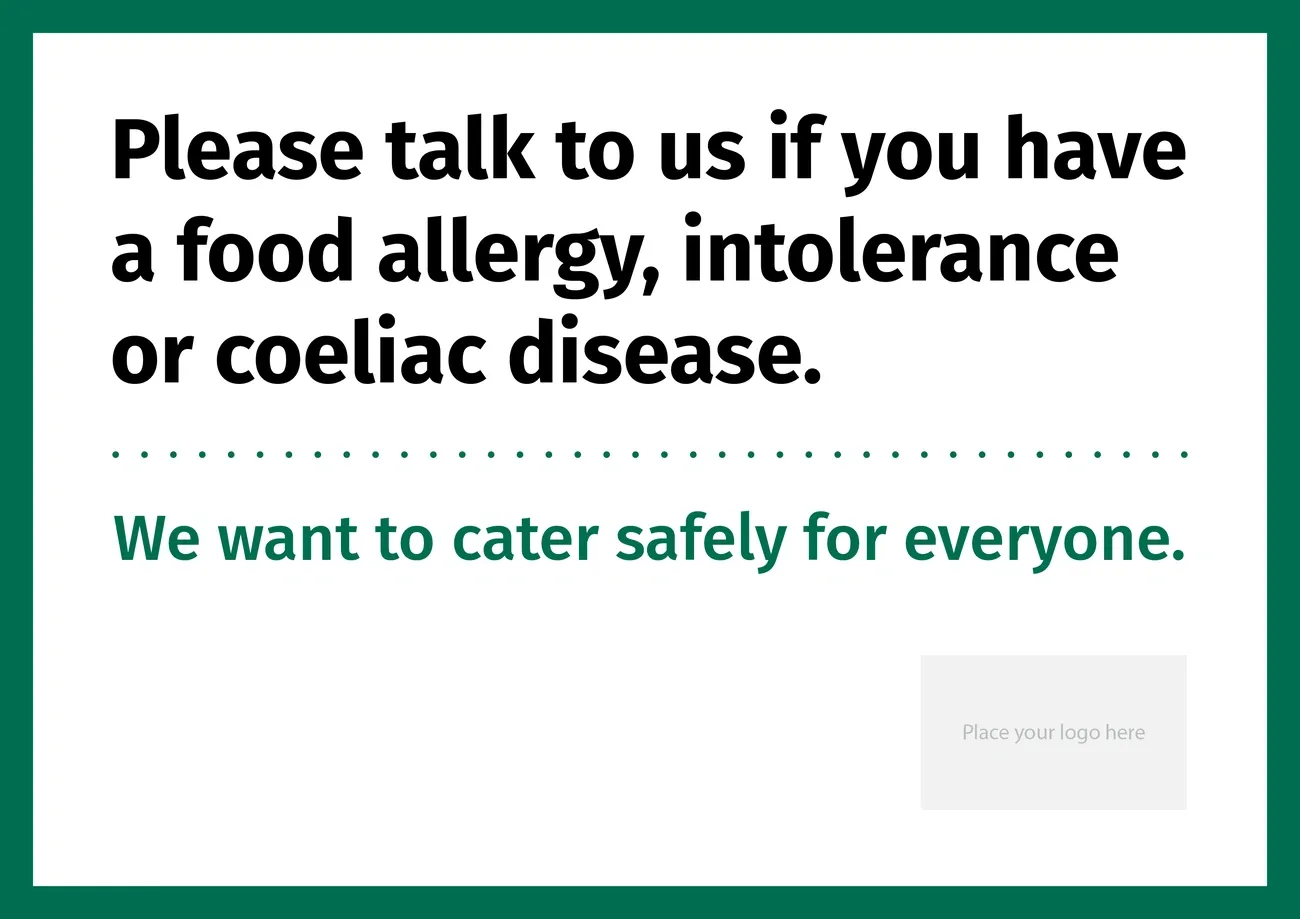
Image Source: Food Standards Agency
Changes to supplier allergen information present ongoing challenges that just need systematic management protocols. The Food and Drink Federation guidance, supported by the Food Standards Agency, outlines actions food businesses should think about when managing changes that affect allergen labelling [16].
Change notification procedures
Businesses must set up agreements requiring suppliers to notify of any changes to ingredient or allergen profiles right away [4]. Food Standards Agency guidance recommends asking suppliers to notify changes in allergen status of supplied ingredients or materials [8]. A change notification process will give newly identified allergen risks for ingredients already being supplied proper communication and action [9].
How to handle supplier reformulations
When suppliers reformulate products, businesses must conduct allergen risk assessments and set up required changes [17]. Addition of allergenic ingredients requires label change reviews with allergen declarations emphasised in ingredients lists [17]. Removal of allergens demands risk assessment and label modifications as well [17]. For hidden allergen sources introduced through reformulations, businesses should verify complete ingredient breakdowns.
Re-approval processes after changes
Any change triggering a re-assessment of allergen profiles requires re-approval before accepting modified materials [9]. A supplier management system with periodic reconfirmation prevents unreported changes [4].
Communication protocols with your team
Production and packaging employees must know about allergen changes through internal communication [18]. Weekly allergen checks, briefings during team meetings and visible allergen lists in kitchens maintain awareness [19]. Staff provide incorrect information to consumers if systematic team updates are missing.
Updating your allergen matrix and labels
Businesses must update product data on brand websites, nutritional databases and customer service training based on new allergens [17]. Front of pack alerts such as ‘New recipe’ or ‘Allergen Update’ inform consumers right away [17]. Supplier communications about product changes should be documented within 24 hours to create an audit trail that protects businesses legally [19]. Changes must flow through to allergen cross-contamination assessments and HACCP plans so they stay current.
Hidden allergen risks in supplier-provided materials
Complete specifications don’t eliminate hidden allergen sources that persist within supplier-provided materials through mechanisms standard documentation often fails to capture. These risks just need scrutiny beyond surface-level allergen declarations.
Complex ingredients and compound materials
Multi-component ingredients processed at multiple facilities present layered contamination risks [20]. Antioxidants derived from egg or soy, spice blends with allergenic carriers, and flavourings that contain undisclosed allergen substrates require breakdown to constituent parts [21]. Each processing stage introduces potential cross-contact that compound specifications may obscure.
Shared equipment and facility risks at supplier sites
Facilities that request allergen statements from suppliers must determine what allergens are handled in manufacturing environments, not just in supplied ingredients [22]. Shared production lines create cross-contact possibilities. Airborne particles from powdered allergens like flour or milk powder travel through facilities and settle on surfaces [23]. Microscopic allergen amounts trigger reactions in sensitive individuals [24].
Undeclared processing aids and carriers
Processing aids such as lactoperoxidase from milk, anti-caking agents derived from wheat flour, and carriers with soy escape declaration [21]. Businesses must verify whether ingredients contain bases, binders, or fillers that originate from allergenic sources. Tocopherols from soy and maltodextrin from wheat represent common undeclared risks [21].
Cross-contamination during transport
Storage and distribution introduce allergen contamination through spillages during loading, unclean transport vehicles, and inadequate segregation [22]. Clean tankers and careful material handling prevent cross-contact during transit [25].
Documentation, record-keeping and system options
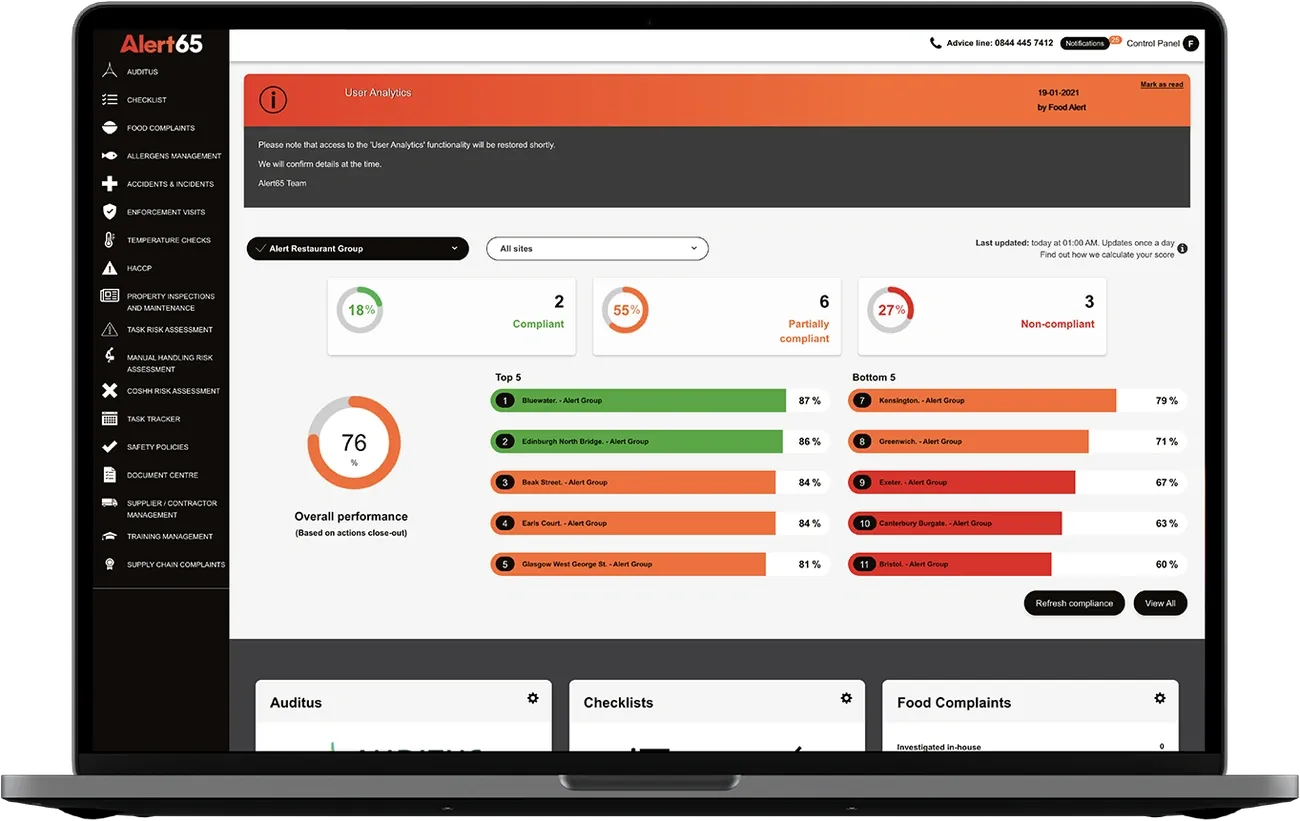
Image Source: Food Alert
What records you must maintain
Accurate record-keeping proves due diligence in allergen management programmes [26]. Businesses must maintain digital logs covering ingredient sourcing, supplier allergen statements, cleaning protocols, cross-contamination controls, staff training records, allergen checks, and corrective actions [26]. Product specification sheets should record allergen ingredient information. Containers must be kept labelled with ingredients labels included. Recipes need documentation and you should think about recipe changes [27]. An allergen matrix listing every menu item alongside the 14 major allergens represents a legal requirement. Environmental Health Officers request this first during inspections [26].
Digital supplier management systems
Modern allergen cross-contamination prevention requires knowing exactly what exists in every ingredient, from every supplier, in every batch [28]. ERP systems maintain detailed records. These include full ingredient breakdowns with allergen declarations, processing facility information, shared equipment risks, supplier certifications, and audit trails. The systems send automatic alerts when supplier specifications change [28]. Digital platforms store everything securely in the cloud. Everything is time-stamped and inspection-ready [26]. These systems generate accurate allergen warnings based on current recipes and update labels the moment formulations change. They ensure compliance with Natasha’s Law requirements and maintain audit trails for regulatory inspections [28].
Manual documentation approaches
A simple record-keeping system can work when integrated into existing operations. You can use delivery invoices and checklists to record allergen status [9]. Manual approaches require consistency in documentation. Records should be retained alongside risk assessments to demonstrate due diligence [9]. Businesses using manual systems should provide supplier allergen checklists when making orders. Suppliers complete product and allergen details on separate sheets for each product [29]. Each sheet contains the 14 notifiable allergen groups. Allergens present are highlighted or circled [29]. Suppliers must sign forms that confirm allergen information and provide documentation with delivered products [29]. Delivered products should remain unused until allergen notification is received from suppliers [29].
Common failures in supplier allergen control
Manual allergen management proves nearly impossible to execute safely given modern food supply chain complexity [28]. Manufacturers face incomplete traceability when supplier information changes without warning. Human error in manual data entry and label generation creates problems. Communication breakdowns between departments and suppliers occur. Audit failures shut down operations. Legal liability destroys businesses overnight [28]. Inadequate supplier approval represents the most important problem causing food allergen recalls [4]. Other failures include inadequate training and supervision, inadequate artwork design verification, and ineffective communication between marketing, technical and import teams. Inadequate or failed processes for label verification, inadequate documentation and quality checks, inadequate website management, insufficient regulatory knowledge, and equipment malfunction also contribute [4]. Recalls rarely come from one dramatic failure. They come from slow breakdown of communication and documentation [30]. Companies that manage allergens best treat it as a live process, not a static list [30].
Real-life examples of supplier-related incidents
The average cost of a food recall now exceeds £10 million. This factors in direct recall costs, destroyed stock, legal fees, potential compensation claims, lost sales, damaged brand reputation, increased insurance premiums, and increased regulatory scrutiny [28]. More than 170 foods have been reported to cause allergic reactions. Nine major food allergens are responsible for most serious reactions [31]. About 33 million Americans have food allergies. Thirteen people die each year from severe peanut allergies alone [31]. Someone is rushed to an emergency department due to a food allergy reaction every three minutes [32]. Manufacturers who fail to label known food allergens correctly create the foundations of product liability claims [31]. A restaurant employee in one North Carolina case made a mistake. The employee gave a customer low-carb cheesecake containing nuts instead of regular cheesecake after being told about the daughter’s severe nut allergy [32]. The girl became violently ill and required hospitalisation. Plaintiffs pursued damages for hospital bills, pain, suffering, and mental anguish [32].
Legal liability from incorrect supplier information
A food manufacturer convicted for supplying food injurious to health faced combined fines of £38,119.69 plus £16,677.36 in professional costs [5]. Courts acknowledged the offences were serious, especially when consumers rely on labelling. Allergic reactions can prove fatal [5]. Victims of mislabelled foods have rights. Families of persons dying due to mislabelled food products can seek justice through civil claims [31]. Strong evidence must demonstrate the manufacturer either failed to inform about allergen presence, mislabelled the product, or failed to provide sufficient warnings about cross-contamination in manufacturing processes to establish successful undeclared food allergen lawsuits [33]. Medical records related to incidents must be preserved. Packaging for food involved in incidents should be kept. Eyewitnesses need to be interviewed and experienced personal injury attorneys contacted [31]. Medical charts must include reaction type and severity that link reactions to consuming particular allergens [33]. Businesses face not only regulatory penalties but substantial civil liability when supplier allergen information proves incorrect or incomplete. This reinforces why verification systems cannot rely solely on supplier declarations within the broader UK food allergen regulations framework.
Conclusion
Supplier allergen information management extends beyond simple documentation collection. Verification processes are the foundations of legal compliance and consumer protection in UK food businesses of all sizes. Shared responsibility between suppliers and food operators needs reliable approval systems, risk-based assessments and systematic change management protocols.
Inadequate supplier controls cause the majority of allergen-related recalls. Businesses cannot afford passive reliance on supplier declarations. Digital management systems eliminate human error, while manual approaches require disciplined consistency. The objective remains similar whatever system a business implements: protecting allergic consumers through verified and accurate allergen information that flows smoothly from supplier to final product label.
Key Takeaways
Effective supplier allergen information management is essential for legal compliance and consumer safety, requiring systematic verification processes rather than passive acceptance of supplier declarations.
• Legal compliance demands active verification: The Food Safety Act 1990 requires businesses to demonstrate due diligence through documented verification of supplier allergen information, not just acceptance of declarations.
• Risk-based supplier categorisation optimises resources: Classify suppliers by allergen risk level to allocate verification activities effectively, with high-risk suppliers requiring enhanced monitoring and audit schedules.
• Change management protocols prevent recalls: Establish formal notification procedures requiring suppliers to immediately communicate any ingredient or allergen profile changes, with re-approval processes before accepting modified materials.
• Hidden allergen risks require deeper scrutiny: Complex ingredients, shared equipment, undeclared processing aids, and transport contamination create risks that standard specifications often fail to capture.
• Digital systems eliminate costly human errors: Modern allergen management requires robust documentation systems that maintain audit trails, generate automatic alerts for specification changes, and ensure regulatory compliance.
The average cost of a food recall now exceeds £10 million, making investment in comprehensive supplier allergen management systems a critical business protection strategy that safeguards both consumer health and company viability.
FAQs
Q1. What legal obligations do UK food businesses have regarding supplier allergen information? Under the Food Safety Act 1990 and Food Information Regulations 2014, UK food businesses must verify supplier allergen information through documented processes. Simply accepting supplier declarations isn’t sufficient—businesses must demonstrate due diligence by conducting reasonable checks and maintaining comprehensive records. Failure to comply can result in unlimited fines, with documented penalties ranging from £50 to £93,000 depending on the severity of the offence.
Q2. What specific allergen documentation should I request from my suppliers? You must obtain raw material specifications with complete ingredient breakdowns, formal allergen declarations identifying all 14 regulated allergens, cross-contamination risk assessments covering shared equipment and facilities, processing facility details, explanations for any ‘may contain’ statements with supporting evidence, and handling and storage requirements. These documents should be reviewed annually or whenever changes occur.
Q3. How do I categorise suppliers based on allergen risk? Conduct a documented risk analysis of all raw materials and ingredients to identify intentional and cross-contact allergens. High-risk suppliers include those providing ingredients containing common allergens, using shared equipment, or supplying complex compound ingredients. Categorise suppliers into risk tiers that determine verification intensity—high-risk suppliers require enhanced monitoring, regular audits, and certificate of analysis review per lot.
Q4. What should I do when a supplier changes their product formulation? Establish agreements requiring suppliers to notify you immediately of any ingredient or allergen profile changes. When notified, conduct a new allergen risk assessment, initiate re-approval processes before accepting modified materials, update your allergen matrix and product labels, communicate changes to your team within 24 hours, and revise your HACCP plan accordingly. Never accept reformulated products without completing these steps.
Q5. Why are digital allergen management systems recommended over manual approaches? Digital systems eliminate human error in data entry and label generation, maintain automatic audit trails with time-stamped records, generate instant alerts when supplier specifications change, ensure accurate allergen warnings based on current recipes, and provide inspection-ready documentation. Manual systems struggle with modern supply chain complexity and increase the risk of communication breakdowns, incomplete traceability, and costly recalls that average over £10 million per incident.
References
[1] – https://www.fao.org/fao-who-codexalimentarius/sh-proxy/en/?lnk=1&url=https%253A%252F%252Fworkspace.fao.org%252Fsites%252Fcodex%252FStandards%252FCXC%2B80-2020%252FCXC_080e.pdf
[2] – https://www.alleratech.com/blog/supplier-approval-programme
[3] – https://www.nutricalc.co.uk/allergen-guidance-for-food-businesses/
[4] – https://www.fdf.org.uk/globalassets/resources/publications/guidance/allergen-recall-prevention-guidance.pdf
[5] – https://www.foodauthority.nsw.gov.au/sites/default/files/_Documents/casestudies/manufacturer_allergen_case_study.pdf
[6] – https://paddl-ai.co/allergens/cross-contact/supplier-allergen-verification
[7] – https://www.igd.com/reports/allergen-risk-assessment-template-and-guidance/71618
[8] – https://www.food.gov.uk/business-guidance/precautionary-allergen-labelling
[9] – https://www.fooddrinkeurope.eu/wp-content/uploads/2022/04/FoodDrinkEuropes-Guidance-on-Food-Allergen-Management-for-Food-Manufacturers-2022.pdf
[10] – https://safetychain.com/blog/developing-effective-supplier-approval-programme
[11] – https://www.fooddocs.com/post/allergen-management
[12] – https://www.hoganlovells.com/en/publications/fda-releases-draught-guidance-on-food-allergen-programmes-under-the-preventive-controls-rule
[13] – https://www.sqfi.com/docs/sqfilibraries/code-documents/tip-sheets/tip-sheet-17-allergen-management.pdf?sfvrsn=aeb37125_9
[14] – https://www.fooddocs.com/post/haccp-allergen-control-programme
[15] – https://pinkpepper.io/articles/allergen-management-within-haccp-plans
[16] – https://www.fdf.org.uk/fdf/resources/publications/guidance/change-management-of-allergen-information/
[17] – https://www.fdf.org.uk/globalassets/resources/publications/guidance/fdf-guidance-change-allergen-info.pdf
[18] – https://www.anaphylaxis.org.uk/my-account/media-centre/membership-news/management-of-allergen-information-changes/
[19] – https://kitchennmbrs.app/en/knowledge-base/allergen-registration-eu-legislation/how-do-i-manage-allergen-changes-when-a-supplier-modifies-a-product
[20] – https://pmc.ncbi.nlm.nih.gov/articles/PMC11250454/
[21] – https://www.qassurance.com/unexpected-food-allergens-derived-from-ingredients/
[22] – https://www.hygiena.com/documents/66561/allergen-cross-contamination.pdf
[23] – https://www.bsigroup.com/LocalFiles/en-GB/food-and-drink/documents/allergens-facility-mapping-guide.pdf
[24] – https://www.labaml.com.au/2026/03/30/hidden-dangers-is-allergen-cross-contamination-undermining-your-food-safety/
[25] – https://www.food.gov.uk/business-guidance/allergen-labelling-for-food-manufacturers
[26] – https://foodsafetyguru.co.uk/the-ultimate-guide-to-allergen-management/
[27] – https://www.food.gov.uk/business-guidance/allergen-guidance-for-food-businesses
[28] – https://signum-solutions.co.uk/allergen-management-made-simple/
[29] – https://simply-docs.co.uk/Food-Allergen-Notification-Requirements-For-Food-Business-Operators/Supplier-Allergen-Checklist
[30] – https://www.sqfi.com/news/blog/view/sqfi-blog/2025/11/21/how-to-avoid-costly-recalls-with-strong-supplier-management–environmental-monitoring–and-allergen-controls
[31] – https://www.lawyertime.com/incorrectly-labelled-food-products-remain-dangerous-for-those-with-allergies/
[32] – https://injury.ansaralaw.com/blog/liability-allergic-reaction-depends-adequate-warning/
[33] – https://www.enjuris.com/blog/news/undeclared-allergen-lawsuits/