
With over 2 million people in the UK living with food allergies and approximately 10 deaths annually from allergic reactions, understanding Food Safety Act allergen requirements isn’t good practise. In fact, it’s a legal obligation that can determine whether a food business survives or faces prosecution. The Food Safety Act 1990 establishes the foundation for allergen control and works alongside the Food Information Regulations 2014 to create detailed legal duties. This piece gets into how the Food Safety Act 1990 allergens framework applies to food business operators. It details offences, due diligence defences and compliance measures for allergen management.
Overview of the Food Safety Act 1990 and Its Purpose
Foundation of UK food safety legislation
The Food Safety Act 1990 serves as the framework for all food legislation across England, Wales, and Scotland [1]. This legislation is over three decades old and establishes the legal foundations for food safety and consumer protection throughout Great Britain [1]. Specific regulations address requirements for hygiene, labelling, and allergen management. The Food Safety Act provides the underlying statutory powers that make these regulations possible.
The Act covers activities throughout the whole food distribution chain, from production through distribution to retail and catering [1]. Food businesses at every stage bear responsibilities under this legislation. They might process raw ingredients, transport products, or serve meals to consumers directly. Northern Ireland operates under parallel provisions through the Food Safety (Northern Ireland) Order 1991, which mirrors the requirements applicable in other parts of the UK.
The Food Standards Agency holds the main responsibility to prepare specific regulations under the Act [1]. The legislation grants powers that the agency exercises to develop detailed requirements. Local authorities and the FSA enforce these provisions through inspection programmes and compliance monitoring. They also prosecute offences. Food business operators who manage allergen control systems operate within this regulatory framework. The Act establishes both general food safety duties and specific offences relevant to allergen management.
Core objectives and scope
The Act establishes three key aims that underpin all UK food safety law [1]. The legislation ensures that all food meets what consumers expect in terms of nature, substance, and quality. Food must not be presented in a misleading way. The Act provides legal powers and specifies offences in relation to public health and consumer interest. It also makes Great Britain able to fulfil its responsibilities within international food safety frameworks.
Food businesses must ensure compliance by not rendering food injurious to health [1]. They cannot sell food which is not of the nature, substance, or quality that the purchaser needs. Businesses face prosecution for falsely describing or presenting food in ways that mislead consumers about what they purchase.
The Act operates alongside Regulation (EC) 178/2002, the General Food Law Regulation, which provides the framework for food law [1]. This regulation contains provisions on food safety, presentation, traceability, and withdrawal of unsafe food. The relationship between domestic and EU-derived legislation creates coverage that is complete. Article 14 of the General Food Law Regulation addresses food safety requirements that work with the Food Safety Act’s provisions on injurious food.
Compliance requirements apply to products from outside the EU [1]. These products must meet food safety and hygiene requirements equivalent to those for UK-produced food. Enforcement authorities conduct checks at UK points of import and inland locations. Businesses that handle imported ingredients for food production face similar obligations regarding allergen compliance as those using domestic supplies.
How the Act protects consumers
Consumer protection operates through three distinct mechanisms that the legislation establishes [1]. Businesses cannot include anything in food, remove anything from food, or treat food in any way that would damage the health of people eating it. The food served or sold must be of the nature, substance, or quality which consumers would expect. All food must be labelled and advertised in ways that are not false or misleading.
Section 14 creates a criminal offence for selling to the purchaser’s prejudice any food which is not of the nature, substance, or quality that they need [1]. The fact that a purchaser bought for analysis or examination does not provide a defence in proceedings under this section. The offence concerns the nature of the food itself rather than the purchaser’s purpose.
Section 15 addresses false descriptions and misleading presentation [1]. Any person who gives a label with food sold that falsely describes the food or is likely to mislead as to its nature, substance, or quality commits an offence. Publishing advertisements that falsely describe food or are likely to mislead constitutes a separate offence. The Act specifies that courts may still find that an offence occurred even if a label contains an accurate statement of composition. This happens if the overall presentation misleads consumers.
That’s why businesses managing allergens must think about not only the accuracy of ingredient listings but also whether their overall food presentation could mislead consumers about allergen risks. A product might list all ingredients correctly whilst still creating a misleading impression through packaging design, product names, or marketing claims. Enforcement authorities apply these consumer protection provisions when they assess whether businesses have met their duties under FSA guidance frameworks for allergen declaration and risk communication.
How the Food Safety Act 1990 Applies to Allergen Control
Image Source: Training Express
How the Food Safety Act 1990 Applies to Allergen Control
Legal definition of ‘unsafe food’ in relation to allergens
Article 14 of Regulation (EC) 178/2002 prohibits placing unsafe food on the market. It defines food as unsafe if it is injurious to health or unfit for human consumption [1]. Whether food is unsafe depends on long-term and short-term effects, toxic effects, and sensitivities in the intended consumer [1]. Dishes containing the food they react to are classified as unsafe for people with food allergies [1].
Section 7 of the Food Safety Act 1990 addresses rendering food injurious to health. This happens through adding substances, using ingredients, removing constituents, or subjecting food to processes or treatments [1]. Enforcement authorities get into the probable immediate or short/long-term effects on the consumer at the time they assess whether food is injurious to health [1]. They assess probable toxic effects where these result from particular health sensitivities of a specific category of consumers where the food is intended for that category substantially, such as at the time it contains an allergen [1].
Consumers take any information the business provides into account at the time they decide whether food is safe for them to eat [1]. The food becomes unsafe for allergic individuals if allergen information proves inaccurate or incomplete, whatever the business intended this outcome or not. The offence applies whether the act is intentional or not, subject to the due diligence defence [1].
Allergen contamination as a safety hazard
Cross-contamination represents a recognised safety hazard under allergen control frameworks. A customer requests that a dish be made without allergens and the business agrees to produce the meal. It must ensure the food is free of the allergenic ingredient and not contaminated with the allergen in question [1]. Claiming allergen-free status while failing to prevent cross-contamination creates liability for criminal offences and potential civil action [1].
The Food Safety and Hygiene Regulations provide a clear offence of selling unsafe food. This has been used where the allergen information provided is incorrect [1]. Section 14 offences have been used widely in allergen cases and depend on proof that the allergen was present following a request for its absence [1]. Analysis or ingredients information establishes this proof during investigations.
Businesses cannot use precautionary allergen labelling as a substitute for good food hygiene and safety practises [1]. Using precautionary allergen labelling could be misleading food information at the time no genuine risk to the consumer has been identified [1]. Businesses face prosecution under Section 15 for false or misleading descriptions in this situation, even at the time they attempt to warn about potential allergen presence.
Allergen mismanagement as an offence
Local authorities enforce allergen information regulations. Failure to comply results in action from the local authority [1]. An improvement notice may be issued if a business fails to act on advice given by the local authority [1]. Not meeting the requirements of this notice results in a penalty. Businesses have 14 days to appeal an improvement notice from the date it was issued [1]. Businesses may also face prosecution in some cases [1].
Providing allergen information is a legal requirement that businesses must comply with, whatever they feel able to serve those with allergies [1]. A business may decide it cannot supply foods without cross-contamination risk of one or more allergens after carrying out a proper risk assessment [1]. This does not negate the requirement to advise which of the 14 allergens are in food [1]. Businesses must check the new ingredients and make changes to allergen files as soon as the change is made if a recipe changes [1]. Any delay means customers receive incorrect information, which may result in them becoming ill or dying [1].
Fines are unlimited if you have committed food hygiene offences, and custodial sentencing can reach up to two years, with the option to prosecute further under criminal law [1]. Understanding legal liability for allergen incidents requires recognising that prosecution can occur under multiple regulations at once, with most recorded prosecutions involving alleged offences under more than one regulation [1].
Key Offences Under the Food Safety Act 1990
Image Source: Training Express
Key Offences Under the Food Safety Act 1990
The Food Safety Act 1990 establishes three principal criminal offences that form the backbone of food safety enforcement in relation to allergen control [1]. These offences apply whether the act is intentional or not, subject to the due diligence defence. Every London borough council, district council and non-metropolitan county council serves as the ‘food authority’ for enforcing powers and duties under the legislation [2].
Selling food not of the nature, substance or quality demanded
Section 14 creates an offence when any person sells to the purchaser’s prejudice food which is not of the nature, substance or quality demanded [1]. The ‘purchaser’ ranges from a customer at a shop to one company buying from another and includes situations where no money changes hands, such as winning prizes in a raffle [1].
Three distinct categories define this offence. Nature means a product sold as one thing when it is another, such as haddock sold as cod [1]. Substance covers two areas: where food contains foreign bodies or damaging residues, or where it does not meet a statutory standard for the food described [1]. This would include products such as double cream with less than 48% milk fat or milk powder with a milk protein level below the legal minimum. Quality refers to commercial quality, with a stale cake representing a product below the quality demanded [1].
The offence applies only when the purchaser is prejudiced, meaning the food being not of the nature, substance or quality demanded harms them [1]. So businesses managing allergen control systems face prosecution under this section when allergen information provided is incorrect and the allergen is present following a request for its absence.
Rendering food injurious to health
Section 7 addresses any person who renders food injurious to health by adding any article or substance to the food, using any article or substance as an ingredient in the preparation, abstracting any constituent from the food, or subjecting the food to any other process or treatment with intent that it shall be sold for human consumption [2]. Such conduct constitutes a criminal offence regardless of intention, subject to due diligence provisions.
Adding excessive amounts of sugar to a product aimed at diabetics could render the food injurious to health [1]. An additive which had not been approved and which damaged the consumer’s health exemplifies where adding an article or substance renders food injurious [1]. Removing a necessary preservative could make food injurious to health in a similar way [1].
Whether food is injurious to health requires regard to the probable immediate or short/long-term effects of the food on the consumer, probable toxic effects including those resulting from a combination of substances in the food, and the particular health sensitivities of a specific category of consumers where the food is intended for that category [2][1]. This provision addresses allergen risks for sensitive consumer groups.
False or misleading descriptions
Section 15 prohibits giving a label with food sold that falsely describes the food or is likely to mislead as to its nature, substance or quality [1]. Publishing or being party to publication of advertisements that falsely describe food or are likely to mislead also constitutes an offence [1]. Selling, offering or exposing for sale food the presentation of which is likely to mislead as to nature, substance or quality creates a further offence [1].
The fact that a label or advertisement contained an accurate statement of the food’s composition does not preclude the court from finding that the offence was committed [1]. Technical accuracy might exist, but the overall presentation can still mislead consumers. Businesses using FSA allergen guidance frameworks must ensure that labels, advertisements and presentation do not create misleading impressions about allergen content.
Failure to comply with food safety requirements
The previous offence in Section 8 of selling or supplying food not complying with food safety requirements no longer exists, owing to amendments in the General Food Regulations 2004 resulting from Regulation (EC) 178/2002 [1]. The General Food Regulations 2004 now create the offence of failing to comply with Article 14(1) of Regulation (EC) 178/2002, placing unsafe food on the market.
The maximum fine a magistrates’ court may set for each offence is £20,000 for offences under Sections 7 and 14 [1]. Crown courts may send offenders to prison for up to two years and impose unlimited fines [1]. Prosecution must occur within three years of the commission of the offence or within one year after its discovery by the prosecutor, whichever is earlier [2].
The Due Diligence Defence and What It Requires in Practise
Image Source: iHasco
What constitutes a due diligence defence
Section 21 of the Food Safety Act 1990 provides a defence for the person charged if they can prove that they took all reasonable precautions and exercised all due diligence to avoid the commission of the offence by themselves or by a person under their control [1]. This defence balances consumer protection against defective food with the right of traders not to be convicted of an offence they took all reasonable care to avoid committing [1]. The result encourages all concerned to take proper responsibility for their products.
The burden of proof lies with the person or company accused [1]. But they need not establish their case beyond all reasonable doubt. They need only persuade the court that they exercised due diligence on the balance of probabilities [1]. Courts decide what ‘reasonable care’ in each case is and take account of all the facts [1]. A small business might not be required to undertake the same precautions expected of major retailers because of this [1].
Evidence required to demonstrate reasonable precautions
Documentary proof is critical, as verbal evidence of precautions alone proves insufficient in most cases [3]. A written system with documentary proof that checks, tests, inspections and supervision needed to avoid the charge of the offence have been regularly carried out must exist [3]. The system must be under the directing mind of the enterprise, with responsibilities of those concerned clearly stated [2].
Precautions and checks depend upon the size and nature of the business, including the risk that the product presents if non-compliant [2]. Producers of allergen-free foods need to take extra care in their manufacturing processes to ensure claims are truthful [2]. Businesses cannot place reliance on warranties or general assurances from suppliers, as verbal assurances are inadequate and any documents should be reviewed to ensure they remain relevant [2].
Common failures that undermine the defence
Staff fault can never be the basis of a third party due diligence defence [4]. This point is often overlooked. Managers cannot blame employees for breaches and claim the defence applies. The food business must give the prosecution information enabling them to identify who was responsible if claiming someone else was at fault [1]. This must be done seven days before the hearing or, if the defendant has already appeared before the court, within one month of that appearance [1].
Documentation needed to support your case
Records must cover HACCP systems, cleaning schedules, evidence that workplace environments are compliant, cross-contamination prevention methods, waste disposal, pest control, supplier use, fridge and freezer temperatures, labelling procedures and staff training evidence [3]. The system should cover all aspects of the business subject to Food Safety Act regulations [2]. Any reasonable precautions which can be taken should be actioned, with the system being both proactive and reactive [2]. Consumer complaints should be recorded and trends addressed [2].
Legal Responsibilities of Food Business Operators for Allergen Management

Image Source: Nutritics
Legal Responsibilities of Food Business Operators for Allergen Management
Duty to identify and control allergen risks
Food business operators in the retail and catering sector are required to provide allergen information and follow labelling rules as set out in food law [5]. Managing allergens in a food business will give safe food for customers with food allergies [5]. This involves including allergen information when menu planning and having good food preparation and hygiene practises in place to avoid cross-contamination in kitchens [5].
Businesses need to know what is in the food they provide by recording allergen ingredient information in a written format [5]. Product specification sheets should record allergen ingredients information. Ingredients labels with ingredients kept in original or labelled containers should include it. Recipes or explanations of dishes provided should include it too [5]. Businesses must think about the effect when recipes change [5]. Keeping this information up to date at all times is required to maintain allergen control frameworks.
Requirement to provide accurate allergen information
The Food Information Regulations 2014 require clear allergen labelling for all food items, listing 14 major allergens [6]. Failure to comply with requirements set out in Regulation 10(1) and (2) of the FIR on the labelling of allergenic ingredients is a criminal offence and may result in criminal prosecution being brought against a food business operator [1]. This position applies equally to failures under Regulation 10(1)(b) of the FIR relating to provision of allergen information for non-prepacked foods and PPDS [1].
A person convicted of an offence under the FIR will be liable to a potentially unlimited fine [1]. Magistrates would determine the level of fine on a case-by-case basis [1]. Accurate allergen information is vital for the safety and well-being of consumers, especially people with food allergies [6]. All food businesses have the responsibility to provide accurate allergen information to all customers who request it and to provide food that is safe for people with allergies [7].
Obligations for staff supervision and training
Food business operators must ensure that staff receive training on managing allergens [5]. Staff should know the procedures when asked to provide allergen information and be trained to handle allergen information requests accurately. They should guarantee that allergen-free meals are served to the right customer and know the risks of allergen cross-contamination when handling and preparing foods and how to prevent this [5].
Emergency procedures should be covered in training, such as recognising anaphylaxis and administering medication if necessary [6]. Businesses are obligated to provide appropriate training for employees to ensure the safety of customers and staff under the Health and Safety at Work Act 1974 [6]. Businesses should keep a copy of the training certificate for staff records once a staff member has completed training [7]. All staff must receive regular training on managing allergens as a food business operator [7].
Liability for allergen cross-contamination
Food businesses must take steps to avoid cross-contamination in food preparation to protect customers with food allergies [5]. Actions to prevent cross-contamination with allergens include cleaning utensils before each usage especially if they were used to prepare meals containing allergens. Hands should be washed really well between preparing dishes with and without certain allergens. Ingredients and prepared foods should be stored separately in closed and labelled containers. Ingredients that contain allergens should be kept separate from other ingredients [5]. The same cooking oil can also cause allergen cross-contamination [5].
Businesses should inform customers that they cannot provide an allergen-free dish if they cannot avoid cross-contamination in food preparation [5]. A business may decide it is unable to supply foods safely without the risk of cross-contamination of one or more allergens after carrying out a proper risk assessment of business practises and facilities [7]. But this does not negate the requirement for being able to advise which of the 14 allergens are in food, as this is a legal requirement businesses are expected to comply with whatever they then feel about serving those with allergies [7].
Personal liability of business owners and managers
A dual enforcement responsibility exists in England in areas where there are county councils and district councils. County councils are under a duty to enforce the FIRs and district councils have the power to enforce elements of the FIRs [1]. Local authorities enforce allergen information regulations, with failure to comply resulting in action from the local authority [5].
An improvement notice may be issued if businesses fail to act on advice given by the local authority [5]. Businesses have 14 days to appeal an improvement notice from the date it was issued. Not meeting the requirements of this notice results in a penalty [5]. Businesses could face the risk of financial and reputational damage if they fail to comply with allergen information requirements, apart from the possibility of making a customer seriously ill [5]. Directors and managers overseeing food safety compliance programmes need to understand legal liability for allergen incidents.
Allergen Risk Assessments and Control Systems Under the Act
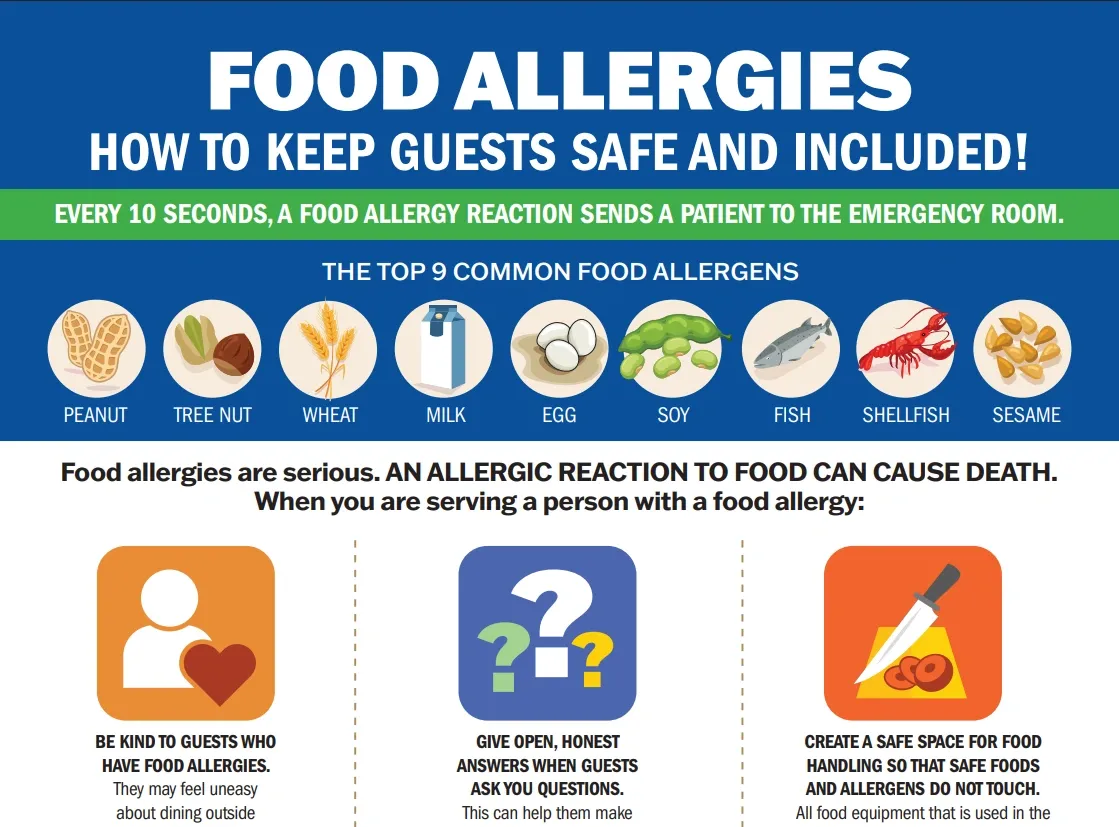
Image Source: The Rotten Apple – Substack
Allergen Risk Assessments and Control Systems Under the Act
Conducting effective allergen risk assessments
We based allergen management regimes on HACCP, and risk assessments are founded on it [2]. Food business operators should conduct risk assessments that determine potential allergenic risks in manufacturing environments. This includes rigorous assessment of ingredients, processes and supply chain [4]. Businesses must carry out a documented risk assessment of each raw material or group of raw materials. They need to take into account the potential for allergens, including allergen content and potential contamination [3].
Food businesses should carry out an assessment that identifies which allergens are present in every dish, side dish, accompaniment, condiment and drink. This helps them comply with legal requirements and provide accurate allergen information [7]. You assess and rank different allergens at the site when building an allergen risk matrix. Think over contamination risks posed by production methods and allergen form [3].
Implementing cleaning and cross-contamination prevention measures
Critical control points on production lines must be identified [2]. You should adopt a risk-based approach where the product with the highest allergen loading on a production line is the foundation for validation of critical control point studies [2]. Specialist sanitation teams take various swabs at different points on production lines after production. They swab different materials such as rubber and stainless steel [2].
Allergen cleaning validation confirms that cleaning procedures are sufficient. They remove allergens or reduce them to acceptable levels [3]. Businesses must carry out allergen cleaning validation when they recognise that cleaning is a control measure. It eliminates risks or reduces them to acceptable levels [3]. You test the worst-case scenario and prove the effectiveness of cleans. This happens when you remove the most challenging allergen under the hardest conditions, and then it proves effectiveness when tackling less-challenging scenarios [3].
The food industry uses wet cleaning as the most common cleaning methodology [8]. Results point to the efficacy of chlorinated alkaline cleaning agents. Acid detergents, sanitizers and conventional detergents show variable results [8]. Many factors intrinsically affect cleaning effectiveness. Whether particular chemicals perform successfully and remove allergenic foods depends on these factors [8].
Verification procedures and testing
The next product prepared on the line is tested at eight timepoints from T=0 to T=60 minutes on three different occasions after production of high-allergen products. This proves that precautionary allergen labelling is not required [2]. The risk assessment stays in place until something changes. Verification checks are also performed annually [2].
Sites typically use quantitative methods such as ELISA tests to validate cleaning processes. They send samples to external laboratories or use on-site laboratories that determine specific allergen levels [3]. You carry out lateral flow immunoassays alongside quantitative tests during validation of cleaning processes. This proves correlation between the two methods, which is vital if you use LFIs for ongoing verification [3].
Testing laboratories must take part in FAPAS proficiency testing rounds and perform as expected. They supply this data on test reports [2]. Testing labs must complete matrix validation studies. Spike recovery testing yields data within the 80-130% tolerance of expected levels [2]. Testing laboratories must be accredited to ISO 17025 and use reference materials [2].
VITAL 3.0 reference doses are the basis for maximum indicative levels [2]. We prepare food safety risk assessments based on information that includes the number of affected units outside company control and prevalence of allergy in affected geographic areas. Severity of reaction is also part of this [2].
Review and update requirements
Allergen ingredients information must be up to date [9]. Businesses need to update this information every time they receive a delivery or shop for ingredients. This makes sure allergen information is accurate. This is not a one-off task but needs to be a living, working document [7]. Businesses need to review, update and replace allergen matrices if they have new dishes, new ingredients, new suppliers, new menus, new equipment, move to new facilities or have staff changes [7].
You undertake testing when risk assessment dictates it is required, along with annual verifications [2]. The risk assessment stays in place until something changes [2]. Businesses should carry out root cause analysis in the case of a failed test. They work out why the cleaning process failed and which stages need targeting [3]. Businesses must repeat the validation process once they make the changes to be made [3].
Documentation, Traceability, and Audit Trails for Legal Compliance
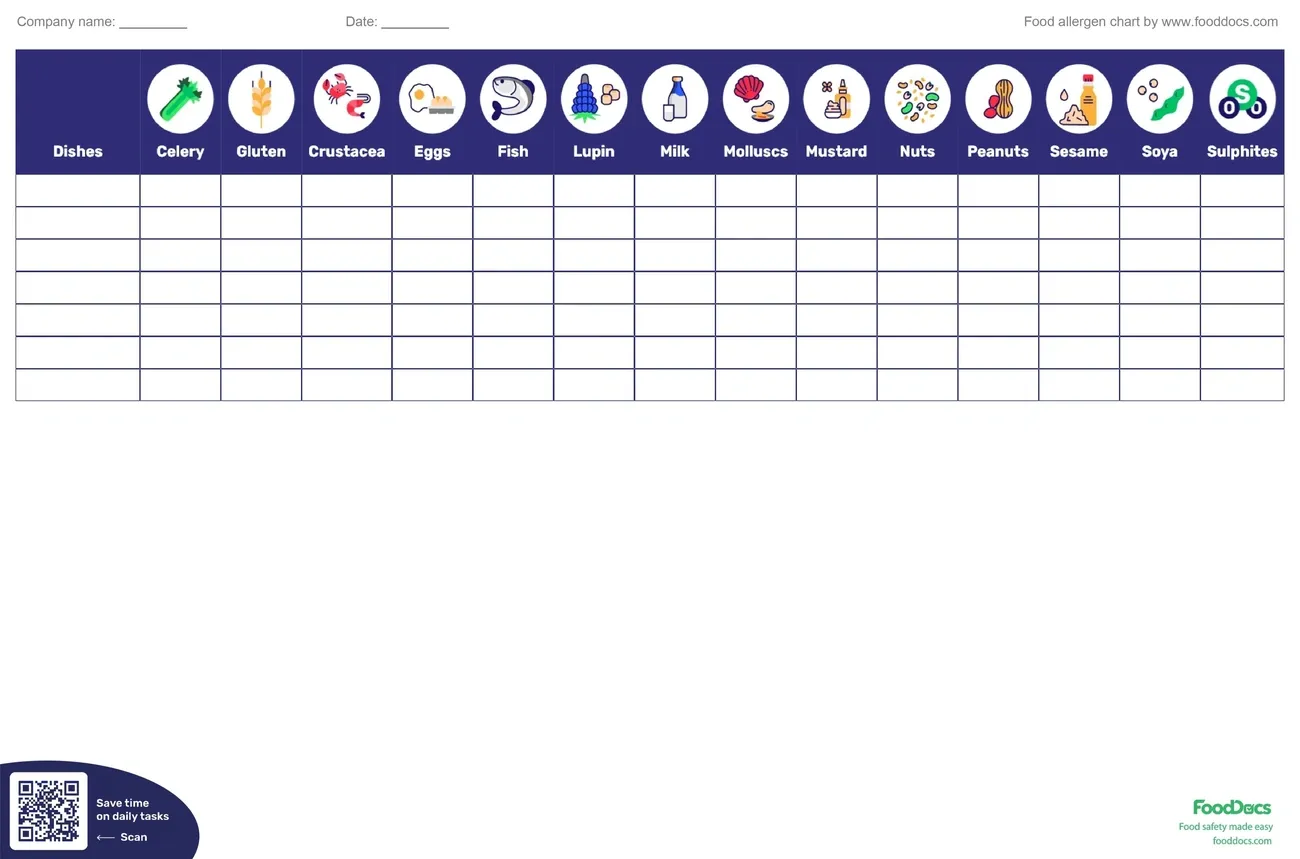
Image Source: FoodDocs
Everything in allergen management records
Businesses need to set up procedures to verify that received items match orders when ingredients arrive [1]. Procedures must approve, record and report changes if substitutions occur [1]. Clear procedures and dedicated personnel should be ready to update written allergen information when recipes or ingredients change [1]. Accurate recipe lists clearly document allergens present in food served [1]. Reminders should exist to update records and report recipe changes [1].
Supplier verification and ingredient traceability
Allergen management systems rely on accurate supplier information. Legal responsibility for allergen accuracy rests on the food business operator selling to consumers, not suppliers [10]. Businesses need to keep a supplier allergen file that contains current specifications for every ingredient and dates of last verification. The file also includes correspondence about allergen queries, records of specification changes, and goods-in check records showing delivered products match specifications [10]. This file provides evidence of due diligence [10].
Training records and competency evidence
Staff allergen and food hypersensitivity training happens each year [1]. Training records need documentation and all records must stay current [11]. Employees’ allergen knowledge and skills need checking and verification [11].
Audit trails that maintain due diligence
Catering management teams run internal food allergen audits at least every six months. These include desk-based and visual audits [12]. Audit results get written down with highlighted issues and corrective actions noted [12].
Relationship Between Food Safety Act 1990, Food Information Regulations 2014, and FSA Guidance
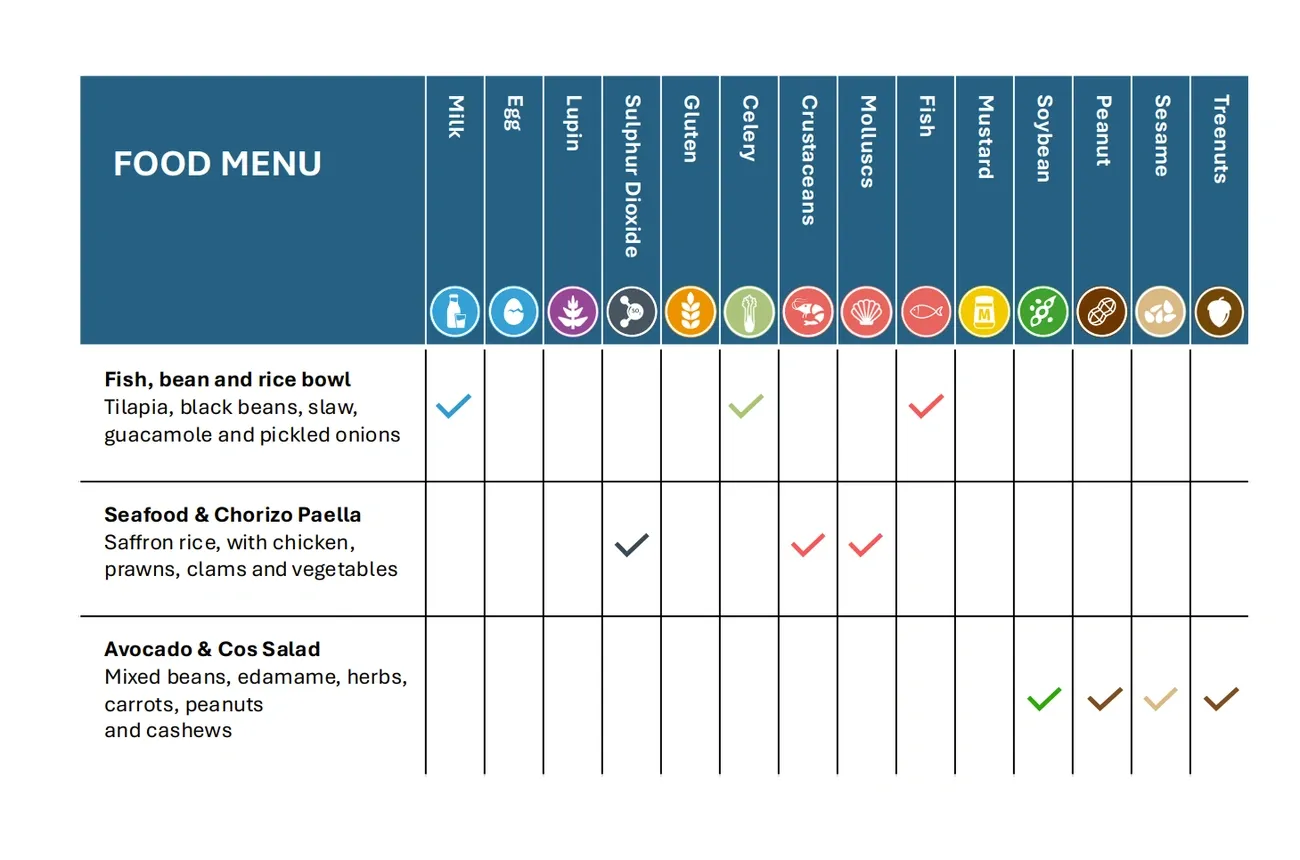
Image Source: Food Standards Agency
How the Food Safety Act and Food Information Regulations 2014 work together
The Food Safety Act 1990 provides the framework for all food legislation in England, Wales and Scotland. The domestic Food Information Regulations 2014 came into force on 14 July 2014 and allows local authorities to enforce assimilated Regulation (EU) 1169/2011 on food information to consumers [6]. The FIR references “the Act” to mean the Food Safety Act 1990 and establishes the legal foundation for enforcement actions [13].
Businesses need to provide allergen information if food contains any of the 14 allergens as listed in the FIC regulations [6]. Criminal offences continue for contravention of certain provisions, especially mislabelling of foods containing allergens. Failure to comply with allergen provisions may result in risks to consumer health and safety [6].
FSA guidance on allergen control
The Food Standards Agency publishes guidance for food businesses on providing allergen information and best practise for handling allergens [6]. Businesses can understand their obligations under both the Food Safety Act and Food Information Regulations frameworks through this guidance.
The 2025 Food Standards Agency allergen guidance recommends all out-of-home food businesses providing non-prepacked or ‘loose’ food share allergen information in writing and provide information of the 14 allergens to consumers [14]. This best practise supports compliance with UK food safety laws, though not a legal requirement [14].
Natasha’s Law and prepacked food requirements
Any food business producing prepacked for direct sale (PPDS) food is required to label it with the name of the food and a full ingredients list in Wales, England and Northern Ireland [15]. Allergenic ingredients must be emphasised within this list [15]. These labelling requirements, known as Natasha’s Law, help protect consumers. They provide potentially life-saving allergen information on packaging [15].
Natasha’s Law was named in memory of Natasha Ednan-Laperouse, a teenager who died tragically in 2016 after consuming a pre-packaged sandwich that contained sesame seeds, an allergen not listed on the product’s label [16]. The regulation came into effect on 1 October 2021 [16].
The label for PPDS food needs to show the name of the food, an ingredients list, and any of the 14 allergens emphasised in the ingredients list if these are present in the food [17]. The 14 allergens required to be labelled by food law are celery, cereals containing gluten (such as barley and oats), crustaceans (such as prawns, crabs and lobsters), eggs, fish, lupin, milk, molluscs (such as mussels and oysters), mustard, peanuts, sesame, soybeans, sulphur dioxide and sulphites (if they are at a concentration of more than ten parts per million), and tree nuts (such as almonds, hazelnuts, walnuts, brazil nuts, cashews, pecans, pistachios and macadamia nuts) [17].
The 14 allergens required to be declared by food law must be emphasised within the list through bold type, capital letters, contrasting colours or underlining [17]. Precautionary allergen information from ingredient suppliers must be passed on to the consumer [17]. The FSA recommends that information on the unintended presence of allergens for PPDS foods is communicated on the packaging or label, although not a legal requirement of food law [17]. This precautionary allergen information should only be provided if a genuine risk of allergen cross-contact has been identified following a full risk assessment [17].
Local authority enforcement powers
Authorised food officers at local authorities have responsibility for official controls relating to allergen rules in the UK [5]. There is a dual enforcement responsibility in areas where there are county councils and district councils in England. County councils are under a duty to enforce the FIRs whilst district councils have the power to enforce elements of the FIRs [5].
Subsections (1) and (2) of section 10 of the Act (improvement notices) apply for the purposes of enabling an improvement notice to be served on a person requiring compliance with specified provisions [13]. Failure to comply with the requirements set out in Regulation 10(1) and (2) of the FIR on the labelling of allergenic ingredients is a criminal offence. It may result in criminal prosecution being brought against a food business operator [5]. A person convicted of an offence under the FIR will be liable to a potentially unlimited fine, with the level determined by Magistrates on a case-by-case basis [5].
Conclusion
The Food Safety Act 1990 establishes non-negotiable legal duties for allergen management in UK food businesses of all sizes. Successful compliance depends on understanding how Section 7 and Section 14 offences apply to allergen failures and implementing resilient control systems that withstand enforcement scrutiny. Documentation is essential for mounting a due diligence defence at the time incidents occur. Food business operators who treat allergen control as a technical legal requirement rather than good practise position themselves to avoid prosecution and protect consumers while safeguarding their business reputation. Compliance requires constant alertness and staff training. Documented procedures that demonstrate reasonable precautions at every operational level are necessary.
Key Takeaways
Understanding your legal obligations under the Food Safety Act 1990 for allergen control is essential for protecting both consumers and your business from serious legal consequences.
• Food businesses face unlimited fines and up to two years imprisonment for allergen failures under Sections 7, 14, and 15 of the Food Safety Act 1990.
• The due diligence defence requires documented evidence of reasonable precautions – verbal assurances and blame-shifting to staff will not protect you in court.
• Accurate allergen information is legally mandatory regardless of whether you can safely serve allergic customers – risk assessments don’t negate labelling requirements.
• Cross-contamination prevention must be documented through HACCP systems, cleaning validation, and regular testing to demonstrate legal compliance.
• Staff training records, supplier verification files, and audit trails provide essential evidence for defending against prosecution when allergen incidents occur.
Effective allergen management under the Food Safety Act requires treating compliance as a continuous legal obligation, not a one-time task. Businesses that maintain robust documentation, implement validated control systems, and ensure staff competency create the strongest defence against prosecution whilst protecting vulnerable consumers from potentially fatal allergic reactions.
FAQs
Q1. What legal duties do UK food businesses have regarding allergen information? Food businesses in the UK have a legal obligation to provide accurate allergen information to consumers about the food they serve and sell. This includes identifying which of the 14 major allergens are present in dishes, maintaining up-to-date records of allergen ingredients, and ensuring staff are properly trained to handle allergen enquiries. Businesses must also implement control measures to prevent cross-contamination and keep documentation that demonstrates compliance with food safety requirements.
Q2. What actions are prohibited under the Food Safety Act 1990? The Food Safety Act 1990 prohibits businesses from selling or keeping for sale food that is unfit for consumption or dangerous to health. Businesses must not sell food that fails to meet the nature, substance, or quality that customers are entitled to expect. The Act also forbids adding substances to food, removing constituents, or treating food in ways that would make it harmful to consumers’ health, particularly for those with specific sensitivities such as food allergies.
Q3. What penalties can food businesses face for allergen-related offences? Food businesses that fail to comply with allergen requirements can face serious penalties. Magistrates’ courts may impose fines of up to £20,000 for each offence under certain sections of the Food Safety Act. Crown courts have the power to impose unlimited fines and custodial sentences of up to two years. Local authorities can also issue improvement notices, and failure to comply with these notices within 14 days can result in additional penalties and potential prosecution.
Q4. What training obligations do food business operators have for their staff? Food business operators are legally required to ensure that all staff receive appropriate supervision and training in food hygiene and allergen management. This training must be suitable for the area in which staff work and enable them to handle food safely. Training should cover procedures for providing allergen information, preventing cross-contamination, recognising emergency situations like anaphylaxis, and understanding the risks associated with allergen mismanagement. Businesses must maintain records of completed training as evidence of compliance.
Q5. What is the due diligence defence and how can businesses establish it? The due diligence defence allows businesses to avoid conviction if they can prove they took all reasonable precautions and exercised all due diligence to prevent the offence. To establish this defence, businesses must provide documentary evidence of their control systems, including HACCP procedures, cleaning schedules, staff training records, supplier verification documents, and regular audit trails. Verbal assurances are insufficient—businesses need written systems with proof that checks and inspections were regularly carried out. The burden of proof lies with the accused business to demonstrate compliance on the balance of probabilities.
References
[1] – https://www.food.gov.uk/business-guidance/allergen-checklist-for-food-businesses
[2] – https://www.food.gov.uk/research/review-of-allergen-analytical-testing-methodologies-stakeholder-engagement
[3] – https://www.klipspringer.com/blogs/allergen-cleaning-validation-a-practical-guide-for-food-factories/
[4] – https://www.fdf.org.uk/globalassets/resources/publications/guidance/fdf-guidance-change-allergen-info.pdf
[5] – https://www.food.gov.uk/business-guidance/food-allergen-labelling-and-information-requirements-technical-guidance-enforcement-of-the-measures
[6] – https://www.food.gov.uk/about-us/key-regulations
[7] – https://www.devonsomersettradingstandards.gov.uk/business/food-law-guidance/allergens-in-food/
[8] – https://www.food.gov.uk/research/review-of-the-literature-and-guidance-on-food-allergen-cleaning-results
[9] – https://www.food.gov.uk/business-guidance/allergen-guidance-for-food-businesses
[10] – https://paddl-ai.co/allergens/cross-contact/supplier-allergen-verification
[11] – https://www.fooddrinkeurope.eu/wp-content/uploads/2022/04/FoodDrinkEuropes-Guidance-on-Food-Allergen-Management-for-Food-Manufacturers-2022.pdf
[12] – https://www.tuco.ac.uk/sites/default/files/2019-07/COP-Food-Allergens-Management 2018.pdf
[13] – https://www.legislation.gov.uk/uksi/2014/1855/body
[14] – https://www.hublapp.co.uk/post/new-fsa-food-allergen-guidance-what-every-food-business-needs-to-know
[15] – https://www.food.gov.uk/allergen-labelling-changes-for-prepacked-for-direct-sale-ppds-food
[16] – https://www.anaphylaxis.org.uk/my-account/media-centre/membership-news/understand-natashas-law/
[17] – https://www.food.gov.uk/business-guidance/labelling-guidance-for-prepacked-for-direct-sale-ppds-food-products