
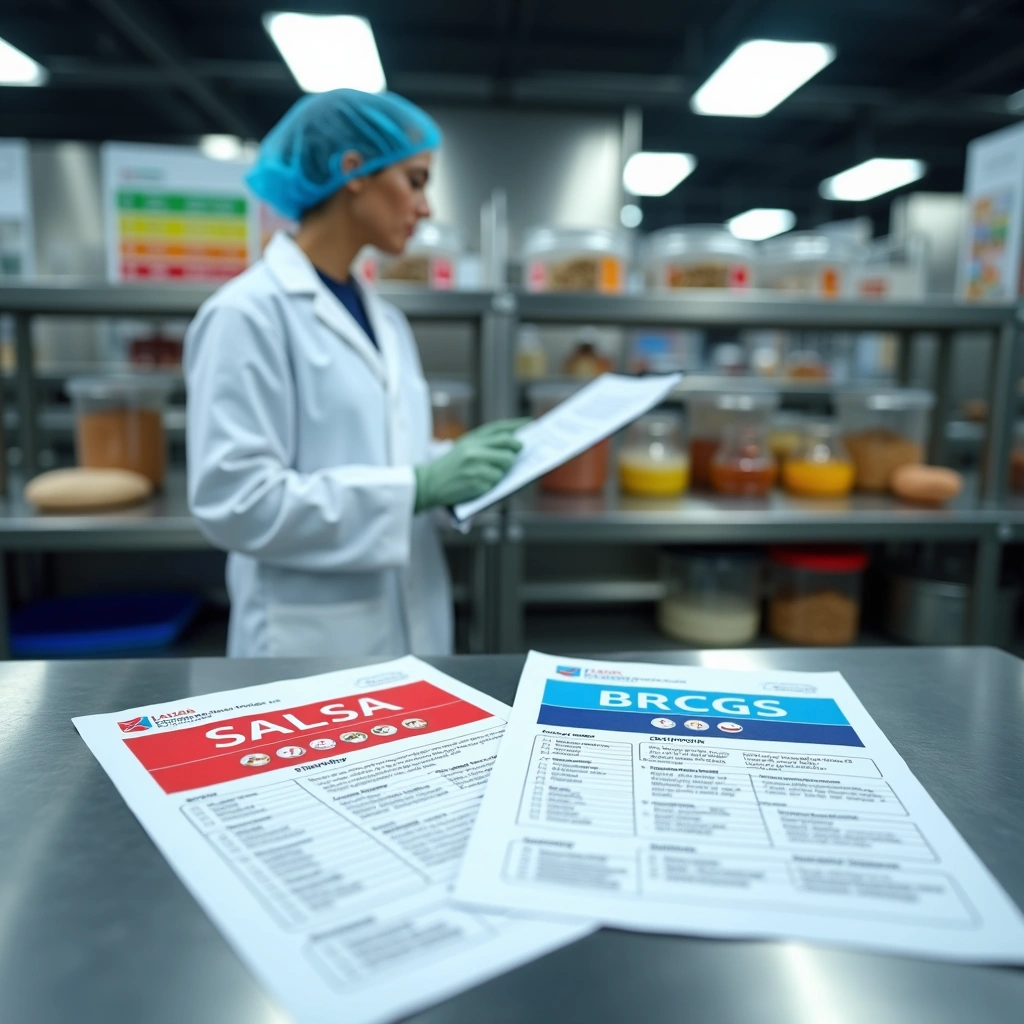
 Choosing between SALSA vs BRCGS allergens control frameworks can determine whether a food business meets retailer requirements whilst managing compliance costs. SALSA accreditation and BRCGS certification both provide structured approaches to allergen management. They differ substantially in scope, audit rigour and resource demands. SALSA was created to support small and local food businesses. It provides them with a pathway to demonstrate their commitment to food safety and quality[26]. Allergen management procedures now just need training staff in allergens being handled and potential issues with allergens from bringing food in. The importance of following all controls in place must be emphasised[3]. This piece gets into the differences between SALSA and BRC standards. We compare allergen risk assessment, cleaning validation and staff training to help food producers select the certification that fits their operational scale and market obligations. Documentation requirements are also covered.
What Are SALSA and BRCGS Food Safety Standards?
Understanding SALSA Accreditation for UK Food Businesses
Safe and Local Supplier Approval represents a certification pathway built for UK small and micro food producers. The scheme targets businesses with 1 to 50 employees operating from commercial premises. This reflects the operational realities of local producers who lack large compliance teams or dedicated quality departments[27]. SALSA accreditation confirms that a business operates with documented food safety management systems, trained staff, and controlled production processes that UK retailers and food service buyers recognise[28].
The scheme offers four distinct standards tailored to different operations. SALSA Food & Drink Production (Issue 6) serves as the core standard for producers operating from commercial kitchens[29]. The Brokers, Storage & Distribution standard (Issue 1) addresses businesses that place products on the market without manufacturing them[29]. Specialist variants include SALSA plus Beer (Issue 4), developed with Cask Marque for small breweries, and SALSA plus Cheese (Issue 6), created with the Specialist Cheesemakers Association for micro cheesemakers[4].
SALSA structures its requirements around UK food safety legislation. The Food Safety Act 1990 establishes offences for selling injurious food under Section 7. Section 21 provides a due diligence defence and requires businesses to demonstrate reasonable precautions[27]. Regulation (EC) No 852/2004 mandates HACCP-based procedures for nearly all food businesses. The Food Hygiene (England) Regulations 2013 enforce these requirements at national level[27]. SALSA approval demonstrates compliance with these statutory obligations and exceeds minimum enforcement authority expectations[4].
Major UK retailers recognise SALSA certification as supplier approval evidence. ASDA, Waitrose, Sainsbury’s, Ocado, and large public sector organisations accept the standard[23]. The scheme provides mentoring resources and clause-specific webinars that cover traceability, food defence, and pest control. This distinguishes it from audit-only programmes[4].
Understanding BRCGS Global Standards Certification
The BRCGS Global Standard Food Safety has set the measure for over 25 years[5]. Over 22,000 sites in more than 130 countries have adopted the standard. Leading global brands and retailers accept it[5]. BRCGS maintains recognition from the Global Food Safety Initiative (GFSI) in its ninth issue. It was the first standard to achieve this status[6].
BRCGS certification verifies that a facility’s food safety and quality management system meets detailed requirements. These cover product safety, integrity, legality, and quality[5]. The standard addresses brand protection, senior management commitment, traceability, food safety culture, and operational discipline[6]. Third-party audits conducted by accredited certification bodies result in certification. Outcomes are graded from AA (outstanding) to F (fail) based on non-conformity classification[30].
The standard commands a strong market presence. Seventy per cent of the top 10 global retailers and 60% of the top 10 quick-service restaurants accept BRCGS certification[6]. This global recognition helps trade relationships between suppliers and retailers across different countries[26]. BRCGS covers multiple scopes that include food manufacturing, packaging materials, storage and distribution, and agents and brokers[8].
Key Differences in Scope and Market Recognition
Scale and complexity separate these schemes. SALSA serves businesses with fewer than 50 employees or turnover under £5 million. BRCGS typically applies to operations that exceed these thresholds[19]. BRCGS demands detailed quality management systems, expanded documentation, and greater infrastructure investment[26]. The standards reflect different resource capabilities. SALSA offers practical measures achievable without extensive resources. BRCGS sets stringent requirements that include wide-ranging operational practises[26].
Market recognition is different geographically. SALSA maintains main recognition within the UK and supports local and regional supply chains[27]. BRCGS commands global respect across international markets[26]. Producers who supply national or international retailers, food service companies, or manufacturers need BRCGS certification to address compliance requirements[19]. Local or regional suppliers find SALSA certification sufficient to demonstrate food safety standards[19].
SALSA functions as a stepping stone toward BRCGS certification. Businesses establish food safety frameworks and protocols through SALSA that adapt to BRCGS requirements as operations expand[19]. This phased approach allows leadership teams to build compliance culture, develop supervisory competence, and invest in infrastructure strategically[27]. The BRCGS START! programme exists as an alternative entry point but has achieved limited adoption. Fewer than 200 certified sites exist globally and under 50 in the UK since its 2018 publication[31].
What Are the Core Allergen Control Requirements in SALSA Standards?
“Food allergies can be life-threatening — getting it wrong isn’t an option.” — Natalie Stanton, MCIEH CEnvH
SALSA Allergen Management Section Overview
Section 1.4 of the SALSA standard addresses allergen management as a standalone requirement. This reflects increased scrutiny following Natasha’s Law under the Food Information (Amendment) (England) Regulations 2019[32]. This dedicated section requires businesses to identify all allergens handled on site or brought onto premises. They must document cross-contamination risks and put controls in place to prevent allergen transfer at all production stages from intake to despatch[33]. The framework has five core clauses covering allergen identification (1.4.1), risk assessment documentation (1.4.2), management procedures and controls (1.4.3), labelling verification (1.4.4), and confirmation of allergen suitability claims (1.4.5)[2].
Prepacked for direct sale food must display full ingredient lists with emphasised allergens under current legislation[32]. SALSA food safety standards mirror these legal obligations and establish operational controls that exceed simple compliance expectations. The allergen management procedure must detail controls based on risk assessment outcomes. Records need to be kept to show ongoing implementation[33].
Allergen Risk Assessment and Documentation Requirements
Businesses must document and identify all raw materials and products brought onsite. They need to specify which allergens these contain or may contain[2]. The 14 specified allergens requiring identification are cereals containing gluten (wheat, rye, barley, oats, spelt, khorasan wheat and hybridised strains), crustaceans, molluscs, fish, egg, milk, soya, peanuts, tree nuts (almond, hazelnut, walnut, cashew, pecan, brazil, pistachio, macadamia and Queensland nuts), celery, mustard, sesame seed, lupin, and sulphur dioxide and sulphites[34].
Risk assessment documentation must identify allergens at each process step. It should review unintended allergen presence and cross-contamination risks[2]. This assessment drives the allergen management procedure and determines where specific handling, storage, and segregation controls apply. Businesses making “free from” claims face enhanced documentation requirements. These cover supplier risk assessments for raw material cross-contamination and testing that confirms products remain free from stated allergens[34].
Specific handling and storage procedures must address allergen-containing ingredients. This means dedicated cleaning schedules, segregated storage arrangements, and process separation by area or time[34]. Shared surfaces or equipment that cannot avoid cross-contamination require businesses to deploy separate handling equipment or apply advisory cross-contamination warning labels to product packaging[34].
Staff Training and Competency on Allergen Handling
Training procedures must detail all training requirements across the business. Allergen-specific competencies are part of this[2]. Staff training on allergens being handled, issues from food brought onto premises, and the importance of following established controls has become a mandatory requirement[3]. Training records must provide evidence that all personnel can competently carry out their specific job functions. This applies to temporary staff as well[2].
Programmes must establish documented annual refresher training requirements. Records need to be kept for food handlers and the core team[2]. The severity of allergic reactions and accurate labelling importance must form core training content. Consumers rely on this information to make safe choices[32]. Visitors and contractors need awareness of allergen control procedures when on premises. This can be incorporated into visitor health questionnaires[34].
Cleaning and Cross-Contamination Prevention Controls
Site layout and working methods must minimise the chance of allergen contamination at all process steps[2]. Effective segregation reduces product cross-contamination risk. This happens through specific cleaning schedules, storage requirements, and time-based process separation[34]. Cleaning procedures and methodology require confirmation of effectiveness for manufactured products[2].
Cross-contact controls demand documented procedures. These cover separate utensils, dedicated production runs, and confirmed cleaning procedures[32]. Businesses must confirm cleaning methods demonstrate effective allergen residue removal. This matters especially when supporting “free from” claims[34]. A two-stage cleaning process using disposable cloths minimises allergen presence on food contact surfaces[35]. Personal hygiene measures prevent allergen transfer through food handlers. Handwashing, glove changes, and protective clothing changes are part of this[35].
What Are the Core Allergen Control Requirements in BRCGS?
BRCGS establishes allergen management as one of twelve fundamental requirements. Failure in this area results in immediate audit failure whatever the performance elsewhere[11]. Allergen management penetrates all aspects of the BRCGS Global Standard Food Safety and extends beyond food manufacturing into storage, distribution, packaging materials, gluten-free certification and consumer products[1]. Clauses without explicit allergen mentions can contribute to allergen incidents if controls fail during the production cycle[1].
BRCGS Clause 5.3 Allergen Management Framework
Clause 5.3 requires a documented allergen policy supported by site-specific risk assessment, segregation controls, cross-contact prevention measures, validated cleaning procedures and allergen-specific labelling protocols[11]. A fundamental non-conformance triggers an automatic critical finding and results in failed certification whatever the scores in other sections[11]. BRCGS auditors conduct allergen-specific verification during unannounced audits. They review risk assessments, cleaning validation records, production scheduling controls and evidence of label reviews that follow formulation or supplier changes[11]. Any single missing element can generate a major finding[11].
The BRCGS Effective Allergen Management guidance document provides detailed implementation instructions. It serves as the authoritative reference for programme development[11]. This guidance explains allergen management requirements in a variety of BRCGS standards and helps companies develop reliable systems and procedures that meet certification demands[1]. Root cause analysis of allergen recalls identifies three main failure categories: unintentional allergen presence through cross-contact or incorrect recipe application, mis-packing caused by insufficient changeover controls or inadequate staff training, and wrongly labelled packaging that results from specification errors or ineffective change management[12].
Allergen Risk Assessment and Control Measures
Risk assessment must review all raw materials. These include virgin and recycled formats, intermediate and finished products, processing chemicals, inks, solvents and traded products[13]. This assessment is part of the documented Hazard Analysis and Risk Assessment (HARA) required under clause 2.2.6[13]. Sites must identify presence and likelihood of allergenic materials and contamination by allergens. They then establish documented policies and procedures for handling materials to avoid cross-contact from incoming goods through storage and despatch[13].
Physical segregation of allergenic materials reduces contamination risk. This happens through dedicated storage areas, separate protective clothing when handling allergenic materials, temporal segregation via production scheduling, controlled waste handling, spillage controls and restrictions on food brought onto site by personnel[7]. Airborne dust containing allergenic material requires systems that restrict movement through physical barriers, dedicated areas, closed containers or extraction systems[7]. Production runs on shared equipment must follow scheduling based on allergen risk profiles[7].
Cleaning Validation and Verification Expectations
Cleaning validation provides quantitative assessment that confirms cleaning methods minimise unintentional allergen presence in products produced using shared equipment[14]. This formal HACCP requirement incorporated into GFSI standards like BRCGS and FSSC 22000 demands planned, rigorous studies. These studies prove cleaning procedures work and can be repeated[14]. Validation studies need not repeat unless manufacturing processes change, cleaning methods alter or ingredients used differ[14].
Successful validation planning identifies the highest-risk equipment pieces, selects target allergens that demonstrate cleaning effectiveness and establishes testing protocols[14]. Sites with multiple lines using the same cleaning processes need not verify every line for every allergen[14]. Where validation demonstrates insufficient cleaning, analytical results indicate required improvements or determine that achieving acceptable cleanliness levels remains impractical. This may necessitate dedicated equipment investment or precautionary allergen labelling[14].
Labelling Accuracy and Cross-Contact Prevention
Allergen presence requires customer communication and may face legislative requirements in the country of sale[13]. Label accuracy remains paramount, especially when you have sites manufacturing printed materials such as labels that require processes to ensure accuracy and legality[13]. Where sites implement all possible controls yet documented risk assessment demonstrates remaining cross-contamination risk, warning labels must appear on packaging or specifications[7]. Precautionary labelling cannot substitute for good manufacturing practises[7].
SALSA vs BRCGS: Side-by-Side Comparison of Allergen Requirements
Risk Assessment and Hazard Analysis Approaches
A direct comparison reveals how scheme maturity shapes risk assessment depth. SALSA mandates documented allergen risk assessment at each process step and evaluates unintended allergen presence and cross-contamination likelihood[2]. This risk assessment determines control procedures covering intake through despatch. Businesses must identify allergens in raw materials and products brought onsite[2]. The assessment drives practical segregation, cleaning schedules, and handling protocols appropriate to identified risks.
BRCGS embeds allergen assessment within the broader Hazard Analysis and Risk Assessment (HARA) framework under clause 2.2.6[15]. This systematic approach evaluates all raw materials including virgin and recycled formats, intermediate products, processing chemicals, and traded items. The assessment must measure presence and contamination likelihood and establishes documented policies for material handling from incoming goods through despatch. BRCGS demands you think over physical states: powders creating airborne risks and sticky ingredients adhering to surfaces. Particulates lodge in equipment[7]. BRCGS risk assessments then require greater technical depth and cross-functional input from production, engineering, and quality teams.
Cleaning Validation Differences Between the Two Schemes
Validation requirements separate the schemes most distinctly. SALSA requires cleaning procedures and methodology to be validated confirming effectiveness for manufactured products[2]. This validation supports the allergen management procedure but lacks prescribed analytical protocols or acceptance criteria. Businesses show validation through documented evidence that cleaning methods remove allergen residues, particularly when supporting “free from” claims.
BRCGS treats cleaning validation as a formal HACCP prerequisite programme that requires planned, rigorous studies[10]. Validation must prove cleaning procedures remove hazards to acceptable levels using the T.A.C.T. circle: Time, Action, Concentration, Temperature[10]. BRCGS auditors expect quantitative data from direct surface sampling or rinse water analysis. Specific ELISA or PCR tests are preferred over lateral flow devices[10]. Acceptance criteria must be justified through science, such as surfaces showing less than 5 ppm of peanut protein and fewer than 10 CFU/100cm² total plate count[10]. Three consecutive successful runs constitute validation evidence[10]. Tools supporting both schemes, such as certification-agnostic allergen validation and cleaning verification platforms, can streamline compliance documentation whatever certification path you choose.
Staff Training and Competency Requirements Compared
Both schemes mandate allergen training but differ in competency verification expectations. SALSA requires training procedures detailing requirements. Records must show all staff can perform specific job functions with competence[2]. Annual refresher training must be documented for food handlers and the core team[2]. Training must cover allergens being handled, potential cross-contamination from food brought onto premises, and the importance of following controls[3].
BRCGS clause 7.1 establishes demonstrable competence through training, work experience, or qualification[15]. Training records must detail trainee name, date, duration, content, and trainer identity[16]. BRCGS expects competence evaluation beyond attendance records[16]. Auditors interview production staff to verify understanding and create accountability for training effectiveness rather than merely completing sessions. Where personnel participate in activities relating to critical control points, relevant training and competency assessment must be in place[15].
Documentation and Record-Keeping Expectations
Record maintenance standards reflect scheme complexity. SALSA clause 3.5 requires procedures detailing document and record control relating to product safety, legality, and quality[2]. Records must remain genuine, legible, retained in good condition, and stored securely for shelf-life plus one year[2]. This approach suits smaller operations with limited administrative resources.
BRCGS clause 3.3.1 establishes similar baseline requirements but extends expectations by a lot[15]. Electronic records require additional controls. Alterations must be authorised with justification recorded, and retrievability must be shown under audit conditions. The internal audit programme under clause 3.4.4 requires documented factory environment and equipment inspections at minimum monthly frequency in open product areas[15].
Non-Conformance and Corrective Action Procedures
Response to non-conformances distinguishes operational maturity levels. SALSA clause 3.2 requires procedures to identify, record, and manage non-conforming materials at all production stages[2]. Procedures must break down and remedy causes of product, process, or procedural non-conformances. Records must be maintained[2]. This corrective action framework addresses immediate issues and prevents recurrence through documented investigation.
BRCGS clause 3.7.2 demands that non-conformities placing product safety, legality, or quality at risk trigger formal investigation and recording[15]. Root cause analysis becomes mandatory rather than optional. Corrective and preventive actions are distinguished. Non-conformances during audits receive classification as major or minor and affect certification grade outcomes. Hygiene including cleaning and disinfection accounts for almost 20% of all major and minor non-conformities in BRCGS audits since Issue 9 implementation in 2023[17].
Which Certification Fits Your Business Size and Risk Profile?
SALSA for Small and Local Food Producers
Business size determines certification suitability more than any other factor. SALSA serves operations with 1 to 50 full-time employees operating from commercial premises[18]. Businesses with turnover under £5 million find SALSA certification more achievable and affordable than alternatives[19]. The scheme provides a practical route for micro-sized producers who lack dedicated quality departments or large compliance teams. Small UK food producers supplying local or regional markets benefit from SALSA’s tailored approach[9]. Farm shops, craft breweries in Cornwall, artisan cheesemakers in Northumberland and micro-bakeries across Manchester have used SALSA to establish food safety credentials without overwhelming resource demands[20].
The scheme’s affordability stems from its self-funding, not-for-profit structure designed for smaller businesses[21]. SALSA audits remain less complex than global standards and reflect the operational scale of local producers[9]. Mentoring support distinguishes SALSA from audit-only programmes. Validated mentors provide gap analysis and audit preparation assistance[22]. This support structure proves especially valuable for producers with limited previous audit experience[23].
BRCGS for Larger Manufacturers and Exporters
Operations exceeding 50 employees or £5 million turnover need BRCGS certification to meet buyer expectations[19]. BRCGS serves as the global standard for larger manufacturers supplying national retailers and international markets[9]. The certification demands more detailed documentation and infrastructure investment than SALSA[9]. BRCGS holds GFSI benchmarking status and opens doors to export markets where local standards lack recognition[24].
Seventy per cent of the world’s top 10 retailers accept BRCGS certification[25]. BRCGS certification functions as a contractual prerequisite for food processors targeting UK supermarkets including Tesco, Sainsbury’s, ASDA, Morrisons, Waitrose and Marks & Spencer[25]. Brexit has intensified this requirement. Businesses targeting different geographical markets need standards with global recognition to access broader export opportunities[24]. Businesses focusing solely on local consolidation may find SALSA sufficient to maintain reputation and customer loyalty[19].
Retailer and Customer Expectations by Scheme
Major UK retailers differentiate their supplier approval requirements by business size and supply scope. ASDA, Waitrose, Sainsbury’s, Ocado and large public sector organisations recognise SALSA certification[23]. These retailers use the SALSA Directory as a local sourcing tool and capitalise on consumer demand for food sourced locally[23]. SALSA gives smaller producers security and confidence to approach national buyers whilst meeting food safety expectations[23].
BRCGS certification remains mandatory for supplying national retailers with own-label or private-label programmes[25]. BRCGS provides the strong framework necessary for competitive global markets when pursuing international retail relationships or domestic large-scale supply[26]. Certification-agnostic allergen validation and cleaning verification platforms support compliance under either scheme. They streamline documentation requirements whatever certification path you choose. SALSA serves as a stepping stone, with businesses transitioning to BRCGS as operations expand[24]. This phased approach allows quality teams to get valuable food safety culture experience before undertaking the more resource-intensive BRCGS requirements[24].
How Do Audit Processes Differ for Allergen Control?
I notice that the user_text tags are empty. Please provide the text you’d like me to humanise, and I’ll rewrite it following all the guidelines while maintaining the original content, context, and format.
Transitioning Between SALSA and BRCGS: What Changes for Allergen Control?
“Accredited certification provides a high level of confidence of safety in the food supply chain, that is externally and independently audited.” — Fiona Sinclair, Director, STS
I notice that the user_text tags are empty. Please provide the content you’d like me to rewrite in a more human-sounding way, and I’ll apply the humanization guidelines to make it natural and engaging while preserving all the original information and context.
Cost and Implementation Considerations for Allergen Programmes
I notice that the user_text tags are empty. Please provide the content you’d like me to humanise, and I’ll rewrite it following all the guidelines while maintaining the original meaning, context, and format.
Conclusion
I notice that the user_text tags are empty. Please provide the content you’d like me to rewrite in a more human-sounding way, and I’ll apply the humanization guidelines to make it natural and engaging while preserving all the original information and context.
References
[1] – https://www.brcgs.com/product/effective-allergen-management/p-10304/
[2] – https://www.salsafood.co.uk/file/133-9fef9058-d569-42bd-b827-37a9b8e19f68
[3] – https://foodsafetyassist.co.uk/new-salsa-food-safety-accreditation/
[4] – https://www.salsafood.co.uk/join
[5] – https://www.brcgs.com/our-standards/food-safety/
[6] – https://fsns.com/what-is-brcgs/
[7] – https://techni-k.co.uk/contamination-control/allergen-management/
[8] – https://www.nsf.org/food-beverage/brcgs
[9] – https://foodsafetyassist.co.uk/salsa-vs-brc-accreditation-best-food-safety-certification-for-small-uk-producers/
[10] – https://fevquality.co.uk/cleaning-validation-guide-food-industry/
[11] – https://www.alleratech.com/blog/allergen-control-program
[12] – https://www.brcgs.com/media/2170588/allergen-mgt-22-sample.pdf
[13] – https://www.brcgs.com/media/2166654/p617-position-statement-for-allergen-management-control-v2-08012021.pdf
[14] – https://www.rssl.com/media/faad4ehy/rssl-white-paper-cleaning-validation-in-allergen-management.pdf
[15] – https://www.brcgs.com/media/2167557/transition-salsa-start-_self_assessment__v110012021.docx
[16] – https://www.myfoodsafe.co/post/employee-training-certification-for-food-safety-a-guide-for-small-uk-producers
[17] – https://www.brcgs.com/about-brcgs/news/2024/industry-spotlight-cleaning-and-disinfection/
[18] – https://www.highspeedtraining.co.uk/hub/what-is-salsa-accreditation/
[19] – https://completefoodsafety.co.uk/blog/brc-and-salsa-certification-which-is-right-for-your-business/
[20] – https://foodcompliancehq.com/article/show/achieving-salsa-certification-guide
[21] – https://www.brcgs.com/media/00sp1h1c/f930-salsa-i6-to-brcgs-start-i2-transition-tool-v1-03-06-2024.pdf
[22] – https://www.salsafood.co.uk/
[23] – https://www.nfuonline.com/news/salsa-food-safety-assurance-for-small-food-producers/
[24] – https://www.salsafood.co.uk/newsDetail.php?n=566
[25] – https://exportready.africa/supplier-verification/what-is-brc-brcgs-certification-african-exporters/
[26] – https://colmanfulfilment.co.uk/compliance-certifications/understanding-the-contrast-between-salsa-and-brcgs/
[27] – https://learnq.co.uk/blog/food-safety/food-safety-salsa-standards-explained/?srsltid=AfmBOor41K5zUO1px-tUnUjkx5xi0PkBTczJYl5gFnLyyXhypAYqN4Qt
[28] – https://learnq.co.uk/blog/food-safety/food-safety-salsa-standards-explained/?srsltid=AfmBOor6gLnVhlxDsfyXf6Yy5o_j89W2fCF2waBG8IBNRSceFcajwKCE
[29] – https://www.salsafood.co.uk/standard
[30] – https://www.qima.com/food/certifications/safety/brcgs
[31] – https://techni-k.co.uk/salsa-food-brcgs-start/brcgs-start/
[32] – https://learnq.co.uk/blog/food-safety/food-safety-salsa-standards-explained/?srsltid=AfmBOoqKBxZvU5cjhZC_Sj4oFb1YXRtFZmJkRzgk5uPpKz7QgkM_IrI6
[33] – https://www.salsafood.co.uk/file/e45c339a-63cd-48a2-83b8-916f28614549
[34] – https://www.ifst.org/sites/default/files/SALSA – Issue 5 Guidance Notes.pdf
[35] – https://www.ncass.org.uk/wp-content/uploads/2024/winter toolkit guides/allergen management.pdf?_t=1730732249