UK Food Allergen Regulations & Legal Compliance Framework: Complete Guide for Food Businesses
Businesses face serious legal and financial fallout when they don’t comply with UK food allergen regulations. Food recalls hit companies hard, with costs ranging from £1.5 to £10 million for each incident. The whole ordeal gets even pricier when you add crisis management, legal fees, and the work needed to rebuild the brand’s reputation .
The UK enforces strict laws that protect people at risk from allergens. Food establishments must provide clear allergen information and prevent cross-contamination . Since 2021, Natasha’s Law has made it mandatory for businesses to include complete ingredient and allergen details on all pre-packed food sold directly to consumers . The Food Information Regulations 2014 demand clear allergen labelling that lists 14 major allergens such as nuts, milk and gluten . Businesses that fail to meet these standards face heavy fines, legal battles, regulatory sanctions and long-term damage to their reputation .
Food businesses of all sizes must understand the complete framework of allergen legislation. The core regulations include the Children and Families Act 2014, Food Safety Act 1990, and Health and Safety at Work Act 1974. The piece also gets into practical ways to comply, staff training methods, and how verified allergen removal solutions can help implement FSA allergen guidance across food service operations.
Understanding UK Allergen Legislation
UK’s legislative framework for food allergens includes several interconnected laws that protect consumers and employees. Food businesses must learn to direct their way through this complex regulatory world to stay compliant and safe.
Children and Families Act 2014
Section 100 of the Children and Families Act 2014 places a legal duty on schools to support pupils with medical conditions, especially when they have food allergies [1]. Schools must:
- Make proper arrangements for pupils with allergies
- Work with parents to develop Individual Healthcare Plans [2]
- Let children with allergies eat school meals safely
Schools can get ‘spare’ adrenaline auto-injector (AAI) devices for emergencies, though this choice remains optional rather than required [2]. These spare devices work only with proper medical approval and parents’ consent for specific children.
Food Information Regulations 2014
Food Information Regulations 2014 (FIR) puts into action EU Regulation No 1169/2011 about providing food information to consumers [3]. These rules apply to all food businesses that supply food to the public or mass caterers.
Clear allergen labelling stands as a vital requirement for all food items, with major allergens listed clearly [4]. Businesses serving non-prepacked foods can share allergen details through menus, tickets, notices, or verbal communication [3][5].
Since October 2021, all ‘prepacked for direct sale’ (PPDS) foods must show:
- Food’s name
- Complete ingredient list
- Highlighted allergen information right on the package [3][3]
This change marks a vital step forward in allergen safety, giving consumers access to key information before buying.
Health and Safety at Work Act 1974
Health and Safety at Work Act 1974 requires employers to protect their employees and customers from health risks, including allergen management [6][4]. Employers should take “reasonable steps” to reduce workplace injury risks, including severe allergic reactions [7].
Businesses’ responsibilities include:
- Looking over policies and procedures regularly
- Making work environments safe
- Supporting employees with allergies properly [6]
This approach goes beyond following laws – it creates an inclusive workplace where everyone can work safely.
Food Safety Act 1990
Food Safety Act 1990 is the life-blood of UK’s food safety laws. Selling or processing unsafe food for sale breaks this law [5]. Food businesses must ensure their food is:
- Safe for health
- Good for human consumption
- Described and presented truthfully
- Matches what customers expect [5]
Breaking allergen rules can lead to harsh penalties. Businesses now face unlimited fines for wrong allergen labels or incorrect information [4].
Equality Act 2010
Equality Act 2010 offers vital protection if you have severe allergies [6][7]. Not every food allergy counts as a disability, but they might qualify if they substantially affect daily life long-term [4][7].
When allergies become disabilities under this Act:
- Discrimination against affected people becomes illegal
- Employers must make “reasonable adjustments” to help employees [7]
- Food businesses might have to make special provisions for allergic customers
Food businesses using verified allergen removal solutions like DrCleanish can better meet these legal requirements while protecting vulnerable people. These systems help follow UK food safety frameworks without limiting menu options or operations unnecessarily.
Understanding and following these five key laws helps food businesses create safer spaces for consumers and employees while avoiding serious legal and money problems.
What is Natasha’s Law and Why It Matters
Natasha’s Law changed everything about how UK food businesses handle allergen information for pre-packed foods. This crucial legislation became a cornerstone of allergen compliance that food businesses need to follow.
Background of Natasha’s Law
The story behind Natasha’s Law (officially the Food Information Amendment) is heartbreaking. In 2016, 15-year-old Natasha Ednan-Laperouse died from an allergic reaction after eating a baguette with unlabeled sesame seeds. Even two epinephrine injections couldn’t save her life. Her parents fought hard to strengthen food labelling laws to prevent such tragedies.
The investigation into Natasha’s death revealed major gaps in allergen labelling rules for foods made and packaged where they were sold. These pre-packed for direct sale (PPDS) foods were in a grey area. They didn’t need the same full ingredient labels required for factory-made pre-packed foods.
The UK government talked to consumers, food businesses, and allergy support groups. They announced Natasha’s Law in June 2019. The law took effect in October 2021, giving businesses two years to adapt their operations.
Requirements for pre-packed food
Natasha’s Law focuses on PPDS foods—items prepared, packaged, and sold at the same place or by the same food business. Before this law, businesses only had to give allergen details when customers asked for them. This put allergy sufferers at risk.
The new rules say all PPDS foods must show:
- The name of the food
- A complete ingredients list with allergens emphasised (usually in bold, italics, or a different colour)
- All ingredients listed by weight, highest to lowest
- Any of the 14 major allergens clearly marked
Labels must be on the packaging itself, not on separate signs or through verbal explanations. This helps people with allergies make safe choices on their own. The law applies to cafés, delis, sandwich shops, takeaways, and food-to-go sections in supermarkets.
Food businesses must make sure their labels are accurate, easy to read, and firmly attached to packages. Yes, it is fine to write labels by hand if they meet these standards, which helps smaller businesses with changing menus.
Impact on food businesses
UK food businesses had to make big changes when Natasha’s Law came in. They reviewed their ingredient tracking systems, trained staff differently, and changed how they package food.
Many businesses bought label printers and new software, and trained their staff to follow the rules. About 80% of food businesses say they spend more money to meet these new labelling requirements.
Small businesses with limited resources found it harder to adjust. The Food Standards Agency (FSA) helped by creating guides, online resources, and training tools during the transition.
Businesses that put good allergen management systems in place got more benefits than just following the law. Those using proven allergen removal products like DrCleanish can better control cross-contamination risks and build better quality processes that match UK food safety standards.
The law pushed food businesses to use more technology. Many now use systems that track ingredients, allergens, and create labels automatically. These tools help them follow Natasha’s Law and improve their food safety management and HACCP practises.
The law was challenging at first, but it helped businesses improve how they handle allergens. This benefits both allergy sufferers and the businesses that serve them.
The 14 Major Allergens You Must Declare
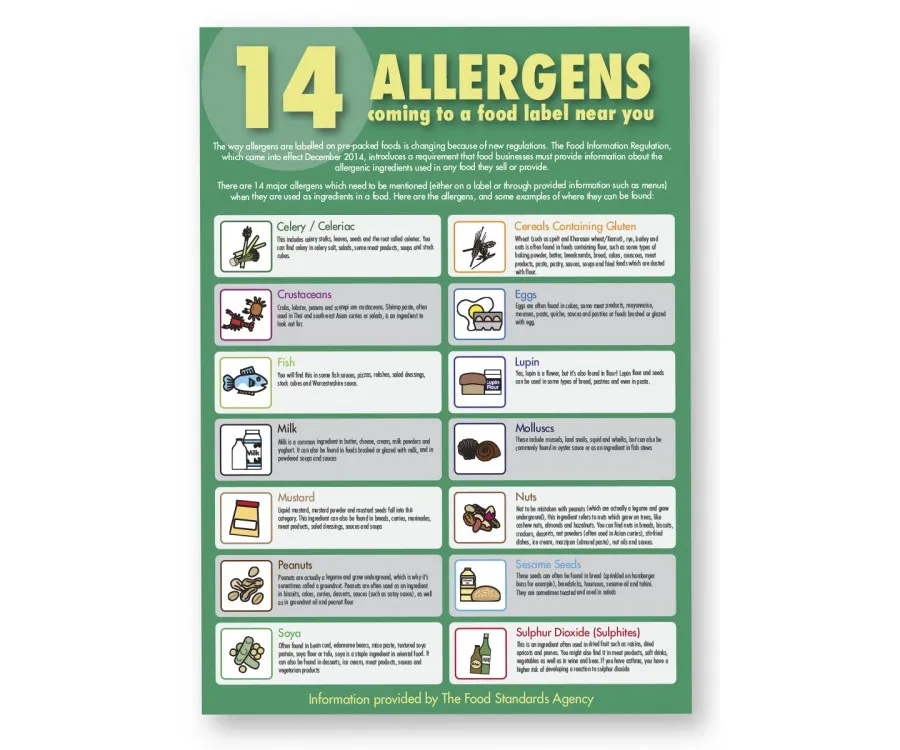
Image Source: Mileta Signs
“The introduction of this law will make it easier for allergy sufferers to make clear, safe choices when buying food.” — Zac Goldsmith, UK Food Minister
Food allergen identification and declaration are the life-blood of food safety compliance for UK businesses. A clear understanding of required allergen declarations and their correct methods protects consumers and businesses from potential risks.
List of allergens under UK law
UK legislation requires food businesses to declare 14 major allergens when used as ingredients in food products [5]. These allergens cause the most severe allergic reactions if you have sensitivities [8]. The list has:
- Celery – found in sticks, leaves, seeds, root (celeriac), and used in soups, salads, and spice mixes
- Cereals containing gluten – including wheat, rye, barley, and oats, commonly found in bread, pasta, and baked goods
- Crustaceans – such as prawns, crabs, and lobsters, present in many seafood dishes
- Eggs – found in cakes, pastries, mayonnaise, and numerous other foods
- Fish – includes all fish with fins like cod, salmon, and tuna
- Lupin – seeds used in some bread and pastry products
- Milk – present in butter, cheese, cream, yoghurt, and as an ingredient in many processed foods
- Molluscs – including mussels, oysters, scallops, and squid
- Mustard – found in sauces, marinades, and various condiments
- Peanuts – a legume related to peas and beans, often used in snacks and cooking oils
- Sesame – found in tahini, hummus, and various bread products
- Soybeans – used in tofu, soy sauce, and as ingredients in many processed foods
- Sulphur dioxide/sulphites – preservatives found in dried fruits, wine, and other products (must be declared when present above 10 parts per million)
- Tree nuts – including almonds, hazelnuts, walnuts, brazil nuts, cashews, pecans, pistachios, and macadamia nuts
How to label them correctly
Allergen declaration methods change based on food service type [5]. Allergens need clear emphasis each time they appear in ingredient lists through bold type, CAPITAL LETTERS, or underlining [9].
Prepacked foods need a complete ingredients list with emphasised allergenic ingredients throughout [10]. Businesses must clearly show allergens in derivative ingredients – like “whey (milk)” or “tahini paste (sesame)” [10].
Prepacked for Direct Sale (PPDS) foods fall under Natasha’s Law. This requires a full ingredients list that emphasises allergens right on the packaging [8]. This applies to food made and packed where it’s sold [11].
Non-prepacked foods (loose foods) allow businesses some flexibility in sharing allergen information. Available options are [5]:
- Written information on menus or chalkboards
- Information packs available to customers
- Clear signage directing customers to ask staff
- Verbal communication supported by written records
The Food Standards Agency suggests written allergen information with verbal confirmation works best [5].
Common mistakes to avoid
Product recalls happen most often due to allergen mislabeling, usually from mistakes that could be prevented [12]. Here are the main pitfalls:
- Incomplete or missing allergen information – missing or wrong allergen listings create serious risks for allergic consumers [12]
- Inadequate emphasis of allergens – allergens need clear formatting like bold type [13]
- Inappropriate precautionary allergen labelling – using “may contain allergens” without proper assessment misleads consumers [1]
- Contradictory claims – products shouldn’t have both “free-from” claims and “may contain” warnings for the same allergen [1]
- Hidden allergens – technical ingredient names might hide allergens; “whey” contains milk and needs labelling as “whey (milk)” [9]
DrCleanish’s verified allergen removal solutions help businesses avoid these mistakes and stay compliant with UK food allergen regulations. Staff training and solid verification processes ensure allergen information stays accurate through menu updates and ingredient changes.
Legal Risks of Non-Compliance

Image Source: Attorneys.Media
Businesses face big legal and money risks if they don’t follow UK food allergen rules. The rules have changed by a lot. Authorities now take a much tougher stand on allergen violations because they can lead to serious harm or death.
Civil and criminal penalties
UK penalties for not following allergen rules have gotten tougher in recent years. Magistrates can now give out unlimited fines for food safety offences. The old £20,000 cap from before March 2015 no longer exists [2]. Big organisations that make over £50 million could pay fines up to £3 million for food safety and hygiene offences [14].
We used these penalties mainly for various offences under the Food Safety Act 1990, including:
- Selling unsafe food
- Providing food that doesn’t match what customers need
- Using false descriptions or presentations of food [14]
The Food Information Regulations 2014 make it clear that not following allergen labelling rules is a crime that could lead to prosecution [2]. Courts look at things like guilt, risk of harm, and the company’s yearly income to decide penalties [14]. The harshest punishments go to those who break rules on purpose or show clear disregard for them.
Improvement notices and enforcement
Local authorities enforce allergen rules through a clear process. They start by giving advice to businesses that don’t follow rules. In spite of that, if a food business ignores this advice, they might get an improvement notice [5].
These improvement notices must spell out:
- Why they think rules weren’t followed
- What exactly went wrong
- Steps needed to fix the problem
- When it needs to be fixed by
- How to appeal [3]
Food businesses have 14 days to appeal an improvement notice after getting it [5]. Not doing what the notice says becomes a crime [3]. The Food Standards Agency warns: “Apart from the possibility of making a customer seriously ill, you could also face the risk of financial and reputational damage to your food business if you fail to comply with allergen information requirements” [5].
Ground case examples
Some big cases show just how bad things can get when allergen rules aren’t followed. Natasha Ednan-Laperouse, age 15, died in 2016 after eating a Pret A Manger baguette that had sesame seeds not listed on the label [15]. Pret didn’t face charges then (they followed rules at that time), but this case ended up leading to Natasha’s Law, which changed allergen labelling rules completely.
An even darker case happened in 2014. Restaurant owner Mohammed Zaman went to jail for manslaughter after Paul Wilson died from anaphylactic shock. Zaman had switched almond powder with cheaper nuts containing peanuts without telling anyone [15]. This shows how courts come down hard on businesses that pick profits over customer safety [14].
Here are more examples:
- Haute Dolci’s owners in Cheshire paid £3,635 in fines after a customer with allergies collapsed at their place [16]
- Royal Spice takeaway in North Staffordshire got fined over £5,000 for giving a pizza with almond powder to someone allergic to nuts [16]
- KFC faced backlash and possible legal action when a milk-allergic customer had a severe reaction due to cross-contamination [15]
Food businesses can cut these risks by using complete allergen management systems. Solutions like DrCleanish that confirm allergen removal can help set up strong checking systems that line up with UK food safety standards like BRCGS, SALSA, and ISO 22000. To learn more about creating a HACCP-based allergen control system, check out this complete guide.
Best Practises for Allergen Management
Food businesses must establish strong allergen management systems to protect consumers and comply with UK food allergen regulations. A comprehensive approach to allergen control creates safer environments and reduces operational risks.
Creating an allergy policy
A good allergen policy shows a business’s steadfast dedication to allergen safety and sets consistent practises. The policy should state its purpose and goals [17]. The policy must also list the 14 food allergens covered by law and explain relevant regulations [17].
A well-laid-out policy has:
- The business’s specific commitments to allergen safety
- Clear responsibilities for the core team
- Detailed procedures for kitchen operations and service
- Emergency protocols for allergic reactions
- Ways to make dining inclusive for customers with allergies [17]
The Food Standards Agency suggests making written allergen information accessible to customers without asking, along with staff-customer conversations to clarify allergen risks [6].
Supplier checks and audits
Communication with suppliers is the life-blood of allergen management. Food businesses need detailed records of ingredients throughout their supply chain [18].
These key practises should be in place:
- Verify that suppliers have formal allergen control plans
- Request guarantees that no undeclared allergens exist
- Do regular supplier audits
- Ask for updates about ingredient changes
- Check their contamination prevention processes [19]
Staff should check all ingredients against orders during delivery, paying special attention to substitutions that might add new allergens [20]. Testing ingredients occasionally helps verify allergen claims [19].
Cross-contamination prevention
Cross-contamination happens when tiny amounts of allergens transfer to allergen-free food through prep processes, surfaces, or utensils [21]. Prevention needs strict controls and aware staff.
These practical steps help:
- Store allergen ingredients in sealed, clearly labelled containers [22]
- Prepare allergen-free meals first and keep them covered [21]
- Clean surfaces with soap and water or proper cleaning products [21]
- Use separate or clean equipment for allergen-free prep [4]
- Follow strict hand-washing rules with soap and water (not just sanitizer) [4]
Businesses that can’t prevent cross-contamination must tell customers they can’t provide allergen-free dishes [5]. Many food businesses now use proven allergen removal products like DrCleanish to meet UK food safety accreditation frameworks.
Regular team meetings about allergen risks highlight these practises’ importance and prevent shortcuts, whatever the time pressure [18].
Staff Training and Communication Protocols

Image Source: FoodDocs
Staff training is the foundation of allergen safety management in food businesses throughout the UK. Well-trained teams make all the difference in preventing allergic reactions and taking the right steps when incidents happen.
Training requirements under FSA allergen guidance
Food business operators need to train their staff thoroughly about allergen management [5]. The Food Standards Agency offers free food allergy training that teaches proper allergen handling techniques [5]. Staff members get a certificate of continuous professional development after completing the training, which they should keep for their records [23].
The core team must learn several abilities:
- They should handle allergen information requests with accuracy
- They need to ensure allergen-free meals reach the right customers
- They must understand how to prevent cross-contamination risks
- They should know reliable sources of allergen information [23]
Menu changes or supplier substitutions might bring new allergens, so refresher courses help staff stay updated [24].
Emergency response procedures
An allergic reaction emergency needs quick action [7]. Staff members should spot anaphylaxis symptoms and know the right response steps. Each business needs clear protocols about using adrenaline auto-injectors (AAIs) like EpiPen and Jext [7].
Staff should act right away instead of waiting to see if a reaction gets worse [25]. Keeping written records of allergic incidents helps improve future responses and serves as valuable documentation.
Communicating with customers and parents
Customers understand allergen information best through both written details and conversation [5]. Allergen information should be ready before customers ask for it [26]. Staff must check definitive sources every time someone asks about allergens – guessing is never an option [23].
Schools and childcare settings need extra care with parent communication. Teachers should review children’s allergy management plans yearly and plan how to keep them safe during activities and mealtimes [27].
Food businesses that use expandable allergen removal solutions like DrCleanish can improve their compliance with FSA allergen guidance. This works best with detailed staff training that covers both prevention and emergency response.
Technology and Verification Systems for Compliance
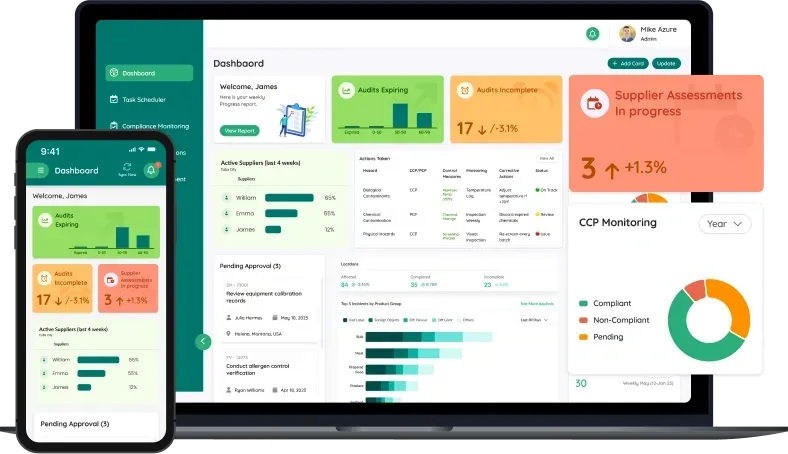
Image Source: Folio3 FoodTech
Modern technology plays a vital role in food businesses that need to maintain allergen compliance. The regulatory environment grows more complex each day. Digital solutions can transform allergen management from a manual burden into an optimised, verifiable process.
Role of data verification tools
Food businesses can use digital allergen management systems to get complete solutions for ingredient tracking throughout the supply chain. These platforms keep detailed records that include full ingredient breakdowns, processing facility information, and supplier certifications [28]. The systems flag potential allergen conflicts automatically and create accurate labels immediately. This makes allergen management proactive instead of reactive.
Technology-enabled audits help maintain compliance and protect customer safety through regular verification. A successful audit programme includes monthly recipe reviews, quarterly supplier checks, bi-annual staff training assessments, and weekly system checks [29].
How DrCleanish supports allergen removal
DrCleanish works as a verified allergen removal solution that finds contamination mechanisms and puts preventive measures in place to reduce future risks [30]. The service looks at designing, validating and verifying allergen control processes. It focuses on proper cleaning techniques that support compliance with UK food safety frameworks like BRCGS, SALSA and ISO 22000.
The process starts with a diagnostic phase to propose and implement the right corrective control measures [30]. Each case needs a prevention plan to stop contamination risks. This helps businesses produce safe food without endangering the final consumer.
Integrating systems into daily operations
Allergen management technology should merge naturally with existing operations. FoodDrinkEurope recommends that businesses add allergen controls “into existing operations using existing paperwork, such as delivery invoices and checklists to record allergen status” [31].
POS systems need to connect with other restaurant tools like kitchen displays, online ordering platforms, and inventory management systems. This allows allergen information to flow smoothly, cuts down manual input and reduces errors [29]. The connected approach keeps information consistent across all ordering channels and helps businesses comply with key regulations like Natasha’s Law.
Preparing for Audits and Inspections
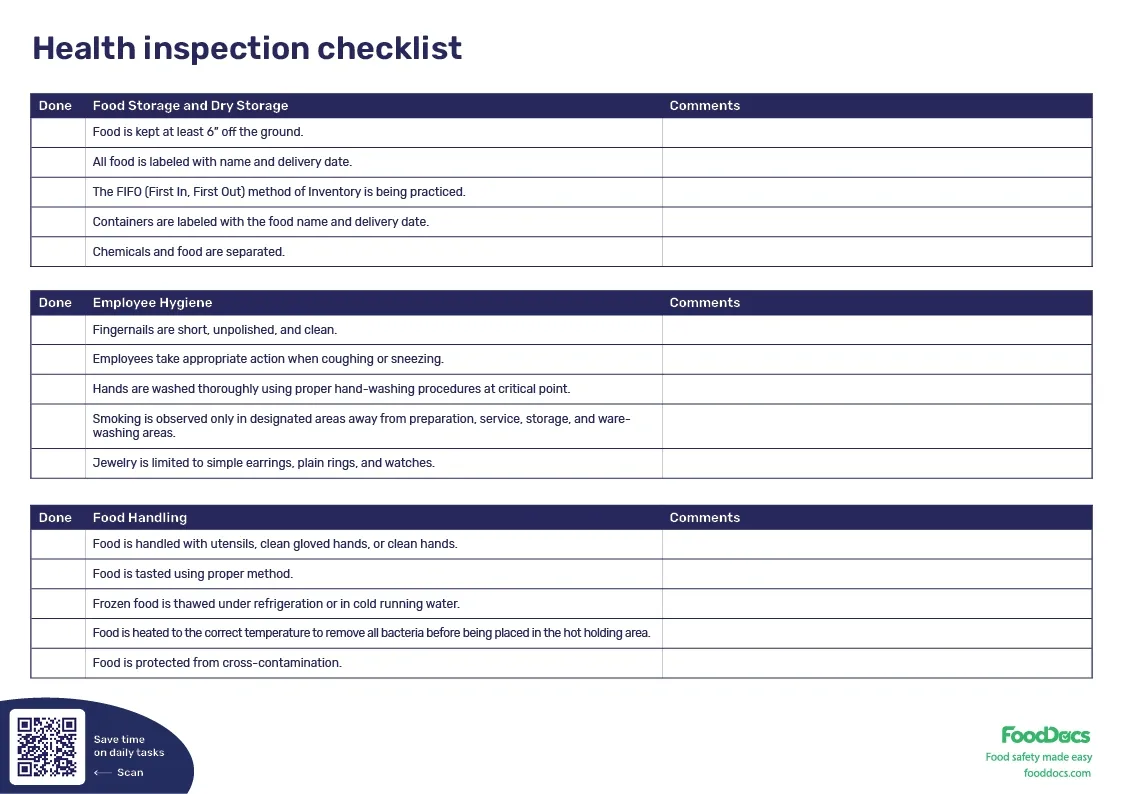
Image Source: FoodDocs
Food businesses stay ahead of regulatory scrutiny by preparing meticulously for allergen audits and inspections. Good preparation can make the difference between compliance and getting pricey enforcement actions.
What auditors look for
Certification auditors usually ask for specific documentation during allergen inspections [32]. These documents typically include:
- Allergen risk assessments per product line
- Written allergen management policies
- Allergen changeover procedures
- Staff training records
- Product label verification logs
Auditors really review allergen procedures and information across the facility [33]. They watch daily operations to verify compliance with stated procedures.
Documentation and traceability
Traceability serves as the life-blood of allergen compliance. Food business operators need to maintain detailed records that document:
- Risk assessment outcomes and decisions made [34]
- Ingredient specifications with supplier agreements [35]
- Verification checks that confirm ingredients match expected allergen profiles [35]
- Process documentation for artwork creation and approval [35]
Teams should review these systems yearly at minimum or whenever major operational changes happen [34].
Corrective action planning
Businesses must analyse the root cause of any allergen-related incidents using proven methods [35]. The findings help develop suitable strategies that prevent future occurrences [35].
The core team needs to set review periods to verify these corrective measures improve allergen management [35]. This strategy supports continuous improvement and shows steadfast dedication to regulatory compliance.
Budget-friendly allergen removal solutions like DrCleanish can help with audit preparation by arranging cleaning protocols with UK food safety accreditation frameworks.
Conclusion
UK food businesses must stay alert and thorough when dealing with food allergen regulations. The rules apply to businesses of all sizes. The law includes Food Information Regulations 2014, Natasha’s Law, Food Safety Act 1990, and other regulations that set clear guidelines to protect consumers with allergies. Allergen management isn’t just about following laws – it’s a vital safety requirement.
Good allergen control starts with a complete understanding of the 14 major allergens. This knowledge should flow through every part of the business – from checking suppliers to training staff and preventing cross-contamination. Companies need solid emergency response plans too. Without proper allergen management systems, businesses risk unlimited fines, damaged reputations, and possible criminal charges.
Technology is now a significant part of allergen management. It helps optimise ingredient tracking, label creation, and record keeping. Tools like DrCleanish are a great way to get contamination risks under control and put preventive measures in place. These tools help businesses line up with UK food safety standards including BRCGS, SALSA and ISO 22000.
Businesses should keep detailed records to prepare for regulatory inspections. This includes documentation, staff training records, and proof of fixes when problems occur. A proactive strategy builds consumer trust and protects the brand’s reputation.
Safety comes from ongoing compliance, not just one-time efforts. Regular audits help businesses stay on track. The core team needs refresher training, and allergen management systems must keep improving. While managing allergens can get pricey, businesses that follow regulations carefully create safer spaces for everyone. This approach sets them up for long-term success in the UK food industry.
Key Takeaways
Understanding UK food allergen regulations is essential for protecting consumers and avoiding severe legal penalties that can reach unlimited fines for non-compliance.
• Natasha’s Law requires full ingredient labelling on all pre-packed for direct sale foods, including emphasised allergen information directly on packaging since October 2021.
• All 14 major allergens must be clearly declared using proper formatting (bold, capitals, or underlining) every time they appear in ingredient lists.
• Non-compliance carries unlimited fines and potential criminal prosecution, with large businesses facing penalties up to £3 million for serious food safety breaches.
• Comprehensive staff training is mandatory under FSA guidance, covering allergen recognition, cross-contamination prevention, and emergency response procedures for anaphylactic reactions.
• Technology solutions streamline compliance by automating ingredient tracking, label generation, and audit documentation whilst reducing human error in allergen management.
Effective allergen management extends beyond legal compliance—it builds consumer trust, protects brand reputation, and creates safer environments for both customers and employees. Businesses implementing validated allergen removal solutions and robust verification systems position themselves for sustainable success whilst fulfilling their duty of care to vulnerable consumers.
FAQs
Q1. What are the key requirements of Natasha’s Law in the UK? Natasha’s Law requires all food businesses to provide full ingredient lists and allergen information on pre-packaged foods sold directly to consumers. This includes items like sandwiches and salads prepared and packaged on the same premises from which they are sold.
Q2. What are the 14 major allergens that must be declared in the UK? The 14 major allergens that must be declared are celery, cereals containing gluten, crustaceans, eggs, fish, lupin, milk, molluscs, mustard, tree nuts, peanuts, sesame seeds, soya, and sulphur dioxide (sulphites). These must be clearly highlighted in ingredient lists on food labels.
Q3. What are the potential penalties for non-compliance with UK food allergen regulations? Non-compliance can result in unlimited fines, with large businesses potentially facing penalties up to £3 million for serious food safety breaches. Criminal prosecution is also possible in severe cases of allergen mismanagement.
Q4. What training is required for food business staff regarding allergens? Food businesses must ensure all staff receive thorough training on allergen management. This should cover allergen recognition, cross-contamination prevention, handling customer inquiries, and emergency response procedures for allergic reactions.
Q5. How can technology help food businesses comply with allergen regulations? Technology solutions can streamline compliance by automating ingredient tracking, generating accurate labels in real-time, maintaining comprehensive documentation, and facilitating regular audits. These systems help reduce human error and make allergen management more proactive.
References
[1] – https://www.food.gov.uk/business-guidance/precautionary-allergen-labelling
[2] – https://www.food.gov.uk/business-guidance/food-allergen-labelling-and-information-requirements-technical-guidance-enforcement-of-the-measures
[3] – https://www.norfolk.gov.uk/article/43634/Enforcement-of-the-Food-Information-Regulations
[4] – https://www.foodallergy.org/resources/avoiding-cross-contact
[5] – https://www.food.gov.uk/business-guidance/allergen-guidance-for-food-businesses
[6] – https://www.allergyuk.org/news/17778/
[7] – https://www.allergyschool.org.uk/resources/responding-to-an-allergy-emergency/
[8] – https://www.allergyuk.org/types-of-allergies/food-allergy/top-14/
[9] – https://www.allergyuk.org/wp-content/uploads/2023/12/Decoding-labelling-Mobile-friendly-design-4.pdf
[10] – https://www.food.gov.uk/business-guidance/allergen-labelling-for-food-manufacturers
[11] – https://www.anaphylaxis.org.uk/my-account/media-centre/membership-news/understand-natashas-law/
[12] – https://www.anaphylaxis.org.uk/business/preventing-allergen-recalls/
[13] – https://www.gov.uk/food-labelling-and-packaging/ingredients-list
[14] – https://www.freshlawblog.com/2016/06/09/when-allergens-go-wrong-uk-potential-penalties-for-food-adulteration-and-breach-of-food-information-and-safety-laws/
[15] – https://www.anaphylaxis.org.uk/my-account/media-centre/membership-news/non-compliance-with-allergen-information-laws/
[16] – https://www.reedsmith.com/articles/prosecutions-are-soaring-due-to-allergens-labelling-breaches-in-the-uk/
[17] – https://www.highspeedtraining.co.uk/hub/food-allergen-policy/
[18] – https://www.nsf.org/gb/en/knowledge-library/managing-allergen-risks-food-businesses
[19] – https://blog.foodsconnected.com/allergen-management-in-the-food-industry
[20] – https://www.gov.uk/government/publications/school-food-standards-resources-for-schools/allergy-guidance-for-schools
[21] – https://foodallergycanada.ca/living-with-allergies/day-to-day-management/avoiding-cross-contamination/
[22] – https://www.food.gov.uk/business-guidance/allergen-checklist-for-food-businesses
[23] – https://www.devonsomersettradingstandards.gov.uk/business/food-law-guidance/allergens-in-food/
[24] – https://www.anaphylaxis.org.uk/my-account/media-centre/membership-news/communicate-allergens-in-restaurants/
[25] – https://www.anaphylaxis.org.uk/about-anaphylaxis/what-to-do-in-an-emergency/
[26] – https://www.thesafetyexpert.co.uk/communicating-allergens-to-customers/
[27] – https://www.allergyuk.org/information-and-support/at-school/for-parents/
[28] – https://signum-solutions.co.uk/allergen-management-made-simple/
[29] – https://lavu.com/how-to-manage-allergen-data-in-pos-systems/
[30] – https://www.christeyns.com/solutions/professional-advice/food-hygiene-services/allergen-defence/
[31] – https://www.fooddrinkeurope.eu/wp-content/uploads/2022/04/FoodDrinkEuropes-Guidance-on-Food-Allergen-Management-for-Food-Manufacturers-2022.pdf
[32] – https://sgsystemsglobal.com/allergen-control-fsma-gfsi-compliance/
[33] – https://www.anaphylaxis.org.uk/business/allergywise-audit-programme/
[34] – https://www.food.gov.uk/sites/default/files/media/document/food-traceability-withdrawals-and-recalls-guidance.pdf
[35] – https://www.fdf.org.uk/globalassets/resources/publications/guidance/allergen-recall-prevention-guidance.pdf