 The right allergen swabbing locations can mean the difference between food safety compliance and expensive product recalls. Undeclared allergens made up 34% of all food recalls in 2024, and the number of people living with allergies rises by 5% every year. Food business operators must implement reliable allergen swabbing procedures at critical control points. This piece provides a zone-based sampling framework for allergen verification and details exactly where to swab on production lines, shared equipment and environmental surfaces. The goal is to protect consumers and maintain BRCGS compliance.
Understanding Allergen Verification vs Validation
Validation and verification serve distinct functions in allergen control programmes. Confusion between these terms creates compliance gaps. Validation proves that a cleaning process can remove allergenic residues from specific equipment. Verification confirms that validated procedures were executed correctly each time production occurs.
What Allergen Swabbing Verifies
Allergen swabbing verifies that validated cleaning procedures were applied as specified during the most recent sanitation event. This is fundamentally different from validation, which establishes whether a cleaning method works at all. Verification testing demonstrates consistent execution of an already-proven cleaning protocol [1].
Protein-based swab tests detect total protein at about 20 parts per million. This makes them suitable to verify [1]. These devices confirm thorough cleaning without identifying specific allergens. ATP swabs measure adenosine triphosphate, yet ATP presence does not indicate protein content [1]. ATP tests alone cannot verify allergen removal.
Visual inspection remains the most common verification method. A trained staff member observes the validated cleaning procedure during sanitation and documents compliance [1]. This approach needs less resource investment than laboratory testing while maintaining control system integrity.
Allergen-specific testing during routine operations indicates a validation problem rather than a verification need. The underlying sanitation procedure needs revalidation if allergen-specific ELISA tests detect residues after cleaning [1]. Verification assumes the cleaning method already works.
When Verification Testing is Required
Verification testing occurs after every cleaning event where allergen cross-contact risk exists. Production facilities that use shared equipment for multiple allergens must verify cleaning effectiveness before each product changeover [2]. Equipment transition between dairy and non-dairy products needs post-clean verification to protect “free-from” label claims.
Risk assessment outcomes determine the frequency and scope of verification testing. Direct product-contact surfaces demand verification swabbing every time the validated cleaning procedure runs [1]. Non-contact surfaces in production areas may follow a rotating schedule based on historical data and equipment complexity.
BRCGS Issue 9 mandates documented verification schedules for allergen cleaning [2]. Facilities must establish responsibility for verification activities and record results consistently. Verification occurs right after cleaning completion, before the next production run commences.
Adverse events trigger increased verification frequency. Facilities should intensify verification testing until control system confidence returns following positive allergen findings, consumer complaints or near-miss incidents [3]. Equipment modifications or cleaning procedure changes also necessitate verification testing to confirm continued effectiveness.
The Role of Swabbing in Your Allergen Control System
Environmental monitoring through swabbing forms one pillar of allergen control alongside ingredient management and segregation protocols. Swabbing provides objective evidence that control measures function as designed [4]. An environmental monitoring programme allows proper identification, management and verification of manufacturing allergen controls.
Validation studies establish baseline cleaning effectiveness using allergen-specific methods. ELISA tests detect target allergens with sensitivities around 5 to 10 ppm [1][2]. Lateral flow devices provide qualitative results suitable for in-plant use without laboratory infrastructure. These allergen-specific tests prove cleaning procedures can remove residues to acceptable levels.
Ongoing verification maintains control system integrity once validation confirms cleaning efficacy. Protein swabs fine-tuned against the validated method serve this purpose well [1]. Facilities should test protein swabs right after allergen-specific validation to establish correlation between methods. This calibration allows lower-cost protein testing for routine verification while preserving allergen-specific testing for validation and troubleshooting.
Swabbing supports multiple decision points within allergen management. Test results inform precautionary labelling choices, particularly “may contain” statements [5]. Manufacturers can assess actual cross-contact risk through targeted swabbing rather than applying blanket advisory labels. Testing also optimises cleaning solution usage and determines the minimum effective quantity to remove allergens [5].
Documentation requirements tie swabbing data to HACCP principles. Records must demonstrate that validated cleaning occurred, verification testing was performed and results met established limits [1]. Audit-ready documentation has sample locations, responsible personnel, test results and corrective actions when limits exceed thresholds.
Zone-Based Sampling Framework for Food Production
Zone-based sampling organises allergen swabbing locations according to contamination risk. This creates a structured approach that prioritises direct food-contact areas and maintains oversight of environmental pathways. This framework divides production facilities into four distinct zones, each requiring different testing intensities and frequencies based on proximity to exposed product [2].
Zone 1: Direct Product Contact Surfaces
Zone 1 has all surfaces where food product remains exposed to the environment before final package closure [3]. These direct contact points represent the highest contamination risk and just need the most rigorous allergen swabbing protocols.
Product-contact surfaces include conveyor belts, rollers, and table tops where products are handled. Brushes, reusable plastic containers, storage bins, sinks, knives, and bucket elevators also fall here [3]. Utensils, employee hands and gloves, fillers, and hoppers fall within Zone 1 boundaries. Items directly over product-contact surfaces such as light fixtures, piping, compressed air lines, and water philtres do too [3][6].
Testing sites should concentrate in Zone 1 for allergen cleaning verification. This zone presents the most direct susceptibility to allergen cross-contact [6]. Surfaces here need post-clean swabbing because residual allergen protein can persist below visual detection thresholds. All product produced on the tested line should be held until final results are received when testing any Zone 1 sites for allergens [3][6].
Zone 2: Surfaces Adjacent to Food Contact Areas
Zone 2 has non-product-contact surfaces in close proximity to Zone 1 areas [3]. These surfaces can become contamination sources through proximity and interaction with production equipment, although not designed for direct food contact.
Equipment frames, drip shields and pans, control panels and buttons make up Zone 2 locations. Overhead fixtures and piping not above food-contact surfaces, computer screens, and maintenance tools are here too [3][6]. Zone 2 has all non-food-contact surfaces within the processing area in smaller production rooms. This includes exterior equipment surfaces, framework, food carts, equipment housing, gears, ventilation equipment, and floors [3].
These areas sit adjacent to Zone 1 and need cleaning with sufficient frequency to prevent becoming cross-contamination sources [3]. A pathway to product contamination could exist through personnel actions or machinery movement [3]. Allergen testing is not performed on Zone 2 surfaces unless risk assessment justifies it [3][6].
Zone 3: Non-Contact Surfaces in Production Areas
Zone 3 has non-food-contact surfaces in the open processing area [3]. These locations could lead to Zone 2 contamination through human actions or machinery movement when contaminated [3].
Specific Zone 3 surfaces include floors, walls, ceilings, and drains. Hoses, cleaning equipment such as brooms and brushes, air handling units, condensate drip pans, carts, pallets, forklifts, and rubbish bins are here [3][6]. Zone 3 represents areas further from food handling equipment than typical Zone 2 locations in larger production rooms. Hallways and doorways leading into production areas fall here as well [3].
Equipment carrying dust presents potential allergen sources within the processing environment. Vacuum cleaners, brooms, and compressed air systems are examples [2][6]. Zone 3 monitoring helps pinpoint allergen cross-contact sites outside the immediate production area [6].
Zone 4: Support and Ancillary Facilities
Zone 4 has support facilities not in open processing areas [3]. These remote areas do not contribute to direct product contamination but may affect Zone 3 through personnel and equipment movement [3].
Bathrooms, locker rooms, cafeterias and break rooms make up Zone 4 locations. Office rooms, hallways, warehouses, loading docks, maintenance shops, and storage areas are here too [3][6]. Employee traffic patterns through these areas need to be considered when identifying potential contamination pathways [2][6].
Zone 4 surfaces represent a lower priority but can still be tested to confirm allergens are not moving into non-production areas [2]. A risk-based approach weighs the allergen’s hazard against surface cleaning difficulty. This determines where to test and sampling frequency [2]. Most environmental samples should be taken from Zones 1 and 2, to a lesser degree Zone 3. Very few samples come from Zone 4 [3].
Critical Zone 1 Swabbing Locations
Direct product-contact surfaces within Zone 1 require targeted swabbing at locations where protein residues persist despite standard cleaning cycles. You should focus on areas most challenging to clean when selecting allergen swabbing locations, as these represent worst-case scenarios. Less problematic areas will also meet cleanliness standards if the most difficult surfaces test clean.
Food Contact Equipment Surfaces
Tables, conveyor belt surfaces, and processing equipment where exposed product makes direct contact are the primary swab sampling sites. Conveyor belts present particular challenges due to porous belt materials that trap protein residues. Standard rinse cycles remove visible soil but leave allergenic residues at 50-200 ppm [7]. Both the top running surface and belt undersides require swabbing. Protein deposits accumulate on lower surfaces through drips and spray-back during cleaning.
Material composition affects protein retention characteristics. Rubber seals and gaskets absorb allergen proteins differently than stainless steel surfaces [1]. So swabbing programmes should target both material types to verify cleaning effectiveness in a variety of surface compositions. Stainless steel equipment surfaces release proteins more readily. Elastomeric materials require extended contact with cleaning solutions.
Crevices, joints, and equipment interfaces just need swabbing attention rather than limiting tests to flat, smooth surfaces [5]. Residual allergen proteins survive in these difficult-to-reach locations even when visible equipment surfaces appear clean. Equipment disassembly points accumulate protein deposits that persist through standard cleaning, where removable guards meet fixed structures.
Processing Line Components
Piping systems contain dead legs where flow velocity drops below 1.5 metres per second. This creates shadow zones during clean-in-place operations [7]. These CIP blind spots allow protein and biofilm accumulation that remains undetected without targeted swabbing. Sample collection from pipe dead legs requires accessing inspection ports or terminal fittings where stagnant product can pool.
Gaskets, seals, and joints throughout processing lines trap microscopic protein deposits at levels triggering anaphylaxis [7]. These components require removal for effective swabbing, as surface testing misses protein embedded within seal material. 38% of allergen recalls trace back to inadequate equipment cleaning during product changeovers, so these high-risk zones warrant systematic attention [7].
Processing equipment frames, support structures, and mounting brackets adjacent to product flow paths collect protein residues through aerosol generation and splash. Swabbing these near-contact surfaces provides early warning of cleaning protocol failures before contamination reaches Zone 1 surfaces.
Filling and Packaging Equipment
Filler nozzles accumulate product residue in orifice openings and nozzle-to-gasket interfaces. Standard rinse protocols fail to remove trapped material. This requires disassembly and soak procedures for allergen elimination [7]. Swab sampling should occur after complete nozzle breakdown. Test the internal orifice surfaces and gasket contact points separately.
Robotic grippers and end-effectors represent a critical gap in many facilities. 62% of manufacturing plants maintain no documented allergen cleaning protocols for robotic handling equipment [7]. Silicone gripper pads absorb protein residues that transfer between product batches without visible signs. These contact points require dedicated swabbing following each allergen-containing production run.
Hoppers, bins, and product transfer buckets accumulate residues in bottom corners, discharge chutes, and lid seal areas. Swab these locations after visual inspection confirms no particulate matter remains. Allergen tests only detect protein if the swabbed area happens to contain trapped particles [5].
Utensils and Hand-Contact Points
Employee hands, gloves, utensils, and hand-operated tools constitute direct transfer pathways for allergen cross-contact. Reusable scoops, paddles, scrapers, and cutting implements require post-clean verification swabbing before deployment in allergen-free production. Contact surfaces on control panels, valve handles, and equipment adjustment points touched during production warrant periodic testing to confirm hand-washing protocols prevent allergen transfer.
Shared utensils stored between production runs should be swabbed before use with allergen-free products. Testing before line restart, rather than only post-clean, confirms that storage conditions did not introduce contamination through environmental exposure or handler contact.
Shared Equipment and Changeover Hotspots
Product changeovers on multi-allergen production lines create the highest-risk scenarios for allergen cross-contact, with 38% of allergen recalls tracing back to inadequate equipment cleaning during these transitions [7]. Swabbing at changeover hotspots for both confirmation and verification gives you the evidence that cleaning protocols actually remove allergenic residues when switching between formulations.
Multi-Product Production Lines
Facilities using shared equipment for multiple allergen profiles must confirm cleaning effectiveness using worst-case product pairs and equipment configurations. The logic here thinks over allergen hazard severity, soiling behaviour, and equipment complexity [8]. Sticky, viscous, high-fat, or powdery products that cling present greater removal challenges than free-flowing formulations. Long pipe runs, complex deposits, belts, enrobing equipment and ovens just need more rigorous confirmation than simple open kettles [8].
Each allergen pair requires its own confirmed changeover protocol [9]. A peanut-to-dairy changeover needs different chemical treatment than milk-to-shellfish transitions. Manufacturing sites must document and confirm unique cleaning procedures for every allergen transition occurring in regular production [9]. If the cleaning works for the stickiest allergen-containing filling on the most complex line, simpler changeovers on the same equipment may be covered through documented scientific justification [8].
Confirmation protocols typically require repetition no fewer than three times to account for different cleaning teams, seasonal variation in raw ingredients and production pressures [10]. The product with the highest allergen percentage effectively assesses sanitation adequacy when tested. You must also think over allergen form, as peanut butter cleans differently than peanut granules [4].
Clean-in-Place System Sampling Points
CIP system confirmation just needs sampling from the first, middle and last product batches following cleaning [10]. This temporal sampling confirms allergen removal throughout the production sequence rather than relying on initial post-clean verification alone. Final rinse water from CIP systems provides qualitative assessment through lateral flow devices, though considerable dilution occurs in rinse streams [5].
You should establish whether cleaning or disinfectant residues present in the sample matrix affect the analytical detection technique’s sensitivity [10]. Laboratory ELISA tests run alongside lateral flow devices in parallel and establish correlation between methods. This allows lower-cost rapid testing for routine verification [10].
Equipment Transition Zones
Pump impellers, valve cavities, mixer blade mounting pockets and tubing interiors represent the highest-risk changeover components [9]. These locations feature tight tolerances and product stagnation zones where allergen particles accumulate. Equipment containing inaccessible internal cavities that cannot be disassembled and cleaned should be documented as non-confirmed zones with risk mitigation controls such as product-free sealing or replacement equipment [9].
Filler nozzles require specific attention during changeover swabbing, as residue accumulates in orifice openings despite standard cleaning [7]. Robot grippers and end-effectors frequently lack documented allergen cleaning protocols, yet silicone grippers absorb protein residues transferred between product batches [7].
Product Changeover Verification Sites
First-run product testing after cleaning completion assesses changeover effectiveness [11]. Some facilities employ ‘safe mode’ testing and run similar allergen products before and after sanitation. If swabs indicate inadequate cleaning, production continues without consumer risk whilst cleaning procedures undergo modification [4]. Product manufactured during verification should be held until test results confirm allergen absence [12].
If allergen swabs return positive despite ATP passing and visual inspection clearing, the cleaning protocol proves insufficient for that specific allergen [9]. This outcome just needs protocol revision and reconfirmation before resuming allergen-free production. Production scheduling minimises changeover frequency by running allergen-free products before allergen-containing formulations on shared lines [7].
Hidden and High-Risk Sampling Locations
Flat, available surfaces pass allergen swabs without issue, but hidden niches harbour protein residues that trigger recalls [2]. A risk-based line walk identifies these critical allergen swabbing locations before validation begins. The walk targets dead legs, gasket lips, threads, seals, scraper edges and CIP shadowed areas [2]. These sentinel sites become the most difficult-to-clean locations trended over time [2].
Overhead Structures and Fixtures
Items over or in close proximity to direct food-contact surfaces need to be tested [13][14]. Compressed air lines, brooms, vacuum cleaners and equipment carrying dust present potential allergen sources within the processing environment [13][14]. Overhead piping, light fixtures and ventilation ducting accumulate settled protein dust. This dust dislodges during production vibration or maintenance activities. Environmental sampling programmes rather than routine post-clean verification include these surfaces, yet they influence Zone 1 contamination risk through gravitational transfer.
Dead Legs and Hard-to-Clean Areas
Dead legs in piping systems create CIP shadowed zones where detergent flow velocity drops below effective cleaning thresholds [2]. Validation runs require specific sampling of these stagnant sections at post-rinse and post-clean timepoints before final sanitiser application [2]. CIP return lines, nozzles and areas where product flow stagnates during processing accumulate protein biofilms invisible to visual inspection.
Validation sampling plans should include 8 to 12 food-contact swabs targeting these difficult zones: belts at start, middle and end positions, hoppers, scraper blades, nozzles, change parts and CIP return points [2]. Adjacent zone swabs cover framework, guards and control panels with 4 to 6 samples [2]. Optional environmental samples from drains or floors in high-risk areas assess spread potential [2].
Gaskets, Seals and Joints
Gasket lips and seal interfaces trap microscopic allergen particles even after thorough equipment rinsing [2]. Food-contact gaskets undergo punishing CIP cycles with caustic washes at 85°C, acid rinses and steam sterilisation [15]. FDA-compliant silicone and EPDM materials absorb proteins differently from stainless steel and require extended detergent contact for effective removal [15].
Tri-clamp gaskets, filling valve seats, capper gaskets and conveyor guide seals complete thousands of cycles per shift [15]. Validation swabbing demands removal of these components because surface testing misses protein embedded within seal material composition. Metal-detectable gaskets containing metallic fillers provide safety redundancy should gasket fragments contaminate product streams [15].
Conveyor Systems and Belt Undersides
Conveyor belts recirculate and load and unload food products repeatedly [16]. Allergens build up and transfer to subsequent products transported when cleaning is inadequate [16]. Belt undersides accumulate protein deposits through drips and cleaning spray-back, yet many facilities limit swabbing to visible top surfaces [2].
Spiral cooling conveyor belts present particular cleaning challenges. One bagel producer required 12 hours and three personnel to clean one belt and failed sesame allergen swabs often [17]. Belt splices, roller contact points and tension adjustment hardware represent additional sampling targets that standard protocols overlook.
Difficult-to-Access Equipment Crevices
Threads, scraper edges and equipment crevices demand focused sampling because flat, available areas tend to pass while niches fail [2]. Fillers, combi-ovens and belt transition points contain crevices where worst-case products (high-load allergen formulations) deposit residues [2]. Pre-defining these sentinel sites allows trending over time and establishes whether cleaning protocols address the most challenging locations consistently [2].
Standardised swab areas of 10×10 cm with consistent pressure and stroke technique minimise variability across validation replication cycles [2]. Verification focused on true niches rather than convenient flat surfaces provides realistic assessment of allergen control effectiveness.
Environmental Monitoring Sampling Points
Environmental monitoring programmes extend allergen surveillance beyond immediate food-contact zones. They identify contamination pathways before they reach production surfaces. Zone 1 just needs post-clean verification after every sanitation event. Zones 2 and 3 follow risk-based schedules that track allergen movement through the facility environment.
Zone 2 Equipment Frames and Drip Shields
Equipment frames, drip shields and pans, control panels and buttons, and maintenance tools constitute Zone 2 environmental monitoring sampling points [3]. These surfaces sit adjacent to Zone 1 and serve as buffer indicators. Positive allergen findings in Zone 2 signal potential migration toward product-contact areas. This triggers intensified Zone 1 verification.
Overhead fixtures and piping not directly above food-contact surfaces require periodic swabbing at the time they are positioned within contamination transfer distance [3]. Production staff touch control panel buttons and create hand-intervened transfer routes between allergen-containing operations and allergen-free lines. Computer screens and equipment housings near product flow paths collect settled protein dust that personnel contact throughout shifts.
Allergen testing is not performed on Zone 2 surfaces unless risk assessment justifies it [3]. Therefore, facilities should assess employee traffic patterns and equipment movement to determine whether Zone 2 allergen swabbing adds meaningful control system value beyond pathogen monitoring.
Zone 3 Floors, Drains and Cleaning Tools
Floors, drains, hoses, cleaning equipment including brooms and brushes, condensate drip pans, carts, pallets, and foot baths comprise Zone 3 locations [3]. These non-contact surfaces in open processing areas can lead to Zone 2 contamination through human actions or machinery movement.
Equipment carrying dust presents particular allergen cross-contact risk [6]. Vacuum cleaners, brooms, and compressed air systems distribute settled protein particles across production zones at the time they are deployed without allergen-specific protocols. Cleaning tools used across multiple production areas require dedicated allergen verification programmes. A single contaminated brush transfers residues to every surface it contacts.
Thinking over employee traffic patterns proves important to identify areas easily contaminated [6]. Personnel walking from allergen-containing production zones into allergen-free areas carry protein residues on footwear and clothing. Foot baths and floor mats at zone boundaries warrant swabbing to verify cross-contamination controls function effectively.
Air Handling and Ventilation Systems
Air handling units and condensate drip pans within processing environments collect airborne protein particles [3]. These systems recirculate facility air and potentially distribute allergenic aerosols generated during powder handling, mixing operations, or equipment washdown. Swabbing air intake grilles and condensate collection points assesses whether ventilation systems contribute to environmental allergen burden.
When to Swab Non-Food-Contact Surfaces
Risk assessment determines when non-food-contact surface allergen swabbing provides applicable control system information [3]. The main goal remains on ensuring cleanliness of food-contact surfaces [3]. Environmental allergen monitoring programmes allow proper identification, management, and verification of manufacturing allergen controls [18]. But routine environmental swabbing should not replace validated Zone 1 cleaning verification. Facilities initiate Zone 2 and 3 allergen testing following adverse events, process changes, or at the time pathogen environmental monitoring reveals sanitation gaps that could equally affect allergen control.
Determining Swab Frequency and Location Selection
Sampling frequency and site selection depend on production complexity, allergen hazard severity, and historical performance data. Facilities must balance comprehensive coverage against testing budget constraints and maintain statistical confidence in their allergen control systems.
Risk-Based Sampling Approach
A risk-based approach prioritises products with the highest allergen loading for validation studies [1]. Allergen load focuses on protein content from the allergenic source, as allergens are proteins [5]. Ingredients with high protein levels from allergenic sources represent greater hazards compared to ingredients with no detectable or low allergenic protein [5]. Then, validation should target the component with the highest allergenic load rather than testing all allergens in a formulation [5].
Physical form influences cleaning difficulty and sampling priorities. Paste formulations require different removal protocols than liquids [5]. Validation may need to address both forms separately if one allergen exists as a paste and another as a liquid [5]. Particulates warrant special concern because they contain appreciable allergenic protein amounts yet only trigger positive swabs if the sampled area happens to contain trapped particles [5].
How Many Swabs Per Production Line
The number of samples depends on line complexity [6][14]. To name just one example, if 60 potential sampling sites exist, facilities can select 10 to 15 sites each week and ensure each location receives sampling at least once per month [6][14]. This rotation system stretches testing budgets and maintains programme effectiveness [6]. Direct product-contact surfaces remain the priority, with all product held until results arrive when testing Zone 1 sites [6].
Rotating Sampling Sites
Detailed sampling logs and facility maps should document each location with written instructions for difficult-to-access areas [6]. Monthly rotation through all identified sites builds historical data patterns without overwhelming laboratory capacity. Sites showing repeated issues require increased attention outside the standard rotation schedule.
Increasing Frequency After Adverse Events
When allergen cross-contact occurs, sampling frequency escalates from weekly to daily [6][14]. Normal sampling resumes only after three consecutive days of negative results [6][14]. If problems persist, facilities must implement corrective actions including equipment breakdown and area access restrictions [6]. Revalidation becomes necessary following ingredient changes, supplier modifications, formulation adjustments, equipment alterations, or SSOP parameter changes [5].
Allergen Swabbing Procedure and Documentation Requirements
Standardised swab collection technique eliminates variability that compromises test validity across validation cycles and verification events. Trained personnel will take various swabs at designated points after production and cleaning completion [1].
Proper Swab Collection Technique
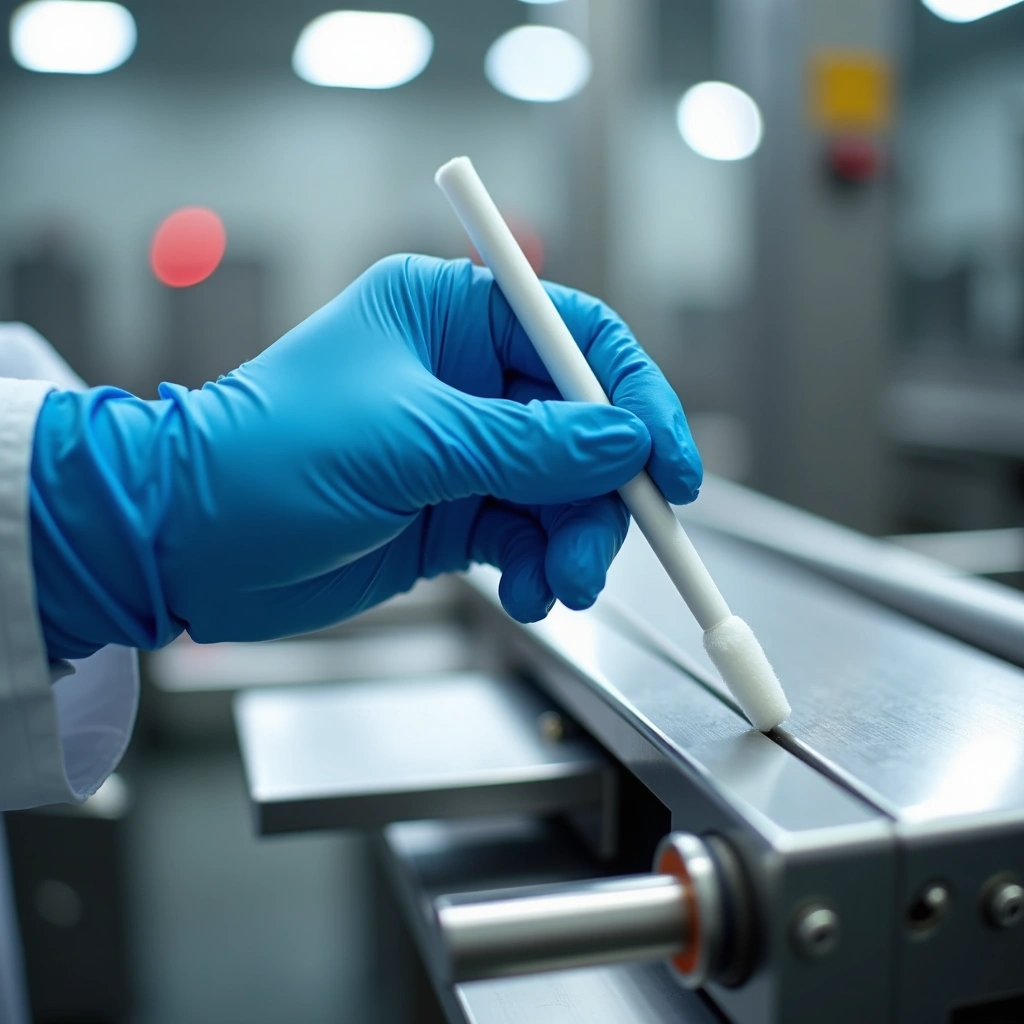
Pre-moisten sterile swabs by dipping in appropriate extraction solution specified in the ELISA kit insert [19]. Sample a 10 cm × 10 cm area using crosshatch technique. Apply sufficient pressure to create a slight bend in the swab shaft [20]. Rotate the swab 360 degrees to cover the whole tip and move corner to corner across the defined square [19]. Place the swab into its original tube right away. Ensure proper labelling with location ID, surface type, timepoint, and analyst name [2]. Add extraction solution drops to the tube bottom without exceeding the swab bud level, seal tightly, and refrigerate at 2-8°C until shipping [20]. Swabs should arrive at testing destinations within 24 hours using overnight service with ice packs [19].
Recording Sample Locations and Results
Record cleaning variables including chemistry lot numbers, concentration, contact time, water temperature, and tools used. Include disassembly checklist completion [2]. Document swab metadata specifying exact location ID, surface material, area size, collection timepoint, and responsible analyst. Note kit lot with expiry date [2]. Deviations and corrective actions require contemporaneous documentation linked to the sampling event [2].
Setting Action Limits and Corrective Triggers
Testing laboratories must hold ISO 17025 accreditation and participate in FAPAS proficiency testing rounds [1]. Spike recovery testing must yield data within 80-130% tolerance of expected allergen levels [1]. Matrix validation studies on facility-specific products establish defensible acceptance criteria [1]. Data trends feed into risk assessments and HACCP documentation to identify annual performance patterns [1].
Maintaining Audit-Ready Records
FSMA Preventive Controls mandate allergen record retention for a minimum of two years [21]. BRCGS and SQF standards require records retrievable within minutes during unannounced audits [21]. Records that cannot be retrieved faster carry similar audit exposure as records never created [21].
Conclusion
A zone-based sampling framework eliminates guesswork in allergen verification programmes. Prioritise Zone 1 food-contact surfaces for post-clean swabbing after every changeover. Target conveyor belts and gaskets, CIP dead legs and filler nozzles where protein residues persist. Environmental monitoring in Zones 2 and 3 follows risk-based schedules and tracks contamination pathways before they reach production surfaces.
Documentation proves compliance during BRCGS audits. Record swab locations with results and corrective actions. Facilities should establish rotating sampling plans that cover all critical control points monthly while maintaining heightened watchfulness at equipment transition zones. Validation confirms cleaning works. Verification proves it happened correctly every time.
Key Takeaways
Understanding where to swab for allergen verification is crucial for food safety compliance, as undeclared allergens caused 34% of food recalls in 2024. Here are the essential insights for implementing effective allergen swabbing programmes:
• Focus on Zone 1 surfaces first – Prioritise direct product-contact areas like conveyor belts, gaskets, and filler nozzles where protein residues persist despite visual cleanliness
• Target hidden contamination hotspots – Swab CIP dead legs, equipment crevices, gasket lips, and conveyor undersides where allergen particles accumulate beyond standard cleaning reach
• Implement risk-based sampling frequency – Test Zone 1 surfaces after every allergen changeover, whilst rotating Zone 2-3 environmental monitoring based on contamination pathways
• Document everything systematically – Maintain audit-ready records of swab locations, results, and corrective actions to demonstrate BRCGS compliance and support HACCP programmes
• Validate before you verify – Establish that cleaning procedures actually remove allergens using worst-case product pairs, then use routine protein swabs to verify execution
Remember that validation proves your cleaning works, whilst verification confirms it happened correctly every time. A structured zone-based approach ensures comprehensive coverage without overwhelming testing budgets, protecting both consumers and your brand reputation.
FAQs
Q1. What is the correct technique for collecting allergen swab samples? Pre-moisten a sterile swab with extraction solution, then sample a 10 cm × 10 cm area using a crosshatch pattern. Apply enough pressure to slightly bend the swab shaft whilst rotating it 360 degrees. Move the swab corner to corner across the defined area, then immediately place it in its original tube with proper labelling and refrigerate at 2-8°C until testing.
Q2. Why is swab testing important in allergen management programmes? Swab testing verifies that validated cleaning procedures have been executed correctly and that no allergenic residues remain on production surfaces. This confirmation is essential for preventing cross-contact incidents, as undeclared allergens accounted for 34% of food recalls in 2024. Testing provides objective evidence that allergen control measures function as designed.
Q3. Which surfaces should be prioritised for allergen swabbing? Zone 1 direct product-contact surfaces require the highest priority, including conveyor belts, filler nozzles, gaskets, processing equipment, and CIP system components. Focus particularly on hidden areas such as equipment crevices, dead legs in piping, seal interfaces, and belt undersides where protein residues persist despite standard cleaning cycles.
Q4. How should allergen information be documented in food production? Allergen information must be recorded on product specification sheets, included on ingredient labels, and documented in recipes with updates when formulations change. For swab testing specifically, maintain records of sample locations, collection dates, test results, responsible personnel, and any corrective actions taken. These records must be audit-ready and retrievable within minutes.
Q5. How often should allergen swabbing be performed on production equipment? Direct product-contact surfaces in Zone 1 require swabbing after every cleaning event where allergen cross-contact risk exists, particularly during product changeovers. Environmental monitoring in Zones 2 and 3 follows a risk-based rotating schedule, typically covering all identified sites monthly. Increase frequency to daily testing following adverse events until three consecutive negative results are achieved.
References
[1] – https://www.food.gov.uk/research/review-of-allergen-analytical-testing-methodologies-stakeholder-engagement
[2] – https://normex.ca/news/allergen-swabbing-why-validation-is-essential
[3] – https://www.eurofinsus.com/food-testing/resources/a-guide-to-environmental-monitoring/
[4] – https://www.food-safety.com/articles/3812-allergen-validation-analytical-methods-and-scientific-support-for-a-visually-clean-standard
[5] – https://www.food-safety.com/articles/4434-best-practises-with-allergen-swabbing
[6] – https://cdnmedia.eurofins.com/eurofins-us/media/12158865/whitepaper-food-allergen-environmental-monitoring-guide.pdf
[7] – https://ifactoryapp.com/industries/fmcg/Allergen-management-equipment-Analytics-fmcg
[8] – https://sgsystemsglobal.com/glossary/allergen-changeover-validation-consumer-products/
[9] – https://ifactoryapp.com/industries/food-manufacturing/allergen-changeover-cleaning-verification-checklist
[10] – https://www.romerlabs.com/en/library/knowledge/detail/10-steps-to-validating-and-verifying-allergen-cleaning-procedures
[11] – https://certified-laboratories.com/blog/food-allergen-testing-avoiding-allergen-cross-contact/
[12] – https://www.qualityassurancemag.com/article/aib1015-managing-allergen-changeover-cleaning/
[13] – https://www.eurofinsus.com/food-testing/resources/allergen-environmental-monitoring-for-the-food-supplement-industry/
[14] – https://www.eurofinsus.com/media/29815/food_allergen_monitoring_guide.pdf
[15] – https://universalgaskets.com.au/industries/food-and-beverage
[16] – https://www.khdtechnology.com/the-role-of-automated-conveyor-cleaning-in-allergen-control/
[17] – https://www.goodway.com/resources/case-studies/purebeltr-leaves-bakerys-conveyor-belts-sesame-free?srsltid=AfmBOorD2jh2-5lKQU1-103_YLx3UhzWX655uOXoFpdeoMTafHZUHfS_
[18] – https://www.eurofinsus.com/food-testing/resources/allergen-management-through-environmental-monitoring/
[19] – https://www.neogen.com/496c85/globalassets/pim/assets/original/10001/lab-services-allergen-swab-collection.pdf?srsltid=AfmBOooRFTyxYXoJnDiC12swChJ1edZBrSn0ipBg7iPM27iu54xEcBAE
[20] – https://www.neogen.com/496c85/globalassets/pim/assets/original/10001/lab-services-allergen-swab-collection.pdf?srsltid=AfmBOop35aBA-XmQ033uUU0bY2ERLQV9zrdjiH2B4WOZgBIdeIFC_e4E
[21] – https://oxmaint.com/industries/food-manufacturing/allergen-changeover-cleaning-verification-checklist-food